
美国全国范围内分析显示,美国老年人中风死亡率与空气污染之间存在不平等现象。
Inequities in air pollution on stroke mortality among Older Americans: a U.S. nationwide analysis.
机构信息
Department of Neurological Surgery, University of Kansas Medical Center, Kansas City, KS, United States.
New York Institute of Technology, College of Osteopathic Medicine at Arkansas State University, Jonesboro, AR, United States.
出版信息
Front Public Health. 2024 Sep 23;12:1364165. doi: 10.3389/fpubh.2024.1364165. eCollection 2024.
BACKGROUND
Air pollution is a known risk factor for cardiovascular diseases, including stroke. This study examines the impact of county-level air pollution on ischemic and hemorrhagic stroke mortality among U.S. individuals aged 65 and older, emphasizing racial and socioeconomic disparities.
METHODS
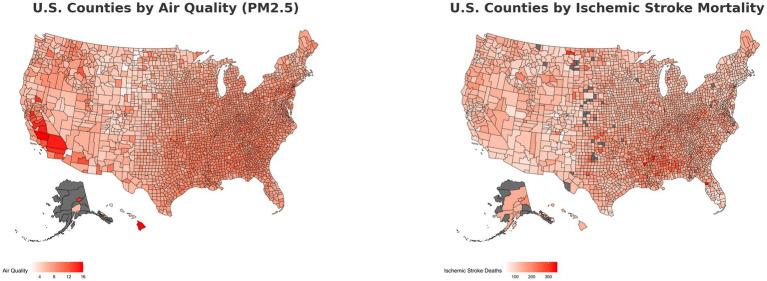
Using data from the Center for Disease Control (CDC) Interactive Atlas of Heart Disease and Stroke, we analyzed county-level ischemic stroke mortality rates for older residents between 2016 and 2020. The data on air pollution at the county level, specifically particulate matter (PM2.5) levels, were obtained from the CDC. We applied multivariable linear and logistic regression models to examine the association between PM2.5 levels and stroke mortality, as well as the probability of meeting the Environmental Protection Agency (EPA) air quality standards.
RESULTS
County-level analysis revealed a significant correlation (R = 0.68, R = 0.48, < 0.001) between PM2.5 levels and overall stroke mortality. For every 1 μg/m increase in PM2.5, there was an increase of 1.89 ischemic stroke deaths per 100,000 residents. Racial and socioeconomic disparities were evident. Counties with predominantly Black populations exhibited a stark disparity, with each 1 μg/m increase in PM2.5 correlating with a significant rise in mortality, amounting to 5.81 additional deaths per 100,000 residents. Persistently poor counties displayed vulnerability, experiencing a 4.05 increase in ischemic stroke deaths per 100,000 residents for every 1 μg/m increase in PM2.5 levels. Conversely, in counties with a White majority and counties without a persistent state of poverty, the associated increases in stroke mortality per 100,000 residents for every 1 μg/m rise in county-level PM2.5 were 1.85 and 1.60, respectively. Counties with a majority of Black residents were over twice as likely to be non-compliant with EPA air quality standards compared to predominantly White counties (aOR 2.36 95% CI: 1.27-4.38, = 0.006).
CONCLUSION
This study underscores the significant impact of county-level air pollution, particularly PM2.5, on ischemic stroke mortality among older U.S. residents. Our findings indicate that counties with predominantly Black populations and those experiencing persistent poverty not only suffer from higher mortality rates but also are more likely to be non-compliant with EPA air quality standards. Targeted interventions and policies are urgently needed to reduce air pollution in these vulnerable communities and promote equitable public health outcomes.
背景
空气污染是心血管疾病(包括中风)的已知危险因素。本研究在美国 65 岁及以上人群中,研究县级空气污染对缺血性和出血性中风死亡率的影响,重点关注种族和社会经济差异。
方法
利用疾病控制中心(CDC)心脏病和中风互动地图集的数据,我们分析了 2016 年至 2020 年期间老年居民的县级缺血性中风死亡率。县级空气污染数据(具体为 PM2.5 水平)来自疾病预防控制中心。我们应用多变量线性和逻辑回归模型来检验 PM2.5 水平与中风死亡率之间的关系,以及符合环境保护局(EPA)空气质量标准的概率。
结果
县级分析显示,PM2.5 水平与总体中风死亡率之间存在显著相关性(R=0.68,R=0.48,<0.001)。每增加 1μg/m3 PM2.5,每 10 万居民中缺血性中风死亡人数增加 1.89 人。存在明显的种族和社会经济差异。以黑人为主的县存在明显的差异,PM2.5 每增加 1μg/m3,死亡人数就会显著增加,每 10 万居民增加 5.81 人。长期贫困的县则较为脆弱,每 10 万居民中缺血性中风死亡人数增加 4.05 人。相比之下,在白人为主的县和没有持续贫困状态的县,每增加 1μg/m3 县级 PM2.5,中风死亡率的相应增加分别为每 10 万居民 1.85 人和 1.60 人。黑人居民为主的县不符合 EPA 空气质量标准的可能性是白人为主的县的两倍多(优势比 2.36,95%置信区间:1.27-4.38,=0.006)。
结论
本研究强调了县级空气污染,特别是 PM2.5,对美国老年居民缺血性中风死亡率的重大影响。我们的研究结果表明,以黑人为主的县和长期贫困的县不仅死亡率较高,而且不符合 EPA 空气质量标准的可能性也较高。迫切需要采取有针对性的干预措施和政策,以减少这些弱势群体社区的空气污染,并促进公平的公共卫生成果。


 Zotero 插件