
语境剥夺、种族和民族以及收入与空气污染和心血管疾病。
Contextual Deprivation, Race and Ethnicity, and Income in Air Pollution and Cardiovascular Disease.
机构信息
Department of Public Health Sciences, Biological Science Division, The University of Chicago, Chicago, Illinois.
Institute for Population and Precision Health, Biological Science Division, The University of Chicago, Chicago, Illinois.
出版信息
JAMA Netw Open. 2024 Aug 1;7(8):e2429137. doi: 10.1001/jamanetworkopen.2024.29137.
IMPORTANCE
Socioeconomically disadvantaged subpopulations are more vulnerable to fine particulate matter (PM2.5) exposure. However, as prior studies focused on individual-level socioeconomic characteristics, how contextual deprivation modifies the association of PM2.5 exposure with cardiovascular health remains unclear.
OBJECTIVE
To assess disparities in PM2.5 exposure association with cardiovascular disease among subpopulations defined by different socioeconomic characteristics.
DESIGN, SETTING, AND PARTICIPANTS: This cohort study used longitudinal data on participants with electronic health records (EHRs) from the All of Us Research Program between calendar years 2016 and 2022. Statistical analysis was performed from September 25, 2023, through February 23, 2024.
EXPOSURE
Satellite-derived 5-year mean PM2.5 exposure at the 3-digit zip code level according to participants' residential address.
MAIN OUTCOME AND MEASURES
Incident myocardial infarction (MI) and stroke were obtained from the EHRs. Stratified Cox proportional hazards regression models were used to estimate the hazard ratio (HR) between PM2.5 exposure and incident MI or stroke. We evaluated subpopulations defined by 3 socioeconomic characteristics: contextual deprivation (less deprived, more deprived), annual household income (≥$50 000, <$50 000), and race and ethnicity (non-Hispanic Black, non-Hispanic White). We calculated the ratio of HRs (RHR) to quantify disparities between these subpopulations.
RESULTS
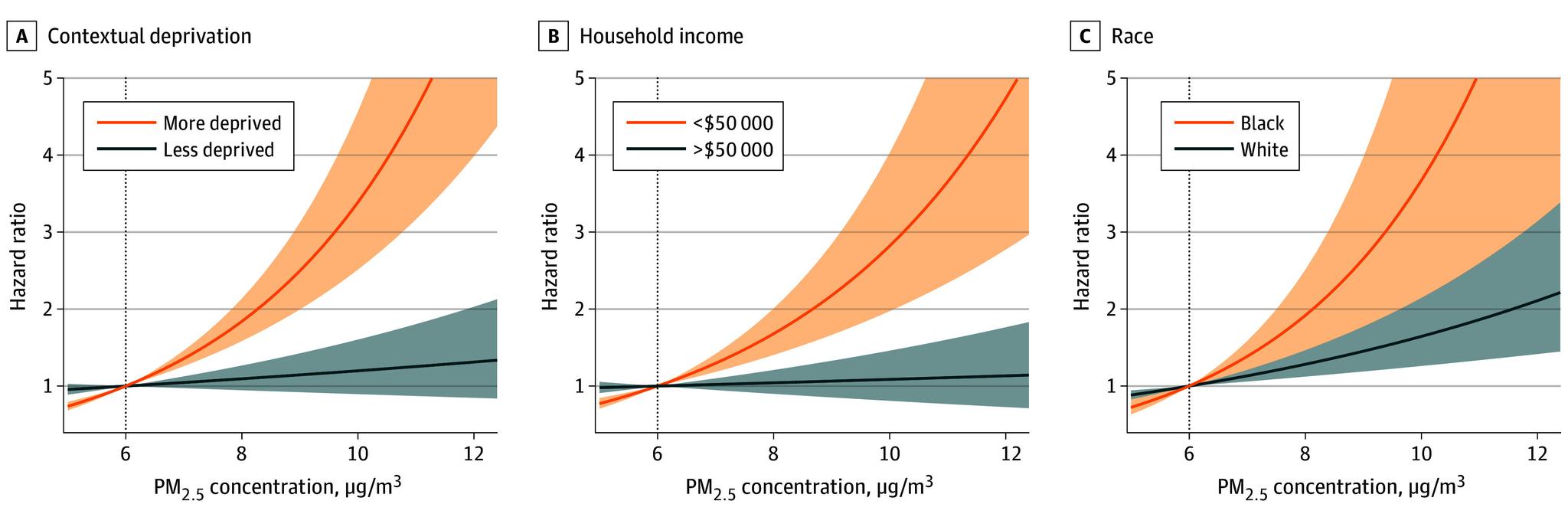
A total of 210 554 participants were analyzed (40% age >60 years; 59.4% female; 16.7% Hispanic, 19.4% Non-Hispanic Black, 56.1% Non-Hispanic White, 7.9% other [American Indian, Asian, more than 1 race and ethnicity]), among whom 954 MI and 1407 stroke cases were identified. Higher PM2.5 levels were associated with higher MI and stroke risks. However, disadvantaged groups (more deprived, income <$50 000 per year, Black race) were more vulnerable to high PM2.5 levels. The disparities were most pronounced between groups defined by contextual deprivation. For instance, increasing PM2.5 from 6 to 10 μg/m3, the HR for stroke was 1.13 (95% CI, 0.85-1.51) in the less-deprived vs 2.57 (95% CI, 2.06-3.21) in the more-deprived cohort; 1.46 (95% CI, 1.07-2.01) in the $50 000 or more per year vs 2.27 (95% CI, 1.73-2.97) in the under $50 000 per year cohort; and 1.70 (95% CI, 1.35-2.16) in White individuals vs 2.76 (95% CI, 1.89-4.02) in Black individuals. The RHR was highest for contextual deprivation (2.27; 95% CI, 1.59-3.24), compared with income (1.55; 95% CI, 1.05-2.29) and race and ethnicity (1.62; 95% CI, 1.02-2.58).
CONCLUSIONS AND RELEVANCE
In this cohort study, while individual race and ethnicity and income remained crucial in the adverse association of PM2.5 with cardiovascular risks, contextual deprivation was a more robust socioeconomic characteristic modifying the association of PM2.5 exposure.
重要性:在易受细颗粒物(PM2.5)暴露影响的亚人群中,社会经济地位较低的亚人群更容易受到影响。然而,由于先前的研究侧重于个体层面的社会经济特征,PM2.5 暴露与心血管健康之间的关联如何受到背景剥夺的影响仍不清楚。
目的:评估不同社会经济特征定义的亚人群中,PM2.5 暴露与心血管疾病之间的关联差异。
设计、设置和参与者:本队列研究使用了来自 All of Us 研究计划的参与者的电子健康记录(EHR)的纵向数据,时间范围为 2016 年至 2022 年日历年度。统计分析于 2023 年 9 月 25 日至 2024 年 2 月 23 日进行。
暴露:根据参与者的居住地址,使用卫星衍生的 5 年平均 PM2.5 暴露值,位于 3 位数邮政编码级别。
主要结果和测量:从 EHR 中获取心肌梗死(MI)和中风的发病情况。使用分层 Cox 比例风险回归模型来估计 PM2.5 暴露与 MI 或中风发病之间的风险比(HR)。我们评估了根据 3 个社会经济特征定义的亚人群:背景剥夺(较不剥夺、较剥夺)、家庭年收入(≥$50000,<$50000)和种族和族裔(非西班牙裔黑人、非西班牙裔白人)。我们计算了比率风险比(RHR),以量化这些亚人群之间的差异。
结果:共分析了 210554 名参与者(40%年龄>60 岁;59.4%女性;16.7%西班牙裔,19.4%非西班牙裔黑人,56.1%非西班牙裔白人,7.9%其他[美国印第安人、亚洲人、超过 1 个种族和族裔]),其中 954 例 MI 和 1407 例中风病例被确定。较高的 PM2.5 水平与较高的 MI 和中风风险相关。然而,弱势群体(较剥夺、年收入<$50000 美元/年、黑人种族)更容易受到高 PM2.5 水平的影响。这种差异在以背景剥夺定义的群体之间最为明显。例如,在较不剥夺的人群中,PM2.5 从 6 微克/立方米增加到 10 微克/立方米,中风的 HR 为 1.13(95% CI,0.85-1.51),而在较剥夺的人群中为 2.57(95% CI,2.06-3.21);在年收入>$50000 美元/年的人群中,HR 为 1.46(95% CI,1.07-2.01),而在年收入<$50000 美元/年的人群中,HR 为 2.27(95% CI,1.73-2.97);在白人个体中,HR 为 1.70(95% CI,1.35-2.16),而在黑人个体中,HR 为 2.76(95% CI,1.89-4.02)。与收入(1.55;95% CI,1.05-2.29)和种族和族裔(1.62;95% CI,1.02-2.58)相比,背景剥夺(2.27;95% CI,1.59-3.24)的 RHR 最高。
结论和相关性:在本队列研究中,虽然个体的种族和族裔以及收入在 PM2.5 与心血管风险的不利关联中仍然至关重要,但背景剥夺是一个更强大的社会经济特征,可改变 PM2.5 暴露与心血管疾病风险之间的关联。



 Zotero 插件