
基于近似贝叶斯计算的随机、基于主体神经元生长模型的校准。
Calibration of stochastic, agent-based neuron growth models with approximate Bayesian computation.
机构信息
CERN, Geneva, Switzerland.
School of Computation, Information, and Technology, Technical University of Munich, Munich, Germany.
出版信息
J Math Biol. 2024 Oct 8;89(5):50. doi: 10.1007/s00285-024-02144-2.
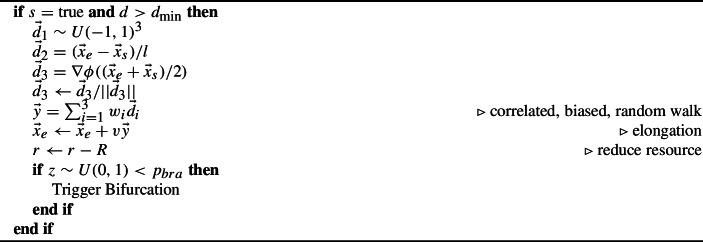
Understanding how genetically encoded rules drive and guide complex neuronal growth processes is essential to comprehending the brain's architecture, and agent-based models (ABMs) offer a powerful simulation approach to further develop this understanding. However, accurately calibrating these models remains a challenge. Here, we present a novel application of Approximate Bayesian Computation (ABC) to address this issue. ABMs are based on parametrized stochastic rules that describe the time evolution of small components-the so-called agents-discretizing the system, leading to stochastic simulations that require appropriate treatment. Mathematically, the calibration defines a stochastic inverse problem. We propose to address it in a Bayesian setting using ABC. We facilitate the repeated comparison between data and simulations by quantifying the morphological information of single neurons with so-called morphometrics and resort to statistical distances to measure discrepancies between populations thereof. We conduct experiments on synthetic as well as experimental data. We find that ABC utilizing Sequential Monte Carlo sampling and the Wasserstein distance finds accurate posterior parameter distributions for representative ABMs. We further demonstrate that these ABMs capture specific features of pyramidal cells of the hippocampus (CA1). Overall, this work establishes a robust framework for calibrating agent-based neuronal growth models and opens the door for future investigations using Bayesian techniques for model building, verification, and adequacy assessment.
理解基因编码规则如何驱动和指导复杂的神经元生长过程对于理解大脑的结构至关重要,基于代理的模型(ABM)为进一步发展这种理解提供了一种强大的模拟方法。然而,准确校准这些模型仍然是一个挑战。在这里,我们提出了一种新的近似贝叶斯计算(ABC)的应用来解决这个问题。ABM 基于参数化的随机规则,描述了小组件(即代理)的时间演化,从而对系统进行离散化,导致需要适当处理的随机模拟。从数学上讲,校准定义了一个随机反问题。我们建议在贝叶斯环境中使用 ABC 来解决它。我们通过使用所谓的形态计量学来量化单个神经元的形态信息,并采用统计距离来测量其种群之间的差异,从而促进数据和模拟之间的重复比较。我们在合成数据和实验数据上进行了实验。我们发现,利用序列蒙特卡罗采样和 Wasserstein 距离的 ABC 可以为代表性的 ABM 找到准确的后验参数分布。我们进一步证明,这些 ABM 可以捕捉海马体(CA1)锥体神经元的特定特征。总的来说,这项工作为校准基于代理的神经元生长模型建立了一个稳健的框架,并为未来使用贝叶斯技术进行模型构建、验证和充分性评估打开了大门。







 Zotero 插件