
质子载体处理可增加处于热中性环境中的小鼠的能量消耗。
Protonophore treatment augments energy expenditure in mice housed at thermoneutrality.
作者信息
Sadler Daniel G, Landes Reid D, Treas Lillie, Sikes James, Porter Craig
机构信息
Arkansas Children's Nutrition Center, Little Rock, AR, United States.
Arkansas Children's Research Institute, Little Rock, AR, United States.
出版信息
Front Physiol. 2024 Sep 24;15:1452986. doi: 10.3389/fphys.2024.1452986. eCollection 2024.
BACKGROUND
Sub-thermoneutral housing increases facultative thermogenesis in mice, which may mask the pre-clinical efficacy of anti-obesity strategies that target energy expenditure (EE). Here, we quantified the impact of protonophore treatment on whole-body energetics in mice housed at 30°C.
METHODS
C57BL/6J mice ( = 48, 24M/24F) were housed at 24°C for 2 weeks; 32 (16M/16F) were then transitioned to 30°C for a further 4 weeks. Following 2 weeks acclimation at 30°C, mice ( = 16 per group, 8M/8F) received either normal (0 mg/L; Control) or supplemented (400 mg/L; 2,4-Dinitrophenol [DNP]) drinking water. Mice were singly housed in metabolic cages to determine total EE (TEE) and its components via respiratory gas exchange. Mitochondrial respiratory function of permeabilized liver tissue was determined by high-resolution respirometry.
RESULTS
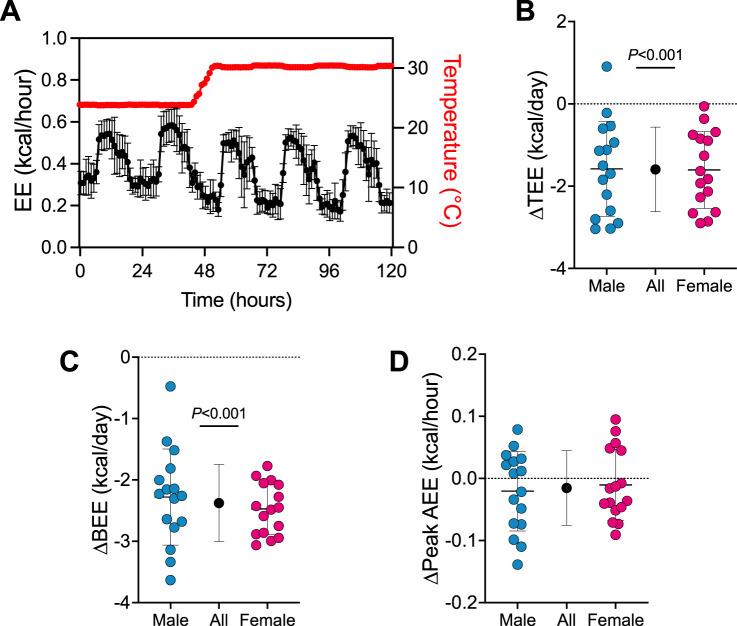
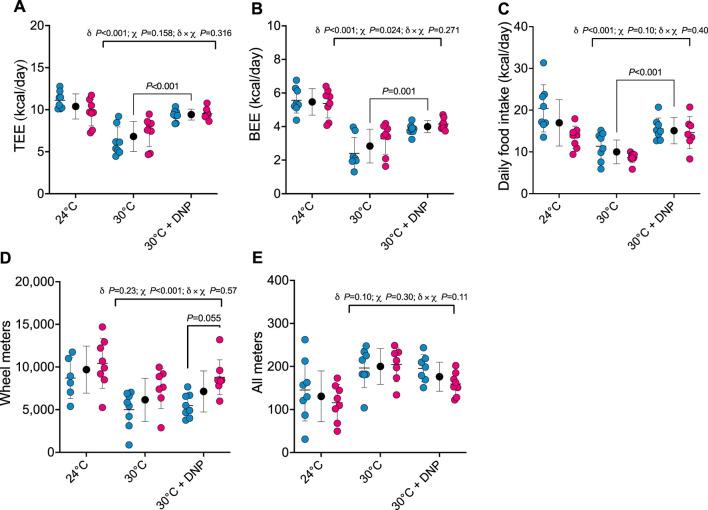
Transitioning mice from 24°C to 30°C reduced TEE and basal EE (BEE) by 16% and 41%, respectively (both < 0.001). Compared to 30°C controls, TEE was 2.6 kcal/day greater in DNP-treated mice (95% CI: 1.6-3.6 kcal/day, < 0.001), which was partly due to a 1.2 kcal/day higher BEE in DNP-treated mice (95% CI: 0.6-1.7 kcal/day, < 0.001). The absolute TEE of 30°C DNP-treated mice was lower than that of mice housed at 24°C in the absence of DNP (DNP: 9.4 ± 0.7 kcal/day vs. 24°C control: 10.4 ± 1.5 kcal/day). DNP treatment reduced overall body fat of females by 2.9 percentage points versus sex-matched controls (95% CI: 1.3%-4.5%, < 0.001), which was at least partly due to a reduction in inguinal white fat mass.
CONCLUSION
Protonophore treatment markedly increases EE in mice housed at 30°C. The magnitude of change in TEE of mice receiving protonophore treatment at 30°C was smaller than that brought about by transitioning mice from 24°C to 30°C, emphasizing that housing temperature must be considered when assessing anti-obesity strategies that target EE in mice.
背景
亚热中性环境饲养会增加小鼠的适应性产热,这可能掩盖以能量消耗(EE)为靶点的抗肥胖策略的临床前疗效。在此,我们量化了质子载体处理对饲养在30°C环境下小鼠全身能量代谢的影响。
方法
将48只C57BL/6J小鼠(24只雄性/24只雌性)饲养在24°C环境下2周;然后将32只(16只雄性/16只雌性)转移至30°C环境下再饲养4周。在30°C环境下适应2周后,小鼠(每组16只,8只雄性/8只雌性)分别饮用正常水(0 mg/L;对照组)或添加了(400 mg/L;2,4-二硝基苯酚[DNP])的饮用水。将小鼠单独饲养在代谢笼中,通过呼吸气体交换测定总能量消耗(TEE)及其组成部分。通过高分辨率呼吸测定法测定透化肝脏组织的线粒体呼吸功能。
结果
将小鼠从24°C转移至30°C后,TEE和基础能量消耗(BEE)分别降低了16%和41%(均P<0.001)。与30°C对照组相比,DNP处理组小鼠的TEE每天高2.6千卡(95%置信区间:1.6 - 3.6千卡/天,P<0.001),这部分是由于DNP处理组小鼠的BEE每天高1.2千卡(95%置信区间:0.6 - 1.7千卡/天,P<0.001)。30°C环境下接受DNP处理的小鼠的绝对TEE低于未接受DNP处理饲养在24°C环境下的小鼠(DNP组:9.4±0.7千卡/天 vs. 24°C对照组:10.4±1.5千卡/天)。与性别匹配的对照组相比,DNP处理使雌性小鼠的总体脂肪减少了2.9个百分点(95%置信区间:1.3% - 4.5%,P<0.001),这至少部分归因于腹股沟白色脂肪量的减少。
结论
质子载体处理显著增加了饲养在30°C环境下小鼠的EE。在30°C环境下接受质子载体处理的小鼠TEE的变化幅度小于将小鼠从24°C转移至30°C所引起的变化幅度,这强调在评估以小鼠EE为靶点的抗肥胖策略时必须考虑饲养温度。

 Zotero 插件