
将小鼠实验转化到人体中,最佳的居住温度是多少?
What is the best housing temperature to translate mouse experiments to humans?
机构信息
Human and Animal Physiology, Wageningen University, De Elst 1, PO box 338, 6700 AH, Wageningen, the Netherlands.
State Key Laboratory of Molecular Developmental Biology, Institute of Genetics and Developmental Biology, Chinese Academy of Sciences, Beijing, China; University of Chinese Academy of Sciences, Beijing, China.
出版信息
Mol Metab. 2019 Jul;25:168-176. doi: 10.1016/j.molmet.2019.04.001. Epub 2019 Apr 6.
OBJECTIVES
Ambient temperature impinges on energy metabolism in a body size dependent manner. This has implications for the housing temperature at which mice are best compared to humans. In 2013, we suggested that, for comparative studies, solitary mice are best housed at 23-25 °C, because this is 3-5 °C below the mouse thermoneutral zone and humans routinely live 3-5 °C below thermoneutrality, and because this generates a ratio of DEE to BMR of 1.6-1.9, mimicking the ratio found in free-living humans.
METHODS
Recently, Fischer et al. (2017) challenged this estimate. By studying mice at 21 °C and at 30 °C (but notably not at 23-25 °C) they concluded that 30 °C is the optimal housing temperature. Here, we measured energy metabolism of C57BL/6 mice over a range of temperatures, between 21.4 °C and 30.2 °C.
RESULTS
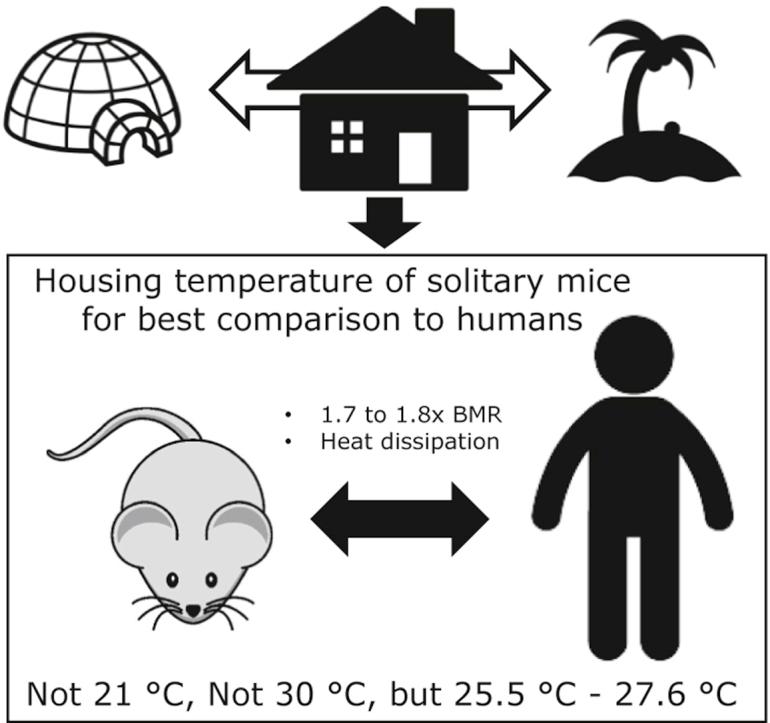
We observed a ratio of DEE to BMR of 1.7 at 27.6 °C and of 1.8 at 25.5 °C, suggesting that this is the best temperature range for housing C57BL/6 mice to mimic human thermal relations. We used a 24 min average to calculate the ratio, similar to that used in human studies, while the ratio calculated by Fisher et al. dependent on short, transient metabolic declines.
CONCLUSION
We concur with Fisher et al. and others that 21 °C is too cool, but we continue to suggest that 30 °C is too warm. We support this with other data. Finally, to mimic living environments of all humans, and not just those in controlled Western environments, mouse experimentation at various temperatures is likely required.
目的
环境温度以依赖于体型的方式影响能量代谢。这对比较研究中应该将小鼠安置在何种环境温度下具有重要意义。2013 年,我们提出,为了进行比较研究,独居小鼠最好安置在 23-25°C,因为这比小鼠的热中性区低 3-5°C,人类通常比热中性低 3-5°C,而且因为这产生了 DEE 与 BMR 的比值为 1.6-1.9,模拟了自由生活的人类中发现的比值。
方法
最近,Fischer 等人(2017 年)对这一估计提出了质疑。通过在 21°C 和 30°C(但显然不是 23-25°C)下研究小鼠,他们得出结论 30°C 是最佳的饲养温度。在这里,我们在 21.4°C 至 30.2°C 的一系列温度下测量了 C57BL/6 小鼠的能量代谢。
结果
我们观察到 27.6°C 时 DEE 与 BMR 的比值为 1.7,25.5°C 时比值为 1.8,这表明这是模拟 C57BL/6 小鼠与人类热关系的最佳温度范围。我们使用 24 分钟的平均值来计算该比值,类似于人类研究中使用的方法,而 Fischer 等人计算的比值依赖于短暂的、瞬态的代谢下降。
结论
我们同意 Fischer 等人的观点,即 21°C 太冷,但我们继续认为 30°C 太热。我们用其他数据支持这一点。最后,为了模拟所有人类的生活环境,而不仅仅是那些在受控的西方环境中的人类,可能需要在不同温度下进行小鼠实验。
 Zotero 插件