
开发一种用于接受姑息性放疗的骨转移患者的预测模型:一项多中心研究(PRAIS 试验)的二次分析。
Development of a predictive model for patients with bone metastases referred to palliative radiotherapy: Secondary analysis of a multicenter study (the PRAIS trial).
机构信息
Palliative Care Unit, IRCCS Istituto Romagnolo per lo Studio dei Tumori (IRST) "Dino Amadori", Meldola, Italy.
Radiation Oncology, Department of Medical and Surgical Sciences (DIMEC), Alma Mater Studiorum University of Bologna, Bologna, Italy.
出版信息
Cancer Med. 2024 Oct;13(19):e70050. doi: 10.1002/cam4.70050.
BACKGROUND
The decision to administer palliative radiotherapy (RT) to patients with bone metastases (BMs), as well as the selection of treatment protocols (dose, fractionation), requires an accurate assessment of survival expectancy. In this study, we aimed to develop three predictive models (PMs) to estimate short-, intermediate-, and long-term overall survival (OS) for patients in this clinical setting.
MATERIALS AND METHODS
This study constitutes a sub-analysis of the PRAIS trial, a longitudinal observational study collecting data from patients referred to participating centers to receive palliative RT for cancer-induced bone pain. Our analysis encompassed 567 patients from the PRAIS trial database. The primary objectives were to ascertain the correlation between clinical and laboratory parameters with the OS rates at three distinct time points (short: 3 weeks; intermediate: 24 weeks; prolonged: 52 weeks) and to construct PMs for prognosis. We employed machine learning techniques, comprising the following steps: (i) identification of reliable prognostic variables and training; (ii) validation and testing of the model using the selected variables. The selection of variables was accomplished using the LASSO method (Least Absolute Shrinkage and Selection Operator). The model performance was assessed using receiver operator characteristic curves (ROC) and the area under the curve (AUC).
RESULTS
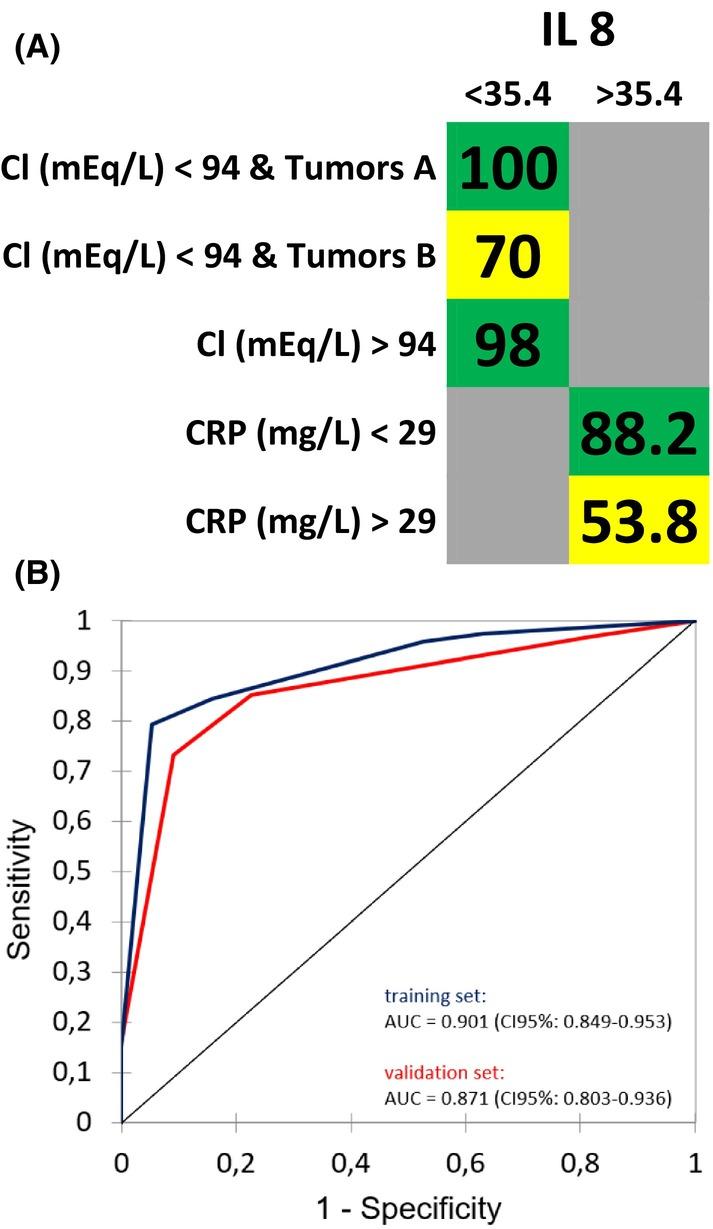
Our analysis demonstrated a significant impact of clinical parameters (primary tumor site, presence of non-bone metastases, steroids and opioid intake, food intake, and body mass index) and laboratory parameters (interleukin 8 [IL-8], chloride levels, C-reactive protein, white blood cell count, and lymphocyte count) on OS. Notably, different factors were associated with the different times for OS with only IL-8 included both in the PMs for short- and long-term OS. The AUC values for ROC curves for 3-week, 24-week, and 52-week OS were 0.901, 0.767, and 0.806, respectively.
CONCLUSIONS
We successfully developed three PMs for OS based on easily accessible clinical and laboratory parameters for patients referred to palliative RT for painful BMs. While our findings are promising, it is important to recognize that this was an exploratory trial. The implementation of these tools into clinical practice warrants further investigation and confirmation through subsequent studies with separate databases.
背景
对于有骨转移(BMs)的患者,是否给予姑息性放疗(RT)以及选择何种治疗方案(剂量、分割),需要准确评估其预期生存时间。本研究旨在建立三个预测模型(PMs),以评估此类患者的短期、中期和长期总生存(OS)。
材料和方法
本研究为 PRAIS 试验的子分析,该研究是一项纵向观察性研究,从接受姑息性 RT 治疗癌性骨痛的患者中收集数据。我们的分析纳入了来自 PRAIS 试验数据库的 567 名患者。主要目的是确定临床和实验室参数与三个不同时间点(3 周、24 周和 52 周)的 OS 率之间的相关性,并构建预后 PMs。我们采用了机器学习技术,包括以下步骤:(i)确定可靠的预后变量并进行训练;(ii)使用所选变量验证和测试模型。变量的选择采用了 LASSO 方法(最小绝对收缩和选择算子)。通过绘制接受者操作特征曲线(ROC)和计算曲线下面积(AUC)来评估模型性能。
结果
我们的分析表明,临床参数(原发肿瘤部位、是否有骨外转移、是否使用类固醇和阿片类药物、饮食和体重指数)和实验室参数(白细胞介素 8 [IL-8]、氯水平、C 反应蛋白、白细胞计数和淋巴细胞计数)对 OS 有显著影响。值得注意的是,不同的因素与不同的 OS 时间相关,只有 IL-8 同时包含在短期和长期 OS 的 PMs 中。3 周、24 周和 52 周 OS 的 ROC 曲线 AUC 值分别为 0.901、0.767 和 0.806。
结论
我们成功地基于患者易于获得的临床和实验室参数建立了三个 OS 的 PMs,这些患者因疼痛性 BMs 接受姑息性 RT。虽然我们的研究结果很有前景,但需要认识到这是一项探索性研究。这些工具在临床实践中的应用需要进一步通过独立数据库的后续研究进行调查和验证。



 Zotero 插件