
以及 FLT3 抑制剂的研究及其在急性髓系白血病中的应用。
and study of FLT3 inhibitors and their application in acute myeloid leukemia.
机构信息
Biomedicine and Ecology Molecular Markers Laboratory, Department of Cellular and Molecular Biology, Biological and Agricultural Sciences Campus, University of Guadalajara, Zapopan, Jalisco 44600, Mexico.
Division of Immunology, Western Biomedical Research Center, Mexican Social Security Institute, Guadalajara, Jalisco 44340, Mexico.
出版信息
Mol Med Rep. 2024 Dec;30(6). doi: 10.3892/mmr.2024.13353. Epub 2024 Oct 11.
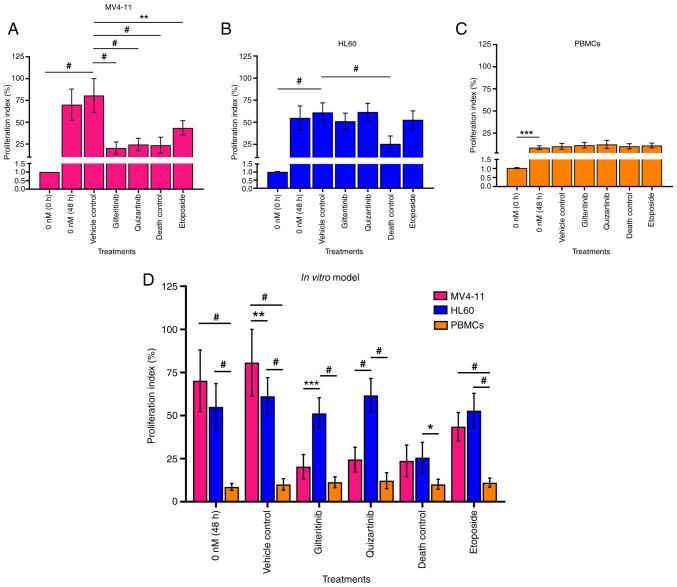
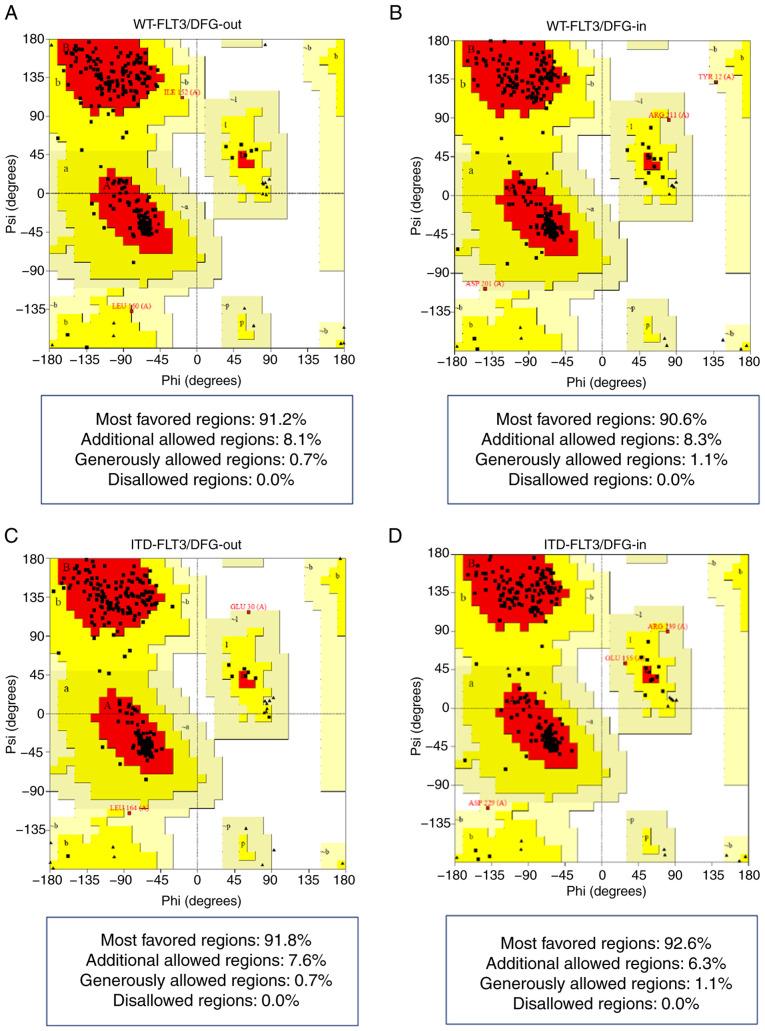
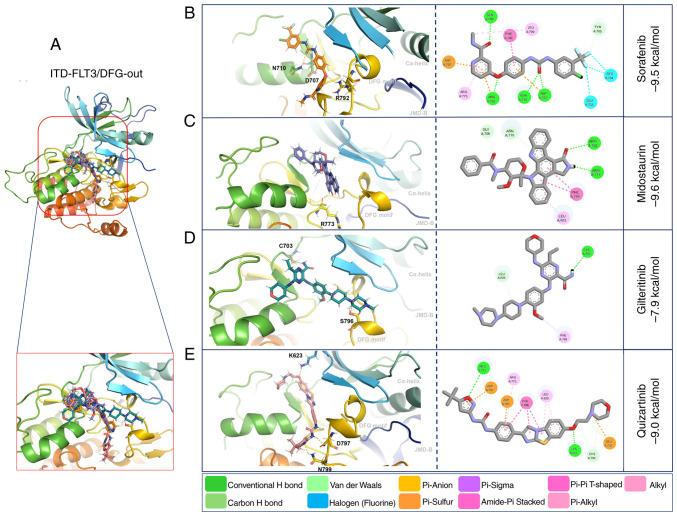
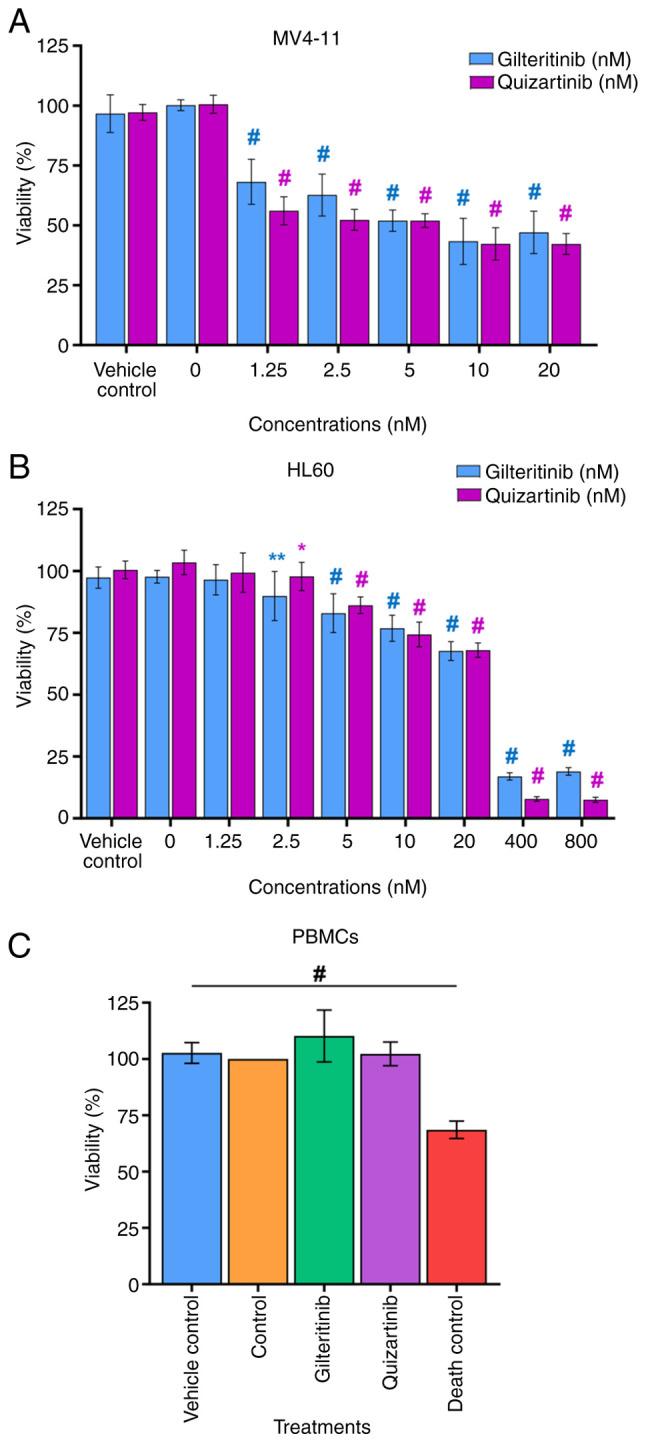
Acute myeloid leukemia (AML) is the most common hematological cancer in the adult population worldwide. Approximately 35% of patients with AML present internal tandem duplication (ITD) mutations in the FMS‑like tyrosine kinase 3 (FLT3) receptor associated with poor prognosis, and thus, this receptor is a relevant target for potential therapeutics. Tyrosine kinase inhibitors (TKIs) are used to treat AML; however, their molecular interactions and effects on leukemic cells are poorly understood. The present study aimed to gain insights into the molecular interactions and affinity forces of four TKI drugs (sorafenib, midostaurin, gilteritinib and quizartinib) with the wild‑type (WT)‑FLT3 and ITD‑mutated (ITD‑FLT3) structural models of FLT3, in its inactive aspartic acid‑phenylalanine‑glycine motif (DFG‑out) and active aspartic acid‑phenylalanine‑glycine motif (DFG‑in) conformations. Furthermore, the present study evaluated the effects of the second‑generation TKIs gilteritinib and quizartinib on cancer cell viability, apoptosis and proliferation in the MV4‑11 (ITD‑FLT3) and HL60 (WT‑FLT3) AML cell lines. Peripheral blood mononuclear cells (PBMCs) from a healthy volunteer were included as an FLT3‑negative group. Molecular docking analysis indicated higher affinities of second‑generation TKIs for WT‑FLT3/DFG‑out and WT‑FLT3/DFG‑in compared with those of the first‑generation TKIs. However, the ITD mutation changed the affinity of all TKIs. The data supported the predictions: MV4‑11 cells presented high selective sensibility to gilteritinib and quizartinib compared with the HL60 cells, whereas the drugs had no effect on PBMCs. Thus, the current study presented novel information about molecular interactions between the FLT3 receptors (WT or ITD‑mutated) and some of their inhibitors. It also paves the way for the search for novel inhibitory molecules with potential use against AML.
急性髓细胞白血病(AML)是全球成人中最常见的血液系统恶性肿瘤。大约 35%的 AML 患者存在 FMS 样酪氨酸激酶 3(FLT3)受体内部串联重复(ITD)突变,与预后不良相关,因此该受体是潜在治疗靶点。酪氨酸激酶抑制剂(TKI)用于治疗 AML;然而,它们与白血病细胞的分子相互作用和影响仍知之甚少。本研究旨在深入了解四种 TKI 药物(索拉非尼、米哚妥林、吉特替尼和 quizartinib)与野生型(WT)-FLT3 和 ITD 突变(ITD-FLT3)FLT3 结构模型的分子相互作用和亲和力,其处于无活性天冬氨酸-苯丙氨酸-甘氨酸基序(DFG-out)和活性天冬氨酸-苯丙氨酸-甘氨酸基序(DFG-in)构象。此外,本研究还评估了第二代 TKI 吉特替尼和 quizartinib 对 MV4-11(ITD-FLT3)和 HL60(WT-FLT3)AML 细胞系中癌细胞活力、凋亡和增殖的影响。健康志愿者的外周血单核细胞(PBMC)被纳入作为 FLT3-阴性组。分子对接分析表明,第二代 TKI 对 WT-FLT3/DFG-out 和 WT-FLT3/DFG-in 的亲和力高于第一代 TKI。然而,ITD 突变改变了所有 TKI 的亲和力。数据支持预测结果:与 HL60 细胞相比,MV4-11 细胞对吉特替尼和 quizartinib 具有更高的选择性敏感性,而这些药物对 PBMC 没有影响。因此,本研究提供了关于 FLT3 受体(WT 或 ITD 突变)与其一些抑制剂之间的分子相互作用的新信息。它还为寻找具有治疗 AML 潜力的新型抑制分子铺平了道路。





 Zotero 插件