
阿兹夫定治疗轻中重度新型冠状病毒肺炎患者的疗效:一项倾向评分匹配分析
Efficacy of Azvudine Therapy in Patients with Severe and Non-Severe COVID-19: A Propensity Score-Matched Analysis.
作者信息
Zhang Siqin, Tan Songsong, Yang Bin, Wu Yaoyao, Yuan Guohang, Chen Fengjiao, Liu Lin
机构信息
Department of Endocrinology and Metabolism, Guizhou Provincial People's Hospital, Guiyang, Guizhou, 550002, People's Republic of China.
Department of Central Laboratory, Guizhou Provincial People's Hospital, Guiyang, Guizhou, 550002, People's Republic of China.
出版信息
Infect Drug Resist. 2024 Oct 7;17:4317-4325. doi: 10.2147/IDR.S481591. eCollection 2024.
OBJECTIVE
Azvudine is used to treat patients with the coronavirus disease 2019 (COVID-19). This study evaluated the clinical efficacy of azvudine in hospitalized patients with different severities of COVID-19 because few studies have described this in patients with severe and non-severe COVID-19.
METHODS
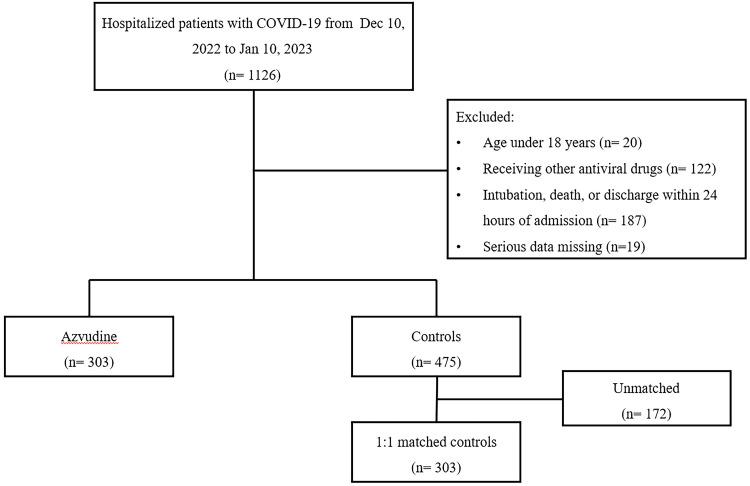
This retrospective study included hospitalized patients with COVID-19 in Guizhou Provincial People's Hospital between December 2022 and January 2023. Azvudine-treated patients and controls were matched for sex, age, and disease severity at admission. Laboratory results and outcomes, including all-cause mortality, invasive mechanical ventilation, intensive care unit admission, and hospital stay length, were evaluated. Stratified analysis was used to explore the difference in the efficacy of azvudine in severe and non-severe COVID-19 patients.
RESULTS
No significant differences in all-cause mortality were observed between the 303 azvudine recipients and 303 matched controls. However, azvudine-treated patients had shorter hospital stays (8.34±4.79 vs 9.17±6.25 days, P=0.046) and higher lymphocyte improvement rates (21.5% vs 13.9%, P=0.019), with a more pronounced effect in patients with non-severe COVID-19 (length of hospital stay, 8.07±4.35 vs 10.00±6.29 days, P=0.001; lymphocyte improvement rate, 23.8% vs 12.8%, P=0.015).
CONCLUSION
Azvudine treatment shortens hospital stay length and increases the rate of lymphocyte count improvement in patients with non-severe COVID-19, suggesting that azvudine may be a treatment option for these patients.
目的
阿兹夫定用于治疗新型冠状病毒肺炎(COVID-19)患者。本研究评估了阿兹夫定在不同严重程度COVID-19住院患者中的临床疗效,因为很少有研究描述其在重症和非重症COVID-19患者中的情况。
方法
这项回顾性研究纳入了2022年12月至2023年1月期间在贵州省人民医院住院的COVID-19患者。对接受阿兹夫定治疗的患者和对照组在性别、年龄和入院时疾病严重程度方面进行匹配。评估实验室检查结果和结局,包括全因死亡率、有创机械通气、重症监护病房入住率和住院时间。采用分层分析探讨阿兹夫定在重症和非重症COVID-19患者中疗效的差异。
结果
303例接受阿兹夫定治疗的患者与303例匹配的对照组在全因死亡率方面未观察到显著差异。然而,接受阿兹夫定治疗的患者住院时间较短(8.34±4.79天 vs 9.17±6.25天,P = 0.046),淋巴细胞改善率较高(21.5% vs 13.9%,P = 0.019),在非重症COVID-19患者中效果更明显(住院时间,8.07±4.35天 vs 10.00±6.29天,P = 0.001;淋巴细胞改善率,23.8% vs 12.8%,P = 0.015)。
结论
阿兹夫定治疗可缩短非重症COVID-19患者的住院时间并提高淋巴细胞计数改善率,提示阿兹夫定可能是这些患者的一种治疗选择。


 Zotero 插件