
奥密克戎变异株流行期间奈玛特韦片/利托那韦片与阿兹夫定治疗北京地区 COVID-19 住院患者的真实世界疗效:一项多中心回顾性队列研究。
Real-world effectiveness of nirmatrelvir-ritonavir versus azvudine in hospitalized patients with COVID-19 during the omicron wave in Beijing: a multicenter retrospective cohort study.
机构信息
College of Pulmonary and Critical Care Medicine, The Eighth Medical Center, Chinese PLA General Hospital, No. 17 Heishanhu Road, Haidian District, Beijing, 100091, China.
Chinese PLA Medical School, Beijing, China.
出版信息
BMC Infect Dis. 2024 Jan 8;24(1):57. doi: 10.1186/s12879-023-08965-8.
BACKGROUND AND AIM
Two oral antivirals (Nirmatrelvir- ritonavir and Azvudine) are widely used in China practice during the Omicron wave of the pandemic. However, little evidence regarding the real-world effectiveness of these two oral antivirals in in-hospital patients. We aimed to evaluate the clinical effectiveness of nirmatrelvir-ritonavir versus azvudine among adult hospitalized patients with COVID-19.
METHODS
This retrospective cohort study used data from three Chinese PLA General Hospital medical centres. Hospitalized patients with COVID-19 treated with azvudine or nirmatrelvir-ritonavir from Dec 10, 2022, to February 20, 2023, and did not require invasive ventilation support on admission were eligible for inclusion.
RESULTS
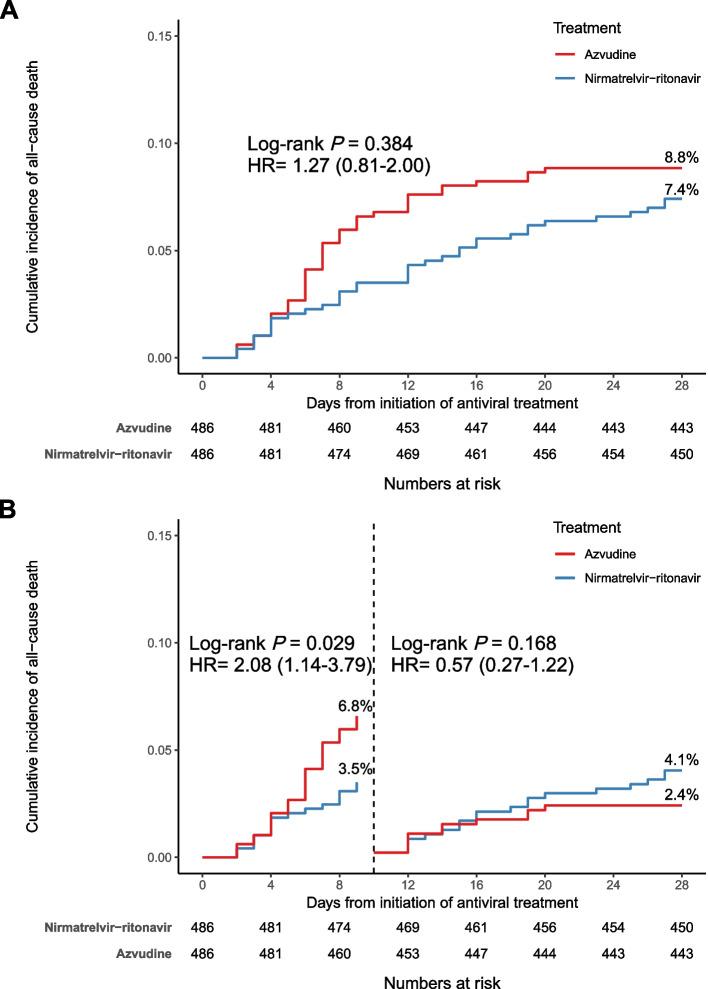
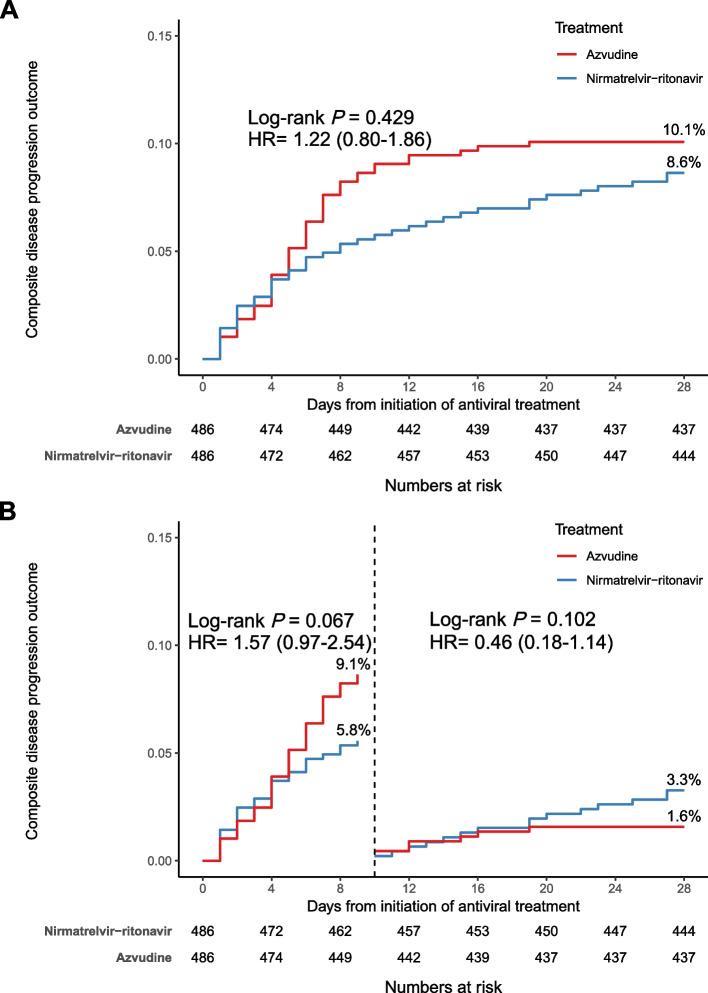
After exclusions and propensity-score matching, the final analysis included 486 azvudine recipients and 486 nirmatrelvir-ritonavir recipients. By 28 days of initiation of the antivirus treatment, the crude incidence rate of all-cause death was similar in both types of antivirus treatment (nirmatrelvir-ritonavir group 2.8 events 1000 person-days [95% CI, 2.1-3.6] vs azvudine group 3.4 events/1000 person-days [95% CI, 2.6-4.3], P = 0.38). Landmark analysis showed that all-cause death was lower in the nirmatrelvir-ritonavir (3.5%) group than the azvudine (6.8%, P = 0.029) within the initial 10-day admission period, while no significant difference was observed for results between 10 and 28 days follow-up. There was no significant difference between the nirmatrelvir-ritonavir group and the azvudine group in cumulative incidence of the composite disease progression event (8.6% with nirmatrelvir-ritonavir vs. 10.1% with azvudine, HR, 1.22; 95% CI 0.80-1.86, P = 0.43).
CONCLUSION
Among patients hospitalized with COVID-19 during the omicron wave in Beijing, similar in-hospital clinical outcomes on 28 days were observed between patients receiving nirmatrelvir-ritonavir and azvudine. However, it is worth noticing that nirmatrelvir-ritonavir appears to hold an advantage over azvudine in reducing early mortality. Further randomized controlled trials are needed to verify the efficacy of those two antivirus medications especially in early treatment.
背景和目的
奥密克戎疫情期间,两种口服抗病毒药物(奈玛特韦/利托那韦和阿兹夫定)在中国广泛应用于临床。然而,关于这两种口服抗病毒药物在住院患者中的真实世界疗效的数据较少。本研究旨在评估奈玛特韦/利托那韦与阿兹夫定在 COVID-19 住院患者中的临床疗效。
方法
这是一项回顾性队列研究,使用了来自中国解放军总医院三家医疗中心的数据。2022 年 12 月 10 日至 2023 年 2 月 20 日期间,接受阿兹夫定或奈玛特韦/利托那韦治疗且入院时无需接受有创通气支持的 COVID-19 住院患者符合纳入标准。
结果
排除和倾向评分匹配后,最终分析纳入了 486 例阿兹夫定治疗者和 486 例奈玛特韦/利托那韦治疗者。抗病毒治疗开始后 28 天,两种抗病毒药物治疗的全因死亡率相似(奈玛特韦/利托那韦组为 2.8 例/1000 人天[95%CI,2.1-3.6] vs 阿兹夫定组为 3.4 例/1000 人天[95%CI,2.6-4.3],P=0.38)。 landmark 分析显示,在最初的 10 天入院期间,奈玛特韦/利托那韦(3.5%)组的全因死亡率低于阿兹夫定(6.8%,P=0.029),而在 10 至 28 天随访期间,两组之间的结果无显著差异。在复合疾病进展事件的累积发生率方面,奈玛特韦/利托那韦组与阿兹夫定组无显著差异(奈玛特韦/利托那韦组为 8.6%,阿兹夫定组为 10.1%,HR,1.22;95%CI,0.80-1.86,P=0.43)。
结论
在北京奥密克戎疫情期间,接受奈玛特韦/利托那韦和阿兹夫定治疗的 COVID-19 住院患者的 28 天住院临床结局相似。然而,需要注意的是,与阿兹夫定相比,奈玛特韦/利托那韦似乎在降低早期死亡率方面具有优势。需要进一步的随机对照试验来验证这两种抗病毒药物的疗效,尤其是在早期治疗中。
 Zotero 插件