
COVID-19 的先天免疫反应:临床病例系列中 NK 淋巴细胞的单细胞多组学特征。
Innate immune response in COVID-19: single-cell multi-omics profile of NK lymphocytes in a clinical case series.
机构信息
Section of Human Anatomy, Department of Neuroscience, University of Padova, Via Gabelli 65, 35121, Padova, Italy.
Foundation for Biology and Regenerative Medicine, Tissue Engineering and Signaling - T.E.S. Onlus, Padova, Italy.
出版信息
Cell Commun Signal. 2024 Oct 15;22(1):496. doi: 10.1186/s12964-024-01867-5.
BACKGROUND
COVID-19 pandemic caused by the Severe Acute Respiratory Syndrome-Coronavirus-2 (SARS-CoV-2) represents the biggest global health emergency in recent decades. The host immune response to SARS-CoV-2 seems to play a key role in disease pathogenesis and clinical manifestations, with Natural Killer (NK) lymphocytes being among the targets of virus-induced regulation.
METHODS
This study performed a single-cell multi-omics analysis of transcripts and proteins of NK lymphocytes in COVID-19 patients, for the characterization of the innate immunological response to infection. NK cells were isolated from peripheral blood samples collected from adult subjects divided into 3 study groups: (1) non-infected subjects (Naïve group, n = 3), (2) post COVID-19 convalescent subjects (Healed group, n = 3) and (3) patients that were vaccinated against SARS-CoV-2 (Vaccine group, n = 3). Cells were then analysed by the BD Rhapsody System for the single-cell multi-omics investigation of transcriptome and membrane proteins.
RESULTS
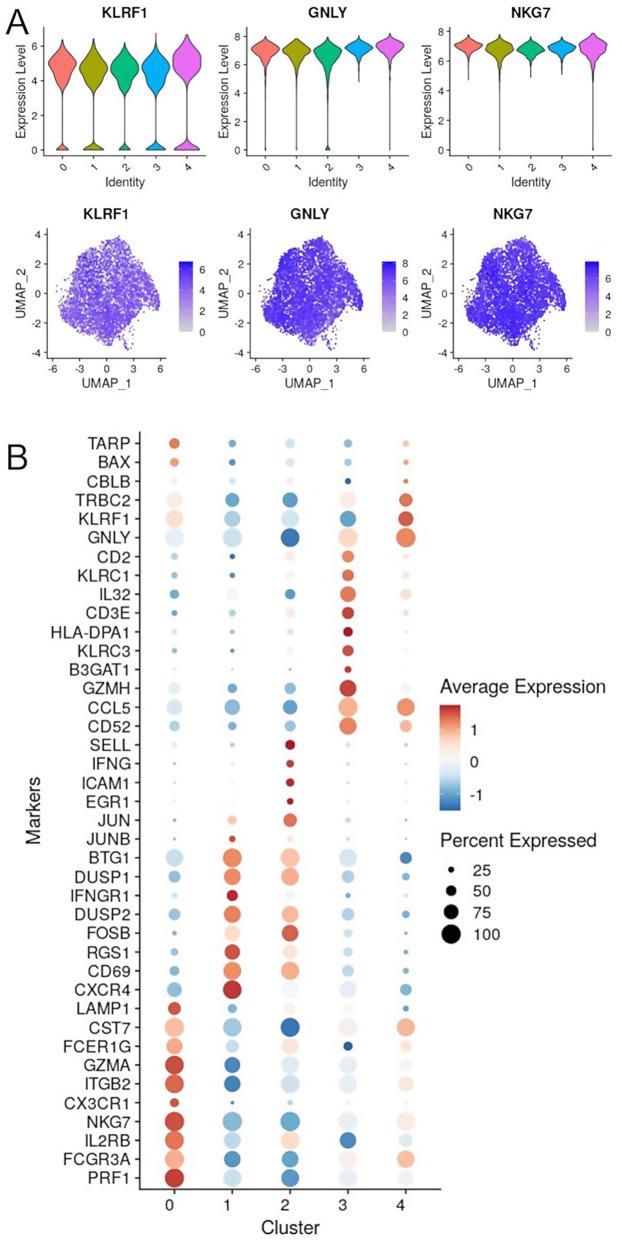
The bioinformatic analysis identified 5 cell clusters which differentially expressed gene/protein markers, defining NK cell subsets as "Active NK cells" and "Mature NK cells". Calculating the relative proportion of each cluster within patient groups, more than 40% of the Naïve group cell population was found to belong to Mature NKs, whereas more than 75% of the Vaccine group cell population belonged to the cluster of Active NKs. Regarding the Healed group, it seemed to show intermediate phenotype between Active and Mature NK cells. Differential expression of specific genes, proteins and signaling pathways was detected comparing the profile of the 3 experimental groups, revealing a more activated NK cell phenotype in vaccinated patients versus recovered individuals.
CONCLUSIONS
The present study detected differential expression of NK cell markers in relation to SARS-CoV-2 infection and vaccine administration, suggesting the possibility to identify key molecular targets for clinical-diagnostic use of the individual response to viral infection and/or re-infection.
背景
由严重急性呼吸系统综合征冠状病毒 2 型(SARS-CoV-2)引起的 COVID-19 大流行是近几十年来全球最大的卫生紧急事件。宿主对 SARS-CoV-2 的免疫反应似乎在疾病发病机制和临床表现中起关键作用,自然杀伤(NK)淋巴细胞是病毒诱导调节的目标之一。
方法
本研究对 COVID-19 患者的 NK 淋巴细胞的转录本和蛋白质进行了单细胞多组学分析,以描述对感染的固有免疫反应。从成年受试者的外周血样本中分离 NK 细胞,这些受试者分为 3 个研究组:(1)未感染者(Naïve 组,n=3)、(2)COVID-19 后康复者(Healed 组,n=3)和(3)接种 SARS-CoV-2 疫苗者(Vaccine 组,n=3)。然后使用 BD Rhapsody 系统对细胞进行分析,以进行转录组和膜蛋白的单细胞多组学研究。
结果
生物信息学分析确定了 5 个细胞簇,这些细胞簇差异表达基因/蛋白标记,将 NK 细胞亚群定义为“活性 NK 细胞”和“成熟 NK 细胞”。计算每个组内各簇的相对比例,发现 Naïve 组细胞群中超过 40%属于成熟 NK 细胞,而 Vaccine 组细胞群中超过 75%属于活性 NK 细胞簇。对于 Healed 组,其 NK 细胞表型似乎介于活性和成熟 NK 细胞之间。通过比较 3 个实验组的图谱,检测到特定基因、蛋白质和信号通路的差异表达,表明接种疫苗的患者 NK 细胞表型较恢复期患者更为活跃。
结论
本研究检测到 NK 细胞标志物在 SARS-CoV-2 感染和疫苗接种方面的差异表达,提示有可能识别出与个体对病毒感染和/或再感染的反应相关的关键分子靶标,用于临床诊断。




 Zotero 插件