
植物性饮食指数与老年人睡眠健康的关系:抑郁症状和焦虑的中介作用。
The Relationship between Plant-Based Diet Indices and Sleep Health in Older Adults: The Mediating Role of Depressive Symptoms and Anxiety.
机构信息
Department of Social Medicine, School of Health Management, Harbin Medical University, No. 157 Baojian Road, Nangang District, Harbin 150081, China.
Department of Cell Biology, School of Basic Medical Sciences, Harbin Medical University, No. 157 Baojian Road, Nangang District, Harbin 150081, China.
出版信息
Nutrients. 2024 Oct 5;16(19):3386. doi: 10.3390/nu16193386.
BACKGROUND
The goal of our research was to determine the effects of plant-based dietary patterns on sleep health among older adults and to examine the parallel mediated effects of anxiety and depression.
METHODS
This investigation utilized data obtained from the 2018 Chinese Longitudinal Healthy Longevity Survey (CLHLS) and contained 6853 participants. Logistic regression and the restricted cubic splines (RCSs) model were employed to examine how plant-based dietary patterns affect sleep health. Additionally, Amos 26.0 was used to construct a structural equation model to examine the parallel mediated effects of anxiety and depression.
RESULTS
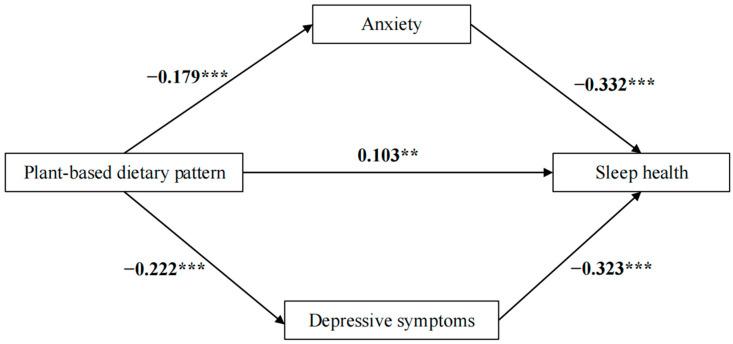
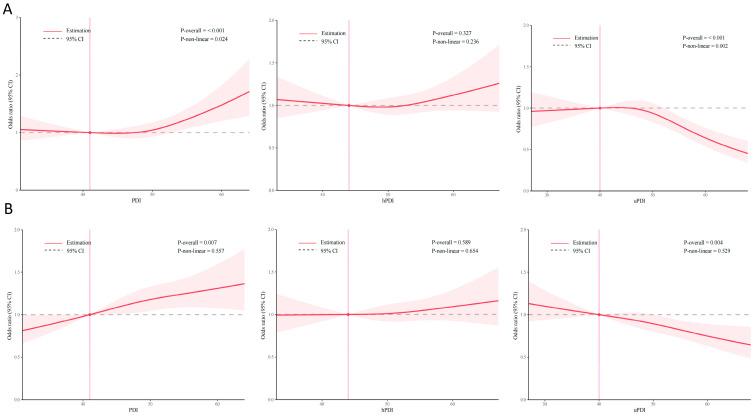
A higher plant-based diet index (PDI) was connected to higher odds of better sleep quality (OR = 1.209, 95% CI: 1.039-1.407) and sleep duration (OR = 1.241, 95% CI: 1.072-1.437). Conversely, an elevated unhealthy plant-based diet index (uPDI) was correlated with a lower likelihood of sleep quality (OR = 0.678, 95% CI: 0.574-0.800) and sleep duration (OR = 0.762, 95% CI: 0.647-0.896). The RCSs regression further identified a significant dose-response relationship. Mediation analysis confirmed that anxiety and depression partially mediate the relationship between plant-based diets and sleep health.
CONCLUSIONS
Our study exhibited significant correlations between plant-based diets and sleep health in the elderly. Depression and anxiety were determined as parallel mediators between plant-based diets and sleep health. Controlling early dietary patterns and affective disorder could help improve sleep quality in older adults.
背景
本研究旨在探讨植物性饮食模式对老年人睡眠健康的影响,并检验焦虑和抑郁的平行中介作用。
方法
本研究利用 2018 年中国长寿队列研究(CLHLS)的数据,共纳入 6853 名参与者。采用 logistic 回归和限制三次样条(RCSs)模型探讨植物性饮食模式对睡眠健康的影响。同时,采用 Amos 26.0 构建结构方程模型,检验焦虑和抑郁的平行中介作用。
结果
较高的植物性饮食指数(PDI)与更好的睡眠质量(OR=1.209,95%CI:1.039-1.407)和睡眠时间(OR=1.241,95%CI:1.072-1.437)呈正相关。相反,较高的不健康植物性饮食指数(uPDI)与较差的睡眠质量(OR=0.678,95%CI:0.574-0.800)和睡眠时间(OR=0.762,95%CI:0.647-0.896)呈负相关。RCSs 回归进一步发现了显著的剂量反应关系。中介分析证实,焦虑和抑郁部分中介了植物性饮食与睡眠健康之间的关系。
结论
本研究表明,老年人的植物性饮食与睡眠健康之间存在显著关联。抑郁和焦虑是植物性饮食与睡眠健康之间的平行中介因素。控制早期的饮食模式和情感障碍可能有助于改善老年人的睡眠质量。
 Zotero 插件