
立体定向体部放射治疗局限性前列腺癌的 3 期临床试验。
Phase 3 Trial of Stereotactic Body Radiotherapy in Localized Prostate Cancer.
机构信息
From the Royal Marsden Hospital (N.A., A.T., O.N.), the Institute of Cancer Research (N.A., C.G., A.T., J. Patel, E.W., J. Pugh, G.M., S. Brown, S. Burnett, E.H.), St. Bartholomew's Hospital (P.W.), and Patient and Public Representative (D.P.), London, the Mount Vernon Cancer Centre, Northwood (P.O.), the James Cook University Hospital, Middlesbrough (H.V.), University Hospitals Birmingham, Birmingham (D.F.), the Clatterbridge Cancer Centre, Birkenhead (S.T.), Queen's University Belfast, Belfast (S.J.), Churchill Hospital, Oxford (P.C.), University Hospitals of Leicester, Leicester (K.K.), Freeman Hospital, Newcastle (J.F.), University Hospitals Coventry and Warwickshire, Coventry (A.C.), Velindre Cancer Centre, Cardiff (J.S.), and Cambridge University Hospitals NHS Foundation Trust, Cambridge (A.M.) - all in the United Kingdom; Odette Cancer Centre, Sunnybrook Health Sciences Centre, Toronto (A.L., W.C.), and the Department of Oncology, McMaster University, Hamilton, ON (I.D.) - both in Canada; and Cancer Trials Ireland and St. Luke's Radiation Oncology Network, St. Luke's Hospital - both in Dublin (J.A.).
出版信息
N Engl J Med. 2024 Oct 17;391(15):1413-1425. doi: 10.1056/NEJMoa2403365.
BACKGROUND
Whether stereotactic body radiotherapy (SBRT) is noninferior to conventionally or moderately hypofractionated regimens with respect to biochemical or clinical failure in patients with localized prostate cancer is unclear.
METHODS
We conducted a phase 3, international, open-label, randomized, controlled trial. Men with stage T1 or T2 prostate cancer, a Gleason score of 3+4 or less, and a prostate-specific antigen (PSA) level of no more than 20 ng per milliliter were randomly assigned (in a 1:1 ratio) to receive SBRT (36.25 Gy in 5 fractions over a period of 1 or 2 weeks) or control radiotherapy (78 Gy in 39 fractions over a period of 7.5 weeks or 62 Gy in 20 fractions over a period of 4 weeks). Androgen-deprivation therapy was not permitted. The primary end point was freedom from biochemical or clinical failure, with a critical hazard ratio for noninferiority of 1.45. The analysis was performed in the intention-to-treat population.
RESULTS
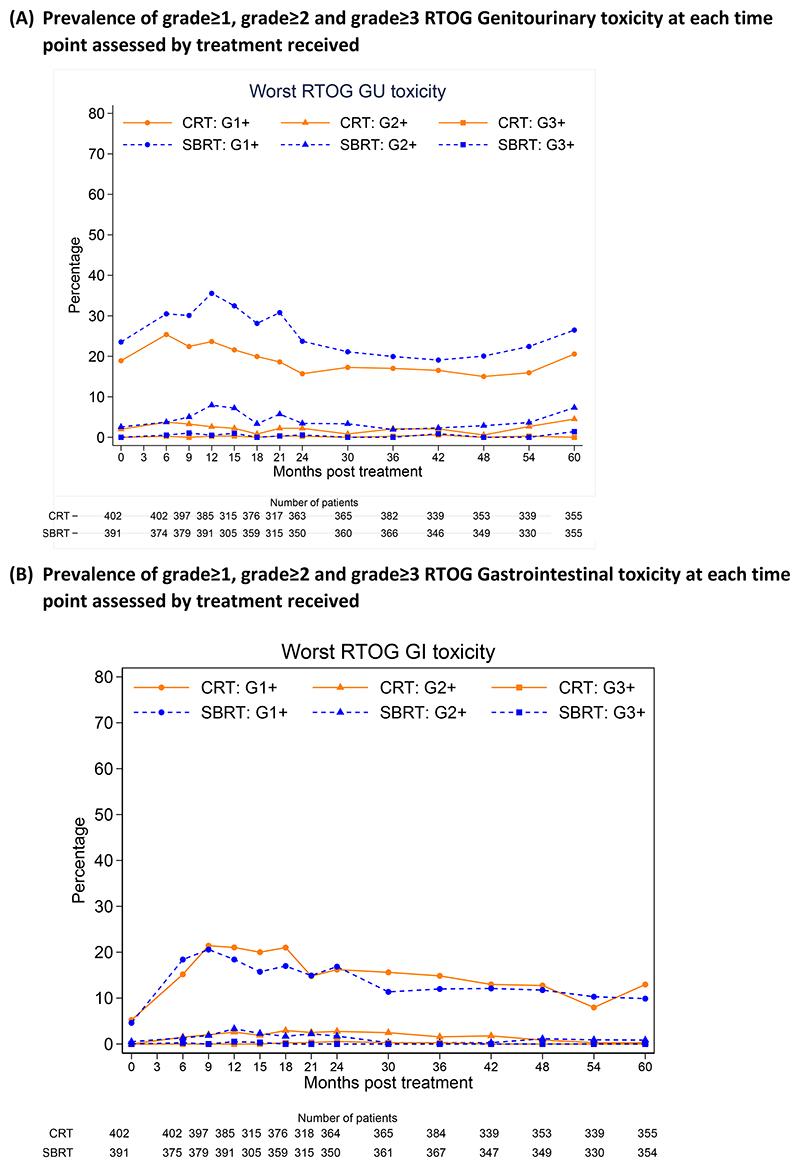
A total of 874 patients underwent randomization at 38 centers (433 patients in the SBRT group and 441 in the control radiotherapy group) between August 2012 and January 2018. The median age of the patients was 69.8 years, and the median PSA level was 8.0 ng per milliliter; the National Comprehensive Cancer Network risk category was low for 8.4% of the patients and intermediate for 91.6%. At a median follow-up of 74.0 months, the 5-year incidence of freedom from biochemical or clinical failure was 95.8% (95% confidence interval [CI], 93.3 to 97.4) in the SBRT group and 94.6% (95% CI, 91.9 to 96.4) in the control radiotherapy group (unadjusted hazard ratio for biochemical or clinical failure, 0.73; 90% CI, 0.48 to 1.12; P = 0.004 for noninferiority), which indicated the noninferiority of SBRT. At 5 years, the cumulative incidence of late Radiation Therapy Oncology Group (RTOG) grade 2 or higher genitourinary toxic effects was 26.9% (95% CI, 22.8 to 31.5) with SBRT and 18.3% (95% CI, 14.8 to 22.5) with control radiotherapy (P<0.001), and the cumulative incidence of late RTOG grade 2 or higher gastrointestinal toxic effects was 10.7% (95% CI, 8.1 to 14.2) and 10.2% (95% CI, 7.7 to 13.5), respectively (P = 0.94).
CONCLUSIONS
Five-fraction SBRT was noninferior to control radiotherapy with respect to biochemical or clinical failure and may be an efficacious treatment option for patients with low-to-intermediate-risk localized prostate cancer as defined in this trial. (Funded by Accuray and others; PACE-B ClinicalTrials.gov number, NCT01584258.).
背景
立体定向体部放疗(SBRT)在生化或临床失败方面是否不劣于常规或适度亚分割治疗方案,对于局限性前列腺癌患者尚不清楚。
方法
我们开展了一项 3 期、国际、开放标签、随机、对照临床试验。分期为 T1 或 T2 期前列腺癌、Gleason 评分为 3+4 或更低、前列腺特异性抗原(PSA)水平不超过 20ng/ml 的男性患者,按照 1:1 的比例随机分配(随机分组),接受 SBRT(5 个周期,每个周期 36.25Gy,共 5 个周期,或 1 或 2 周)或对照放疗(78Gy,共 39 个周期,7.5 周;或 62Gy,共 20 个周期,4 周)。不允许使用雄激素剥夺疗法。主要终点是生化或临床无失败,非劣效性的临界危险比为 1.45。分析是在意向治疗人群中进行的。
结果
共有 38 个中心的 874 名患者(SBRT 组 433 例,对照组放疗组 441 例)于 2012 年 8 月至 2018 年 1 月期间进行了随机分组。患者的中位年龄为 69.8 岁,中位 PSA 水平为 8.0ng/ml;国家综合癌症网络风险类别为低危占 8.4%,中危占 91.6%。中位随访 74.0 个月时,SBRT 组和对照组生化或临床无失败的 5 年发生率分别为 95.8%(95%置信区间[CI],93.3 至 97.4)和 94.6%(95%CI,91.9 至 96.4)(生化或临床失败的未调整危险比,0.73;90%CI,0.48 至 1.12;P=0.004 用于非劣效性),这表明 SBRT 的非劣效性。5 年时,SBRT 组和对照组晚期放射治疗肿瘤学组(RTOG)2 级或更高级别的泌尿生殖系统毒性的累积发生率分别为 26.9%(95%CI,22.8 至 31.5)和 18.3%(95%CI,14.8 至 22.5)(P<0.001),晚期 RTOG 2 级或更高级别的胃肠道毒性的累积发生率分别为 10.7%(95%CI,8.1 至 14.2)和 10.2%(95%CI,7.7 至 13.5)(P=0.94)。
结论
5 个周期的 SBRT 在生化或临床失败方面不劣于对照组放疗,对于本试验定义的低至中危局限性前列腺癌患者,可能是一种有效的治疗选择。(由 Accuray 等资助;PACE-B 临床试验。gov 编号,NCT01584258。)

 Zotero 插件