
多组学解析微生物群-肠-脑轴与减重手术后认知改善的关系
Multi-omics insights into the microbiota-gut-brain axis and cognitive improvement post-bariatric surgery.
机构信息
Dapartment of Neurology, Zhongnan Hospital of Wuhan University, No.169 Donghu Street, Wuhan, Hubei, 430000, China.
Department of Radiology, Zhongnan Hospital of Wuhan University, Wuhan, Hubei, China.
出版信息
J Transl Med. 2024 Oct 17;22(1):945. doi: 10.1186/s12967-024-05757-9.
BACKGROUND
Although numerous studies have shown that bariatric surgery results in sustained weight loss and modifications in gut microbiota composition and cognitive function, the exact underlying mechanisms are unclear. This study aimed to investigate the effects of bariatric surgery on cognitive function through the microbiota-gut-brain axis (MGBA).
METHODS
Demographic data, serum samples, fecal samples, cognitive assessment scales, and resting-state functional connectivity magnetic resonance imaging (rs-fMRI) scans were obtained from 39 obese patients before and after (6 months) laparoscopic sleeve gastrectomy (LSG). PCA analysis, OPLS-DA analysis, and permutation tests were used to conduct fecal 16 S microbiota profiling, serum metabolomics, and neuroimaging analyses, and a bariatric surgery-specific rs-fMRI brain functional connectivity network was constructed. Spearman correlation analysis and Co-inertia analysis were employed to correlate significant alterations in cognitive assessment scales and resting-state functional connectivity difference networks with differential serum metabolites and 16 S microbiota data to identify key gut microbiota and serum metabolic factors.
RESULTS
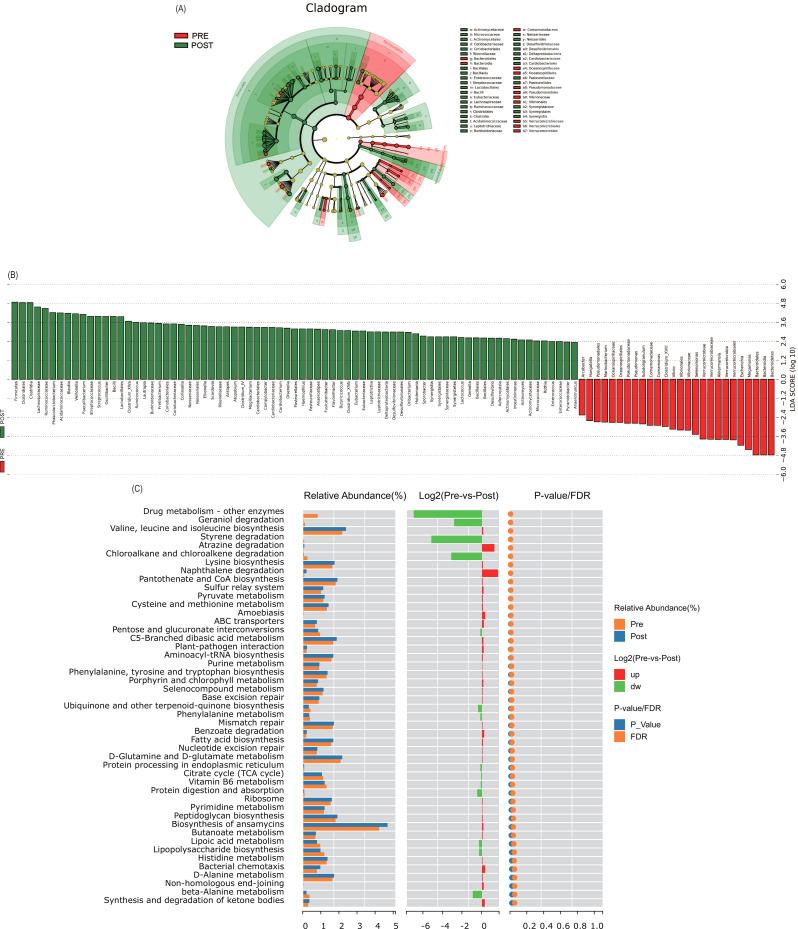
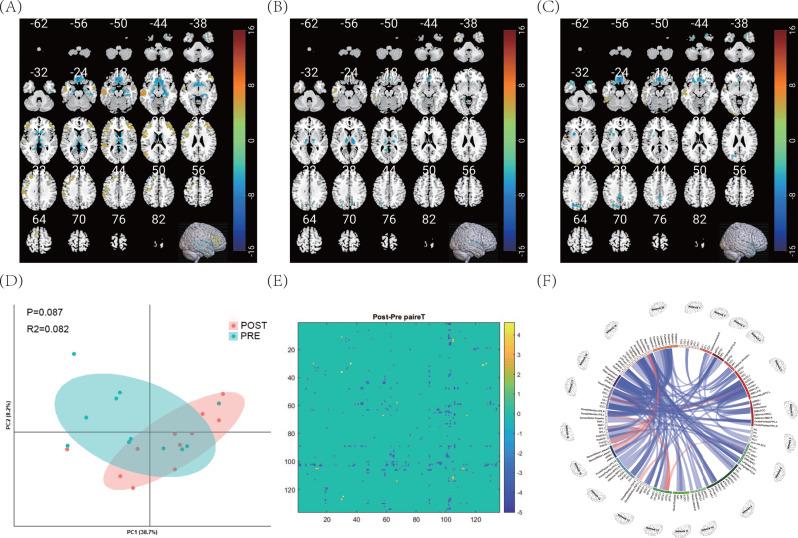
LSG significantly reduced the weight of obese patients, with reductions of up to 28%. Furthermore, cognitive assessment scale measurements revealed that LSG enhanced cognitive functions, including memory (HVLT, p = 0.000) and executive function (SCWT, p = 0.008). Also, LSG significantly altered gut microbiota composition (p = 0.001), with increased microbial abundance and diversity (p < 0.05). Moreover, serum metabolite levels were significantly altered, revealing intergroup differences in 229 metabolites mapped to 72 metabolic pathways (p < 0.05, VIP > 1). Spearman correlation analysis among cognitive assessment scales, gut microbiota species, and serum metabolites revealed correlations with 68 gut microbiota species and 138 serum metabolites (p < 0.05). Furthermore, pairwise correlations were detected between gut microbiota and serum metabolites (p < 0.05). Functional neuroimaging analysis revealed that LSG increased functional connectivity in cognitive-related frontotemporal networks (FPN, p < 0.01). Additionally, normalization of the default mode network (DMN) and salience network (SN) connectivity was observed after LSG (p < 0.001). Further canonical correlation and correlation analysis suggested that the cognitive-related brain network changes induced by LSG were associated with key gut microbiota species (Akkermansia, Blautia, Collinsella, Phascolarctobacterium, and Ruminococcus, p < 0.05) and neuroactive metabolites (Glycine, L-Serine, DL-Dopa, SM (d18:1/24:1(15Z), p < 0.05).
CONCLUSION
These findings indicate the pathophysiological role of the microbiota-gut-brain axis in enhancing cognitive function after bariatric surgery, and the study provides a basis for clinical dietary adjustments, probiotic supplementation, and guidance for bariatric surgery, but further research is still needed.
TRIAL REGISTRATION
Chinese Clinical Trial Registry, ChiCTR2100049403. Registered 02 August 2021, https://www.chictr.org.cn/ .
背景
虽然大量研究表明减重手术可导致持续的体重减轻以及肠道微生物群落组成和认知功能的改变,但确切的潜在机制尚不清楚。本研究旨在通过肠道-脑轴(MGBA)研究减重手术对认知功能的影响。
方法
在腹腔镜袖状胃切除术(LSG)前后(6 个月),我们从 39 名肥胖患者中获取了人口统计学数据、血清样本、粪便样本、认知评估量表和静息状态功能磁共振成像(rs-fMRI)扫描。采用主成分分析(PCA)、正交偏最小二乘判别分析(OPLS-DA)和置换检验进行粪便 16S 微生物组分析、血清代谢组学和神经影像学分析,并构建了特定于减重手术的 rs-fMRI 脑功能连接网络。采用 Spearman 相关分析和共协方差分析,将认知评估量表的显著变化与静息态功能连接差异网络与差异血清代谢物和 16S 微生物数据相关联,以确定关键的肠道微生物群和血清代谢因素。
结果
LSG 显著减轻了肥胖患者的体重,最多减轻了 28%。此外,认知评估量表测量显示 LSG 增强了认知功能,包括记忆(HVLT,p=0.000)和执行功能(SCWT,p=0.008)。此外,LSG 还显著改变了肠道微生物群落组成(p=0.001),增加了微生物的丰度和多样性(p<0.05)。此外,血清代谢物水平也发生了显著改变,在 72 条代谢途径中映射到 229 种代谢物存在组间差异(p<0.05,VIP>1)。认知评估量表、肠道微生物物种和血清代谢物之间的 Spearman 相关分析显示,与 68 种肠道微生物物种和 138 种血清代谢物相关(p<0.05)。此外,还检测到肠道微生物和血清代谢物之间的两两相关性(p<0.05)。功能神经影像学分析显示,LSG 增加了与认知相关的额颞叶网络(FPN,p<0.01)的功能连接。此外,LSG 后还观察到默认模式网络(DMN)和突显网络(SN)连接的归一化(p<0.001)。进一步的典型相关和相关性分析表明,LSG 引起的与认知相关的脑网络变化与关键的肠道微生物物种(Akkermansia、Blautia、Collinsella、Phascolarctobacterium 和 Ruminococcus,p<0.05)和神经活性代谢物(Glycine、L-Serine、DL-Dopa、SM(d18:1/24:1(15Z),p<0.05)有关。
结论
这些发现表明,肠道-脑轴在减重手术后增强认知功能方面具有病理生理学作用,该研究为临床饮食调整、益生菌补充和减重手术提供了依据,但仍需要进一步研究。
试验注册
中国临床试验注册中心,ChiCTR2100049403。注册于 2021 年 8 月 2 日,https://www.chictr.org.cn/。




 Zotero 插件