
老年慢性阻塞性肺疾病(COPD)患者与结核病患者免疫相关性的回顾性研究。
Correlation between elderly patients with COPD and the impact on immunity in tuberculosis patients: A retrospective study.
机构信息
Department of Tuberculosis, The Second Hospital of Nanjing, Affiliated to Nanjing University of Chinese Medicine, Nanjing, China.
General Medicine Department, Affiliated Central Hospital of Jiangnan University, Wuxi, China.
出版信息
Medicine (Baltimore). 2024 Oct 18;103(42):e40140. doi: 10.1097/MD.0000000000040140.
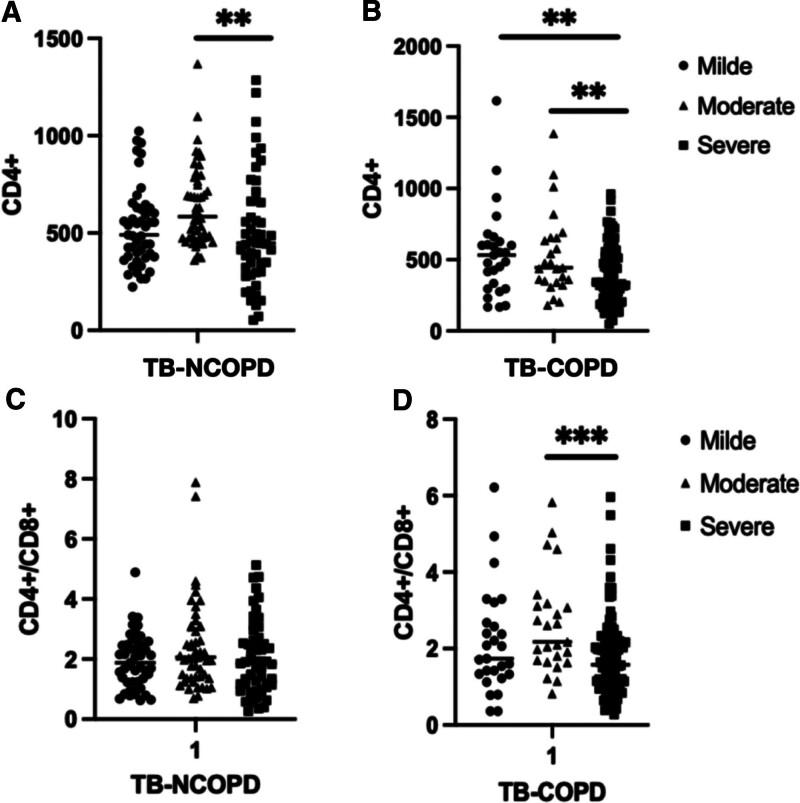
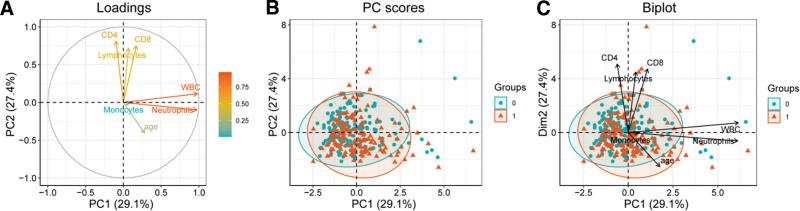
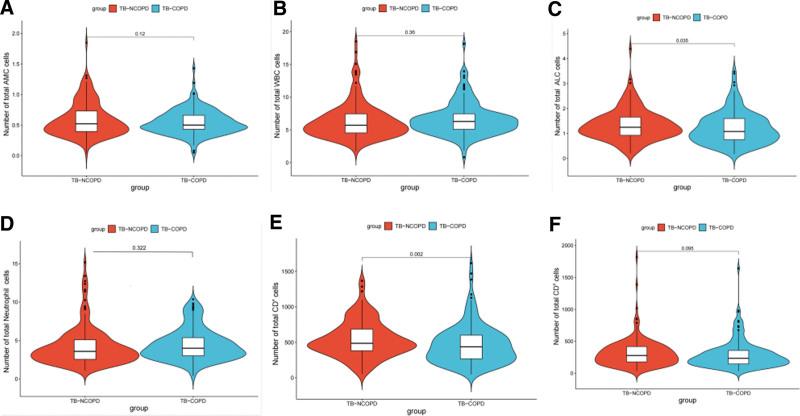
The prevalence of chronic obstructive pulmonary disease (COPD) and tuberculosis (TB) is increasing globally, yet their comprehensive impact on the immune system remains underexplored. This study aimed to provide a thorough assessment of the immune status of patients with COPD and tuberculosis (TB-COPD), including their pulmonary conditions, immune cell responses, and changes in lymphocyte subpopulations. A total of 151 patients with TB-COPD patients were included, and clinical data were compared between the TB-COPD group and a group of TB patients without COPD (TB-NCOPD). Lung imaging findings and peripheral blood immune cell levels were compared between the 2 groups. Flow cytometry was used to analyze the absolute counts of lymphocyte subpopulations. The incidence of pulmonary lobe lesions and cavitation in the TB-COPD group aged 70 years or older was significantly higher than that in the control group. At the immune cell level, patients with TB-COPD showed a significant reduction in total lymphocytes, CD4+ T lymphocytes and CD4+/CD8+ ratio. Regardless of COPD status, the CD4+ T cell count in the CMV-infected group was significantly lower than that in the uninfected group (P < .05). Additionally, the CD4+/CD8+ ratio in the COPD + TB CMV + group was significantly lower than that in the uninfected group. Analysis of lymphocyte subpopulations revealed a decrease in the counts of CD4+ T lymphocytes in patients with TB-COPD, potentially associated with the chronic inflammatory state induced by COPD. The one-month treatment outcomes showed that the improvement rate in the control group was 70.58%, which was significantly higher than the 38.92% in the COPD + TB group (P < .001). We observed a significant increase in the number of pulmonary cavity patients in the TB-COPD group, suggesting that COPD may be a potential risk factor for the formation of pulmonary cavities in patients with TB. At the immune cell level, TB-COPD patients showed a notable decrease in lymphocytes and CD4+ T lymphocytes, implying that COPD combined with pulmonary TB may significantly affect the immune system, leading to a reduction in the counts of key immune cells.
慢性阻塞性肺疾病(COPD)和结核病(TB)的患病率在全球范围内不断上升,但它们对免疫系统的综合影响仍未得到充分探索。本研究旨在全面评估 COPD 和结核病(TB-COPD)患者的免疫状态,包括其肺部状况、免疫细胞反应和淋巴细胞亚群的变化。共纳入 151 例 TB-COPD 患者,比较 TB-COPD 组与无 COPD 的 TB 患者(TB-NCOPD)组的临床资料。比较两组患者的肺部影像学表现和外周血免疫细胞水平。采用流式细胞术分析淋巴细胞亚群的绝对计数。70 岁及以上 TB-COPD 患者肺叶病变和空洞的发生率明显高于对照组。在免疫细胞水平上,TB-COPD 患者总淋巴细胞、CD4+T 淋巴细胞和 CD4+/CD8+比值显著降低。无论是否合并 COPD,CMV 感染组 CD4+T 细胞计数均明显低于未感染组(P<0.05)。此外,COPD+TB CMV+组的 CD4+/CD8+比值明显低于未感染组。淋巴细胞亚群分析显示,TB-COPD 患者 CD4+T 淋巴细胞计数减少,可能与 COPD 引起的慢性炎症状态有关。1 个月治疗结局显示,对照组的改善率为 70.58%,明显高于 COPD+TB 组的 38.92%(P<0.001)。我们观察到 TB-COPD 组肺空洞患者数量明显增加,提示 COPD 可能是 TB 患者肺空洞形成的潜在危险因素。在免疫细胞水平上,TB-COPD 患者淋巴细胞和 CD4+T 淋巴细胞明显减少,提示 COPD 合并肺结核可能对免疫系统有明显影响,导致关键免疫细胞计数减少。

 Zotero 插件