
体外实验表明,埃利司他组氨酸三唑(elexacaftor/tezacaftor/ivacaftor)可改善囊性纤维化跨膜电导调节因子(CFTR)通道功能,同时还能诱导气道上皮细胞基因表达谱发生变化。
Gene expression responses of CF airway epithelial cells exposed to elexacaftor/tezacaftor/ivacaftor suggest benefits beyond improved CFTR channel function.
机构信息
Department of Microbiology and Immunology, Geisel School of Medicine at Dartmouth, Hanover, New Hampshire, United States.
Department of Biomedical Data Science, Geisel School of Medicine at Dartmouth, Lebanon, New Hampshire, United States.
出版信息
Am J Physiol Lung Cell Mol Physiol. 2024 Dec 1;327(6):L905-L916. doi: 10.1152/ajplung.00272.2024. Epub 2024 Oct 22.
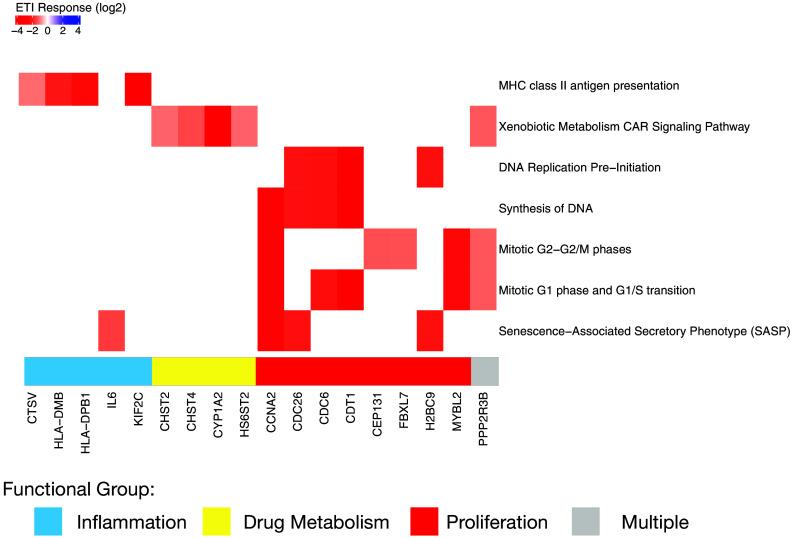
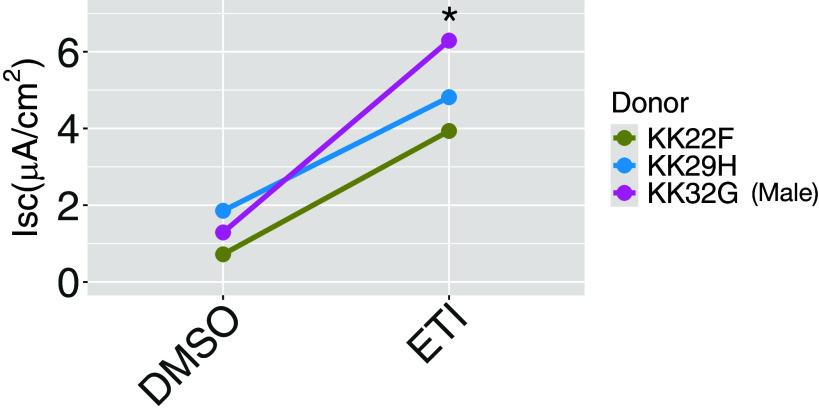
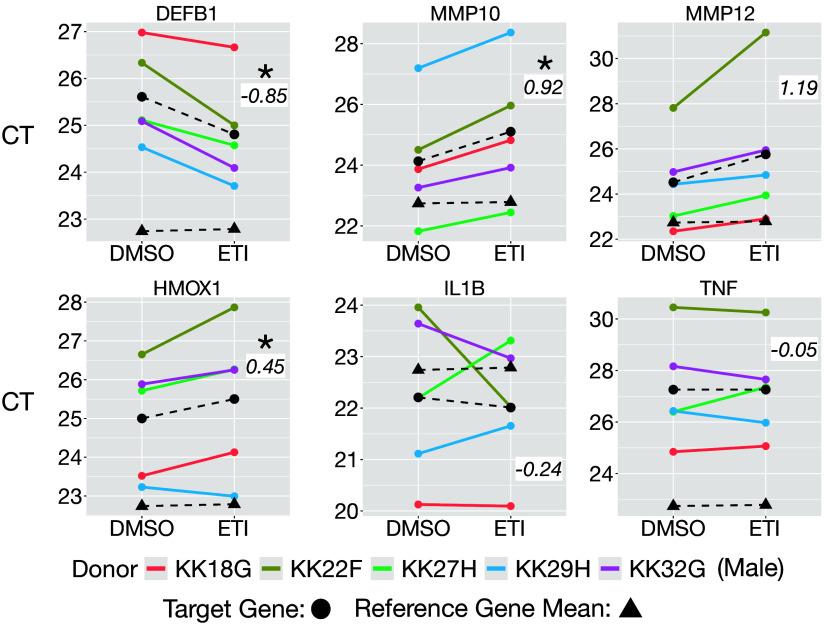
The combination of elexacaftor/tezacaftor/ivacaftor (ETI, Trikafta) reverses the primary defect in cystic fibrosis (CF) by improving CFTR-mediated Cl and HCO secretion by airway epithelial cells (AECs), leading to improved lung function and less frequent exacerbations and hospitalizations. However, studies have shown that CFTR modulators like ivacaftor, a component of ETI, have numerous effects on CF cells beyond improved CFTR channel function. Because little is known about the effect of ETI on CF AEC gene expression, we exposed primary human AEC to ETI for 48 h and interrogated the transcriptome by RNA-seq and qPCR. ETI increased CFTR Cl secretion, and defensin gene expression (), an observation consistent with reports of decreased bacterial burden in the lungs of people with CF (pwCF). ETI decreased and gene expression, suggesting that ETI may reduce proteolytic-induced lung destruction in CF. ETI also reduced the expression of the stress response gene heme oxygenase (). qPCR analysis confirmed , , , and gene expression results observed by RNA-seq. Gene pathway analysis revealed that ETI decreased inflammatory signaling, cellular proliferation, and MHC class II antigen presentation. Collectively, these findings suggest that the clinical observation that ETI reduces lung infections in pwCF is related in part to drug-induced increases in and that ETI may reduce lung damage by reducing and gene expression. Moreover, pathway analysis also identified several other genes responsible for the ETI-induced reduction in inflammation observed in pwCF. Gene expression responses by CF AECs exposed to ETI suggest that in addition to improving CFTR channel function, ETI is likely to enhance resistance to bacterial infection by increasing levels of beta-defensin 1 (hBD-1). ETI may also reduce lung damage by suppressing MMP10 and MMP12 and reduce airway inflammation by repressing proinflammatory cytokine secretion by CF AECs.
依伐卡托/泰比卡托/艾氟康唑(ETI,Trikafta)联合治疗通过改善气道上皮细胞(AEC)中 CFTR 介导的 Cl 和 HCO 的分泌,逆转囊性纤维化(CF)的主要缺陷,从而改善肺功能,减少频繁恶化和住院治疗。然而,研究表明,CFTR 调节剂,如 ETI 的成分艾氟康唑,除了改善 CFTR 通道功能外,对 CF 细胞还有许多其他作用。由于人们对 ETI 对 CF AEC 基因表达的影响知之甚少,我们用 ETI 处理原代人 AEC 48 小时,并通过 RNA-seq 和 qPCR 检测转录组。ETI 增加了 CFTR 的 Cl 分泌和防御素基因表达(),这一观察结果与 CF 患者肺部细菌负荷降低的报道一致。ETI 降低了和基因的表达,这表明 ETI 可能减少 CF 中的蛋白酶诱导的肺破坏。ETI 还降低了应激反应基因血红素加氧酶()的表达。qPCR 分析证实了 RNA-seq 观察到的、和基因表达的结果。基因通路分析表明,ETI 降低了炎症信号、细胞增殖和 MHC Ⅱ类抗原呈递。总的来说,这些发现表明,临床观察到 ETI 减少 CF 患者的肺部感染与药物诱导的增加有关,ETI 可能通过降低和基因的表达来减少肺部损伤。此外,通路分析还确定了其他几个与 CF 患者中观察到的 ETI 诱导的炎症减少有关的基因。CF AEC 暴露于 ETI 后的基因表达反应表明,除了改善 CFTR 通道功能外,ETI 还可能通过增加β防御素 1(hBD-1)的水平来增强对细菌感染的抵抗力。ETI 还可能通过抑制 MMP10 和 MMP12 减少肺损伤,并通过抑制 CF AEC 中促炎细胞因子的分泌来减少气道炎症。



 Zotero 插件