
组织工程化肱二头肌自体肌腱补片增强兔冈上肌腱缺损模型中巨大肩袖缺损的修复。
Tissue-engineered Bicipital Autologous Tendon Patch Enhances Massive Rotator Cuff Defect Repair in a Rabbit Infraspinatus Tendon Defect Model.
机构信息
Dr. Li Dak Sum-Yip Yio Chin Center for Stem Cells and Regenerative Medicine and Department of Orthopedic Surgery of The Second Affiliated Hospital, Zhejiang University School of Medicine, Hangzhou, PR China.
Institute of Sports Medicine, Zhejiang University, Hangzhou, Zhejiang, PR China.
出版信息
Clin Orthop Relat Res. 2024 Dec 1;482(12):2239-2255. doi: 10.1097/CORR.0000000000003218. Epub 2024 Sep 17.
BACKGROUND
Massive rotator cuff defects represent an important source of shoulder pain and functional debilitation, substantially diminishing patients' quality of life. The primary treatment of massive rotator cuff defects includes complete or partial repair and patch augmentation. However, because of the tendon's limited regenerative ability, the tendon retear risk after rotator cuff defect repair is still high. Thus, a new therapy is needed to promote tendon regeneration for repair of massive rotator cuff defects.
QUESTIONS/PURPOSES: Using an in vitro analysis, we first asked: (1) What is the biocompatibility and collagen synthesis ability of fibrin glue, and what is the cell growth of tissue-engineered bicipital tendon patches, which is comprised of fibrin glue and biceps tendon tissue particles? Then, using an in vivo animal model of full-thickness defects in the infraspinatus tendon in New Zealand White rabbits, we asked: (2) What is the potential of the tissue-engineered bicipital autologous tendon patch to promote tendon regeneration?
METHODS
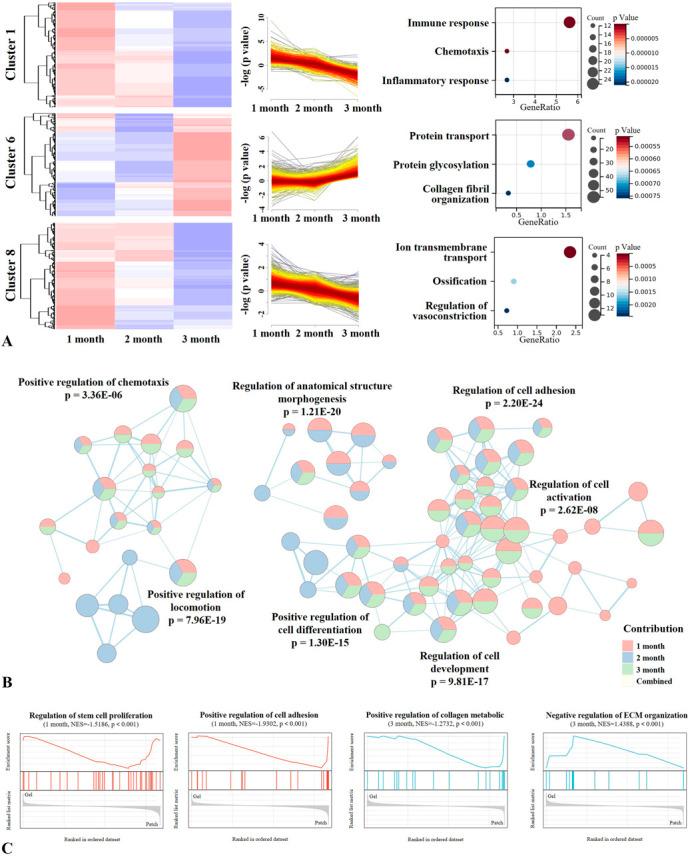
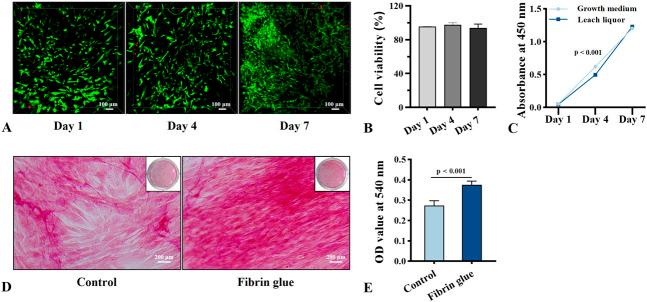
In vitro experiments were conducted to assess the survival, proliferation, and collagen synthesis ability of tendon stem/progenitor cells cultured in fibrin glue. This was achieved through an assay of live/dead cell viability, cell counting kit-8 (CCK-8) assay, and Sirius red staining, respectively. The in vivo animal study was conducted using 8- to 12-week-old New Zealand White rabbits. The left shoulder of each animal was operated on, with equal numbers of males and females. There were 12 rabbits in the control group and 15 rabbits each in the gel and patch groups. Six rabbits were allocated to each of the three groups at the 1- and 3-month time points and three rabbits each were in the gel and patch groups at 2-month time point. Through an infraspinatus tendon defect model, the effectiveness of tissue-engineered bicipital autologous tendon patches (patch group) in tendon repair was assessed compared with untreated (control group) and fibrin glue (gel group) treatments in vivo. This assessment included histological evaluation of repaired tissue morphology, transmission electron microscopy (TEM) evaluation of regenerated collagen fibrils, and RNA sequencing to explore the potential mechanisms of tissue-engineered bicipital autologous tendon patches in tendon regeneration.
RESULTS
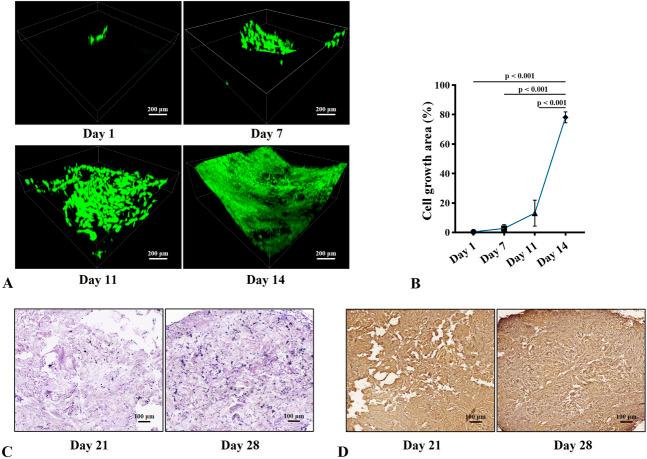
In vitro experiments demonstrated that fibrin glue enhanced the collagen synthesis ability of tendon stem/progenitor cells (0.38 ± 0.02) compared with standard cell culture alone (0.27 ± 0.02, mean difference 0.11 [95% CI 0.07 to 0.14]; p < 0.001). With prolonged cultivation, the cell growth area of tissue-engineered bicipital tendon patches showed a notable increase after culturing for 14 days (78.13% ± 3.68%) compared with 11 days (13.05% ± 8.78%, mean difference -65.08% [95% CI -77.99% to -52.15%]; p001), 7 days (2.67% ± 2.62%, mean difference -75.46% [95% CI -88.37% to -62.53%]; p001), and 1 day (0.33% ± 0.30%, mean difference -77.80% [95% CI -90.71% to -64.87%]; p<0.001). At 3 months after transplantation, in vivo experiments revealed that compared with the control and gel groups, the patch group displayed improved repair outcomes. This was evidenced by better histological scores in the patch group (3.83 ± 2.01) compared with the gel group (10.67 ± 0.58, mean difference 6.84 [95% CI 3.67 to 10.00]; p = 0.001) and control group (10.75 ± 0.66, mean difference 6.92 [95% CI 3.75 to 10.08]; p = 0.001), and by regular alignment and larger diameters of newly formed collagen fibrils in the patch group (77.52 ± 44.41 nm) compared with the control group (53.34 ± 6.64 nm, mean difference 24.18 [95% CI 22.24 to 26.11]; p < 0.001). RNA sequencing analysis revealed that a tissue-engineered bicipital autologous tendon patch facilitated tendon regeneration by modulating the immune response, promoting collagen fibril organization, and alleviating vasoconstriction.
CONCLUSION
This animal study demonstrates that the tissue-engineered bicipital autologous tendon patch effectively modulates an immune response and collagen fibril organization, leading to the promotion of tendon regeneration.
CLINICAL RELEVANCE
The tissue-engineered bicipital autologous tendon patch represents a promising strategy for tendon regeneration, offering potential in the repair of massive rotator cuff defects during clinical rotator cuff surgery. Subsequent research could focus on large animal experiments using a tissue-engineered bicipital autologous tendon patch to explore their feasibility for clinical translation.
背景
巨大肩袖缺损是引起肩部疼痛和功能障碍的重要原因,显著降低了患者的生活质量。巨大肩袖缺损的主要治疗方法包括完全或部分修复以及补片增强。然而,由于肌腱的再生能力有限,肩袖缺损修复后肌腱再撕裂的风险仍然很高。因此,需要一种新的治疗方法来促进肌腱再生,以修复巨大肩袖缺损。
问题/目的:通过体外分析,我们首先提出以下问题:(1)纤维蛋白胶的生物相容性和胶原合成能力如何,以及由纤维蛋白胶和肱二头肌肌腱组织颗粒组成的组织工程肱二头肌肌腱补片的细胞生长情况如何?然后,我们通过新西兰大白兔冈下肌腱全层缺损的体内动物模型,提出以下问题:(2)组织工程肱二头肌自体肌腱补片促进肌腱再生的潜力如何?
方法
体外实验评估了纤维蛋白胶中肌腱干细胞/祖细胞的存活、增殖和胶原合成能力,分别通过活/死细胞活力检测、细胞计数试剂盒(CCK-8)检测和天狼星红染色进行评估。体内动物研究使用 8-12 周龄的新西兰大白兔。每只动物的左侧肩部进行手术,雄性和雌性数量相等。对照组有 12 只兔子,凝胶组和补片组各有 15 只兔子。在 1 个月和 3 个月的时间点,每组各有 6 只兔子,凝胶组和补片组各有 3 只兔子在 2 个月时间点。通过冈下肌腱缺损模型,在体内评估组织工程肱二头肌自体肌腱补片(补片组)与未治疗(对照组)和纤维蛋白胶(凝胶组)治疗在肌腱修复方面的效果。这包括对修复组织形态的组织学评估、对再生胶原纤维的透射电子显微镜(TEM)评估以及通过 RNA 测序探索组织工程肱二头肌自体肌腱补片在肌腱再生中的潜在机制。
结果
体外实验表明,与标准细胞培养相比,纤维蛋白胶增强了肌腱干细胞/祖细胞的胶原合成能力(0.38 ± 0.02 比 0.27 ± 0.02,平均差异 0.11[95%CI 0.07 至 0.14];p<0.001)。随着培养时间的延长,组织工程肱二头肌肌腱补片的细胞生长面积在培养 14 天后(78.13%±3.68%)与 11 天(13.05%±8.78%,平均差异-65.08%[95%CI-77.99%至-52.15%];p<0.001)、7 天(2.67%±2.62%,平均差异-75.46%[95%CI-88.37%至-62.53%];p<0.001)和 1 天(0.33%±0.30%,平均差异-77.80%[95%CI-90.71%至-64.87%];p<0.001)相比有显著增加。移植后 3 个月,体内实验显示与对照组和凝胶组相比,补片组的修复效果更好。补片组的组织学评分(3.83 ± 2.01)明显优于凝胶组(10.67 ± 0.58,平均差异 6.84[95%CI 3.67 至 10.00];p=0.001)和对照组(10.75 ± 0.66,平均差异 6.92[95%CI 3.75 至 10.08];p=0.001),并且补片组新生胶原纤维排列整齐,直径较大(77.52 ± 44.41nm),明显优于对照组(53.34 ± 6.64nm,平均差异 24.18[95%CI 22.24 至 26.11];p<0.001)。RNA 测序分析显示,组织工程肱二头肌自体肌腱补片通过调节免疫反应、促进胶原纤维组织化和缓解血管收缩来促进肌腱再生。
结论
本动物研究表明,组织工程肱二头肌自体肌腱补片通过调节免疫反应和胶原纤维组织化,有效促进了肌腱再生。
临床意义
组织工程肱二头肌自体肌腱补片是一种有前途的肌腱再生策略,为临床肩袖手术中巨大肩袖缺损的修复提供了潜在的治疗方法。随后的研究可以集中在使用组织工程肱二头肌自体肌腱补片的大动物实验上,以探索其在临床转化中的可行性。



 Zotero 插件