
分析五种尿外泌体 miRNA 用于鉴别诊断糖尿病肾病和局灶节段性肾小球硬化症患者。
Profiling of five urinary exosomal miRNAs for the differential diagnosis of patients with diabetic kidney disease and focal segmental glomerulosclerosis.
机构信息
Division of Nephrology, Department of Internal Medicine, Cerrahpasa Medical Faculty, Istanbul University-Cerrahpasa, Istanbul, Turkey.
Department of Molecular Biology and Genetics, Faculty of Science and Letters, Istanbul Technical University, Istanbul, Turkey.
出版信息
PLoS One. 2024 Oct 29;19(10):e0312470. doi: 10.1371/journal.pone.0312470. eCollection 2024.
OBJECTIVE
The objective of this study is to investigate the diagnostic utility of microRNAs (miRNAs) for distinguishing between urine samples from patients with Diabetic Kidney Disease (DKD) and those with Focal Segmental Glomerulosclerosis (FSGS).
METHODS
In this multicentric, cross-sectional investigation, we enrolled patients diagnosed with DKD, individuals with primary biopsy-proven FSGS, and healthy controls. The top 5 miRNAs (hsa-mir-21, hsa-mir-30a, hsa-mir-193a, hsa-mir-196a, hsa-mir-200a) were selected to quantify miRNAs in urine samples. Isolation of targeted miRNAs was performed from urinary exosomes, and the quantitative profile of the isolated miRNAs was measured by RT-qPCR. The ΔΔCt method was implemented to calculate the fold differences between disease and control samples.
RESULTS
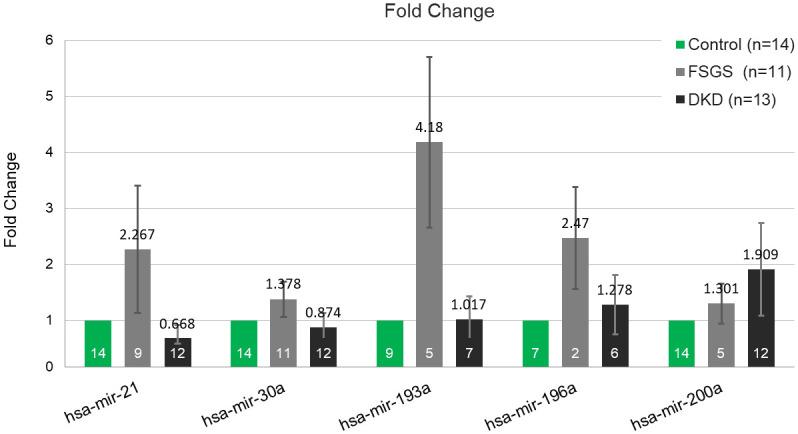
Thirteen DKD patients, 11 FSGS patients, and 14 healthy controls were included in this study. Hsa-mir-21 and hsa-mir-30a exhibited distinct regulation in both groups, with upregulation observed in FSGS and downregulation in DKD (hsa-mir-21 in DKD (0.668 ± 0.25, p < 0.0005) and FSGS (2.267 ± 1.138, p < 0.0077); hsa-mir-30a in DKD (0.874 ± 0.254, p = 0.079) and FSGS (1.378 ± 0.312, p < 0.0006)). Hsa-mir-193a exhibited significant dysregulation in DKD (1.017 ± 0.413, p < 0.029) but not in FSGS (4.18 ± 1.528, p = 0.058). Hsa-mir-196a and hsa-mir-200a showed upregulation in patient groups (hsa-mir-196a in DKD (1.278 ± 0.527, p = 0.074) and FSGS (2.47 ± 0.911, p < 0.0003); hsa-mir-200a in DKD (1.909 ± 0.825, p = 0.082) and FSGS (1.301 ± 0.358, p < 0.008)).
CONCLUSION
Specific miRNAs, particularly miR-21, miR-30a, miR-196a, and miR-200a, might play a role in the pathogenesis of kidney diseases and could potentially serve as biomarkers to distinguish between FSGS and DKD patients.
目的
本研究旨在探讨 microRNAs(miRNAs)在鉴别糖尿病肾病(DKD)患者和局灶节段性肾小球硬化症(FSGS)患者尿液样本中的诊断效用。
方法
在这项多中心、横断面研究中,我们招募了诊断为 DKD 的患者、经活检证实的原发性 FSGS 患者和健康对照者。选择前 5 个 miRNAs(hsa-mir-21、hsa-mir-30a、hsa-mir-193a、hsa-mir-196a、hsa-mir-200a)来定量尿液样本中的 miRNAs。从尿外泌体中分离靶向 miRNAs,并通过 RT-qPCR 测量分离出的 miRNAs 的定量谱。采用 ΔΔCt 法计算疾病和对照样本之间的折叠差异。
结果
本研究纳入了 13 名 DKD 患者、11 名 FSGS 患者和 14 名健康对照者。hsa-mir-21 和 hsa-mir-30a 在两组中均有明显的调节,FSGS 中上调,DKD 中下调(hsa-mir-21 在 DKD 中为 0.668 ± 0.25,p < 0.0005;FSGS 中为 2.267 ± 1.138,p < 0.0077;hsa-mir-30a 在 DKD 中为 0.874 ± 0.254,p = 0.079;FSGS 中为 1.378 ± 0.312,p < 0.0006)。hsa-mir-193a 在 DKD 中表现出显著的失调(1.017 ± 0.413,p < 0.029),但在 FSGS 中没有失调(4.18 ± 1.528,p = 0.058)。hsa-mir-196a 和 hsa-mir-200a 在患者组中均上调(hsa-mir-196a 在 DKD 中为 1.278 ± 0.527,p = 0.074;FSGS 中为 2.47 ± 0.911,p < 0.0003;hsa-mir-200a 在 DKD 中为 1.909 ± 0.825,p = 0.082;FSGS 中为 1.301 ± 0.358,p < 0.008)。
结论
特定的 miRNAs,特别是 miR-21、miR-30a、miR-196a 和 miR-200a,可能在肾脏疾病的发病机制中发挥作用,并可能作为区分 FSGS 和 DKD 患者的生物标志物。

 Zotero 插件