
腹腔镜修补结肠造口旁疝和回肠造口旁疝后的手术结果:一项对比研究。
Surgical Outcomes after Laparoscopic Repairs of Para-colostomy Hernia and Para-ileal-conduit Hernia: A Comparative Study.
作者信息
Suwa Katsuhito, Ushigome Takuro, Enomoto Hiroya, Kitagawa Takahiro, Chikaraishi Kentaro, Okamoto Tomoyoshi, Eto Ken
机构信息
Department of Surgery, The Jikei University Daisan Hospital, Tokyo, Japan.
Department of Surgery, The Jikei University Hospital, Tokyo, Japan.
出版信息
J Anus Rectum Colon. 2024 Oct 25;8(4):340-347. doi: 10.23922/jarc.2024-059. eCollection 2024.
OBJECTIVES
The aim of the study was to investigate the differences in clinical characteristics and surgical outcomes between para-colostomy hernia (PCH) and para-ileal-conduit hernia (PICH) after laparoscopic repairs.
METHODS
We retrospectively analyzed data from 41 laparoscopic parastomal hernia repairs performed at the Jikei University Daisan Hospital between June 2012 and September 2023. The data were divided into PCH (n=31) and PICH (n=10) groups and compared.
RESULTS
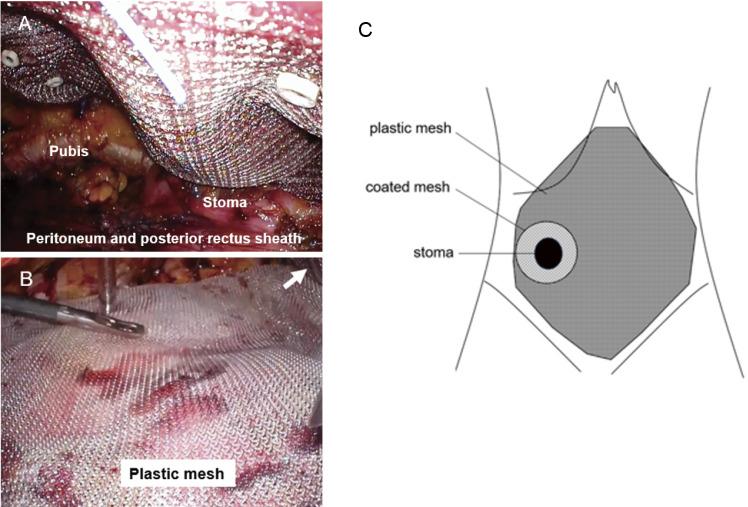
The comparison of patient backgrounds and hernia characteristics showed no significant differences between PCH and PICH groups. Surgical procedures included laparoscopic Sugarbaker repair (LSB) for PCH (29 cases) and PICH (8 cases), and endoscopic Pauli repair (ePauli) for both PCH (2 cases) and PICH (2 cases). Intraoperative findings indicated a significantly higher rate of severe intra-abdominal adhesions (Zühlke index III/IV) in the PICH group (60%) compared to the PCH group (23%) (p=0.0485). The median operation time was significantly longer for PICH (223 [120-423] minutes) than for PCH (158 [48-386] minutes) (p=0.0467). Perioperative complications occurred in 1 PCH case (3%) and 2 PICH cases (20%), with no significant difference in postoperative hospital stay (9 [4-19] vs. 9 [6-14] days). With the follow-up period of 57 [2-110] months for PCH and 52 [20-104] months for PICH, recurrence was observed in 4 PCH cases (12%) but not statistically significant.
CONCLUSIONS
The comparison of PCH and PICH suggests that PICH is associated with more severe intra-abdominal adhesions and longer operation times, indicating higher operative difficulty. Therefore, it would be advisable to discuss the surgical outcomes of repair for these stomas separately.
目的
本研究旨在调查腹腔镜修补术后结肠造口旁疝(PCH)和回肠造口旁疝(PICH)的临床特征及手术结果差异。
方法
我们回顾性分析了2012年6月至2023年9月在日本庆应义塾大学第三医院进行的41例腹腔镜造口旁疝修补术的数据。数据分为PCH组(n = 31)和PICH组(n = 10)并进行比较。
结果
患者背景和疝特征比较显示,PCH组和PICH组之间无显著差异。手术方式包括用于PCH(29例)和PICH(8例)的腹腔镜Sugarbaker修补术(LSB),以及用于PCH(2例)和PICH(2例)的内镜Pauli修补术(ePauli)。术中发现,PICH组(60%)严重腹腔内粘连(Zühlke指数III/IV)发生率显著高于PCH组(23%)(p = 0.0485)。PICH组的中位手术时间(223 [120 - 423]分钟)显著长于PCH组(158 [48 - 386]分钟)(p = 0.0467)。围手术期并发症在1例PCH患者(3%)和2例PICH患者(20%)中发生,术后住院时间无显著差异(9 [4 - 19]天对9 [6 - 14]天)。PCH的随访期为57 [2 - 110]个月,PICH为52 [20 - 104]个月,4例PCH患者(12%)出现复发,但无统计学意义。
结论
PCH和PICH的比较表明,PICH与更严重的腹腔内粘连和更长的手术时间相关,提示手术难度更高。因此,分别讨论这些造口修补术的手术结果是可取的。

 Zotero 插件