
代谢产物增强氧化应激,使耐抗生素的细菌对氟喹诺酮类药物敏感。
Metabolites augment oxidative stress to sensitize antibiotic-tolerant to fluoroquinolones.
作者信息
Batchelder Jonathan I, Taylor Andrew J, Mok Wendy W K
机构信息
Department of Molecular Biology and Biophysics, UConn Health, Farmington, Connecticut, USA.
Department of Biomedical Engineering, Boston University, Boston, Massachusetts, USA.
出版信息
mBio. 2024 Dec 11;15(12):e0271424. doi: 10.1128/mbio.02714-24. Epub 2024 Oct 30.
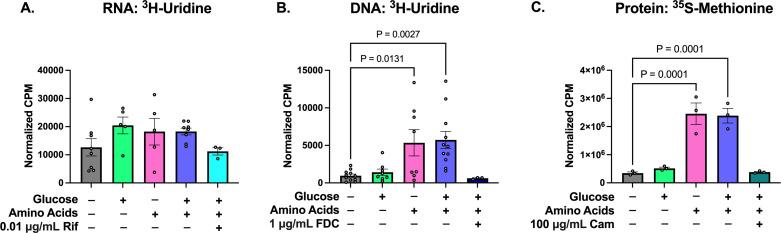
If left unchecked, infections involving antibiotic-refractory bacteria are expected to cause millions of deaths per year in the coming decades. Beyond genetically resistant bacteria, persisters, which are genetically susceptible cells that survive antibiotic doses that kill the rest of the clonal population, can potentially contribute to treatment failure and infection relapse. Stationary-phase bacterial cultures are enriched with persisters, and it has been shown that stimulating these populations with exogenous nutrients can reduce persistence to different classes of antibiotics, including topoisomerase-targeting fluoroquinolones (FQs). In this study, we show that adding glucose and amino acids to nutrient-starved cultures enhanced their sensitivity to FQs, including delafloxacin (Dela)-a drug that was recently approved for treating staphylococcal infections. We found that while the added nutrients increased nucleic acid synthesis, this increase was not required to sensitize to FQs. We further demonstrate that addition of these nutrients increases membrane potential and the ability to generate harmful reactive oxygen species (ROS) during FQ treatment. Chelating iron, scavenging hydroxyl radicals, and limiting oxygenation during FQ treatment and during recovery following FQ treatment rescued nutrient-stimulated . In all, our data suggest that while nutrient stimulation increases the activity of FQ targets in stationary-phase , the resulting generation of ROS, presumably made possible through metabolic upregulation, is the primary driver of increased sensitivity to these drugs.IMPORTANCE causes many chronic and relapsing infections because of its ability to endure host immunity and antibiotic therapy. While several studies have focused on the nutrient requirements for the formation and maintenance of staphylococcal infections, the effects of the nutrient environment on bacterial responses to antibiotic treatment remain understudied. Here, we show that adding nutrients to starved activates biosynthetic processes, including DNA synthesis, but it is the generation of harmful reactive oxidants that sensitizes to DNA topoisomerase-targeting FQs. Our results suggest that the development of approaches aimed at perturbing metabolism and increasing oxidative stress can potentiate the bactericidal activity of FQs against antibiotic-tolerant .
如果不加以控制,涉及抗生素难治性细菌的感染预计在未来几十年每年将导致数百万人死亡。除了具有基因抗性的细菌外,持留菌(persisters)是指在能杀死其余克隆群体的抗生素剂量下存活的基因敏感细胞,它们可能导致治疗失败和感染复发。稳定期细菌培养物中富含持留菌,并且已经表明用外源营养物质刺激这些群体可以降低对不同类抗生素的耐受性,包括靶向拓扑异构酶的氟喹诺酮类药物(FQs)。在本研究中,我们表明向营养饥饿的培养物中添加葡萄糖和氨基酸可增强它们对FQs的敏感性,包括地拉氟沙星(Dela)——一种最近被批准用于治疗葡萄球菌感染的药物。我们发现,虽然添加的营养物质增加了核酸合成,但这种增加对于对FQs敏感并非必需。我们进一步证明,添加这些营养物质会增加膜电位以及在FQ治疗期间产生活性有害氧物种(ROS)的能力。在FQ治疗期间以及FQ治疗后的恢复过程中螯合铁、清除羟基自由基和限制氧合作用可挽救营养刺激的……总之,我们的数据表明,虽然营养刺激会增加稳定期FQ靶点的活性,但由此产生的ROS生成(可能通过代谢上调而成为可能)是对这些药物敏感性增加的主要驱动因素。重要性由于其耐受宿主免疫和抗生素治疗的能力,……导致许多慢性和复发性感染。虽然有几项研究集中在葡萄球菌感染形成和维持的营养需求上,但营养环境对细菌对抗生素治疗反应的影响仍未得到充分研究。在这里,我们表明向饥饿的……添加营养物质会激活生物合成过程,包括DNA合成,但正是有害活性氧化剂的生成使……对靶向DNA拓扑异构酶的FQs敏感。我们的结果表明,旨在干扰代谢和增加氧化应激的方法的开发可以增强FQs对耐抗生素……的杀菌活性。




 Zotero 插件