
通过创造力“揭开疼痛的面纱”:对慢性疼痛患者进行以人为中心的疼痛探索的现象学研究。
'Unmasking Pain' through creativity: A phenomenological study of person-centred pain exploration for people living with chronic pain.
机构信息
Centre for Pain Research, School of Health, Portland Building, Leeds Beckett University, Leeds, United Kingdom.
出版信息
PLoS One. 2024 Oct 30;19(10):e0312014. doi: 10.1371/journal.pone.0312014. eCollection 2024.
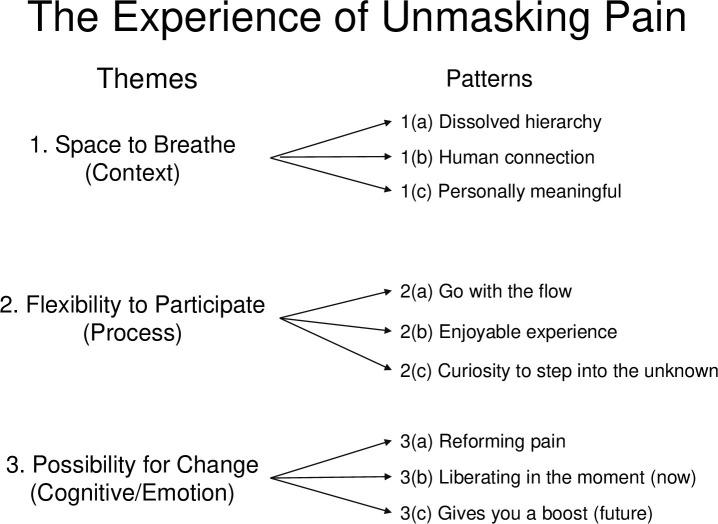
'Unmasking Pain' is an innovative artist-led project to explore creative approaches for telling stories of life with persistent pain. The purpose of this qualitative study was to explore and describe the lived experience of taking part in 'Unmasking Pain' from the perspectives of people living with pain (workshop attendees), artists (workshop facilitators) and pain rehabilitation specialists. Informed by descriptive phenomenology, data was collected via semi-structured interviews with three artists (workshop facilitators), five workshop attendees (all living with persistent pain) and one pain rehabilitation specialist. Data was analysed using thematic analysis for descriptive phenomenology. Three themes emerged from the analysis: Theme 1 Space to Breathe, reflects the context of 'Unmasking Pain' such as the conditions, environment and setting that people experienced; Theme 2 Flexibility to Participate, reflects the experience of the process of 'Unmasking Pain' such as the actions or internal workings/behaviours of the experience; and Theme 3 Possibility for Change, reflects the cognitive or emotional experience of 'Unmasking Pain'. There were nine sub-themes: 1(a) Dissolved hierarchy, 1(b) Human connection, and 1(c) Personally meaningful; 2(a) Go with the flow, 2(b) Enjoyable experience, and 2(c) Curiosity to step into the unknown; and 3(a) Reforming pain, 3(b) Liberating in the moment (now), and 3(c) Gives you a boost (future). In conclusion, the uniqueness of 'Unmasking Pain' was to creatively facilitate curiosity and exploration of pain in a non-clinical, sociocultural, humanised context, to enable the possibility of a different pain experience. The findings from this qualitative study exploring the lived experience of taking part in 'Unmasking Pain' demonstrates the power and opportunity of the Arts sector and artist-led activities to support people with chronic pain to have a better pain experience.
《揭开疼痛的面具》是一个由艺术家主导的创新项目,旨在探索以创意方式讲述患有持续性疼痛人群的生活故事。本定性研究的目的是从患有疼痛人群(工作坊参与者)、艺术家(工作坊导师)和疼痛康复专家的角度,探索和描述参与《揭开疼痛的面具》的体验。本研究受描述现象学的启发,通过对三位艺术家(工作坊导师)、五位工作坊参与者(均患有持续性疼痛)和一位疼痛康复专家进行半结构化访谈收集数据。采用描述现象学的主题分析法对数据进行分析。分析产生了三个主题:主题 1:呼吸的空间,反映了《揭开疼痛的面具》的背景,如人们所经历的条件、环境和环境;主题 2:参与的灵活性,反映了《揭开疼痛的面具》的过程体验,如体验的行动或内部运作/行为;主题 3:改变的可能性,反映了《揭开疼痛的面具》的认知或情感体验。有九个次主题:1(a) 消除等级制度,1(b) 人际联系,1(c) 个人意义;2(a) 顺其自然,2(b) 愉快的体验,2(c) 好奇地步入未知领域;3(a) 重塑疼痛,3(b) 当下解放(现在),3(c) 给你动力(未来)。总之,《揭开疼痛的面具》的独特之处在于以非临床、社会文化、人性化的方式创造性地促进对疼痛的好奇心和探索,从而有可能获得不同的疼痛体验。本定性研究探索了参与《揭开疼痛的面具》的体验,结果表明艺术领域和艺术家主导的活动的力量和机会,可支持慢性疼痛患者获得更好的疼痛体验。
 Zotero 插件