
一氧化氮供体可挽救肥胖型阿尔茨海默病模型的代谢和线粒体功能障碍。
Nitric oxide donors rescue metabolic and mitochondrial dysfunction in obese Alzheimer's model.
机构信息
Vascular Metabolism Laboratory, Pennington Biomedical Research Center, Baton Rouge, LA, 70808, USA.
Department of Kinesiology, Louisiana State University, Baton Rouge, LA, USA.
出版信息
Sci Rep. 2024 Oct 30;14(1):26118. doi: 10.1038/s41598-024-75870-8.
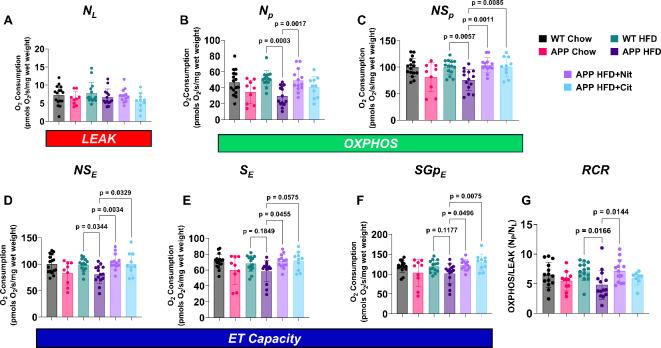
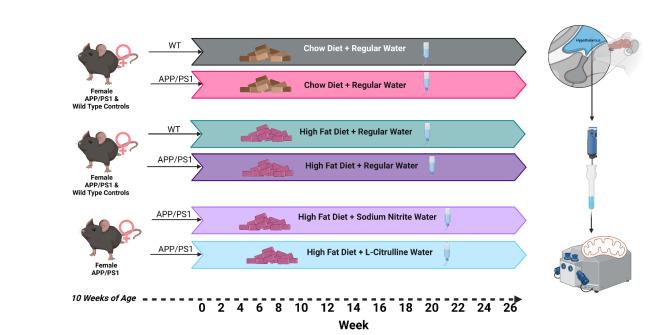
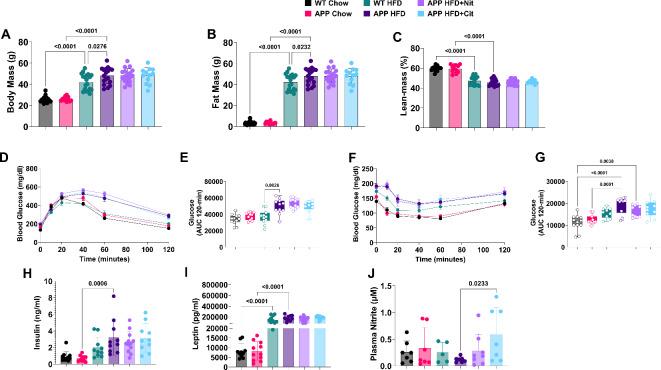
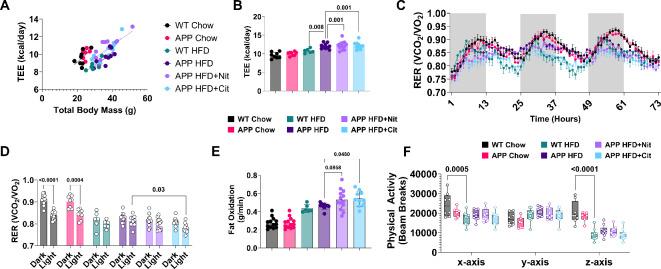
Reduced nitric oxide (NO) bioavailability is a pathological link between obesity and Alzheimer's disease (AD). Obesity-associated metabolic and mitochondrial bioenergetic dysfunction are key drivers of AD pathology. The hypothalamus is a critical brain region during the development of obesity and dysfunction is an area implicated in the development of AD. NO is an essential mediator of blood flow and mitochondrial bioenergetic function, but the role of NO in obesity-AD is not entirely clear. We investigated diet-induced obesity in female APPswe/PS1dE9 (APP) mouse model of AD, which we treated with two different NO donors (sodium nitrite or L-citrulline). After 26 weeks of a high-fat diet, female APP mice had higher adiposity, insulin resistance, and mitochondrial dysfunction (hypothalamus) than non-transgenic littermate (wild type) controls. Treatment with either sodium nitrite or L-citrulline did not reduce adiposity but improved whole-body energy expenditure, substrate oxidation, and insulin sensitivity. Notably, both NO donors restored hypothalamic mitochondrial respiration in APP mice. Our findings suggest that NO is an essential mediator of whole-body metabolism and hypothalamic mitochondrial function, which are severely impacted by the dual insults of obesity and AD pathology.
一氧化氮(NO)生物利用度降低是肥胖症和阿尔茨海默病(AD)之间的病理联系。肥胖相关的代谢和线粒体生物能功能障碍是 AD 病理的关键驱动因素。下丘脑是肥胖症发展过程中的关键脑区,其功能障碍与 AD 的发展有关。NO 是血流和线粒体生物能功能的重要介质,但 NO 在肥胖症-AD 中的作用尚不完全清楚。我们研究了饮食诱导的肥胖症在 APPswe/PS1dE9(APP)雌性 AD 小鼠模型中的作用,并用两种不同的 NO 供体(亚硝酸钠或 L-瓜氨酸)对其进行了治疗。经过 26 周的高脂肪饮食后,雌性 APP 小鼠比非转基因同窝(野生型)对照具有更高的肥胖症、胰岛素抵抗和线粒体功能障碍(下丘脑)。亚硝酸钠或 L-瓜氨酸的治疗并没有减轻肥胖症,但改善了全身能量消耗、底物氧化和胰岛素敏感性。值得注意的是,两种 NO 供体都恢复了 APP 小鼠下丘脑的线粒体呼吸作用。我们的研究结果表明,NO 是全身代谢和下丘脑线粒体功能的重要介质,而肥胖症和 AD 病理的双重影响严重损害了这些功能。
 Zotero 插件