
膳食晚期糖基化终产物(dAGEs)与癌症发病风险无关。一项前瞻性队列研究的系统评价和荟萃分析。
Dietary advanced glycation end-products (dAGEs) are not associated with the risk of cancer incidence. A systematic review and meta-analysis of prospective cohort studies.
作者信息
Sharifi-Zahabi Elham, Soltani Sepideh, Hajizadeh-Sharafabad Fatemeh, Abdollahzad Hadi
机构信息
Student Research Committee Kermanshah University of Medical Sciences Kermanshah Iran.
Yazd Cardiovascular Research Center, Noncommunicable Diseases Research Institute Shahid Sadoughi University of Medical Sciences Yazd Iran.
出版信息
Food Sci Nutr. 2024 Aug 11;12(10):7788-7797. doi: 10.1002/fsn3.4396. eCollection 2024 Oct.
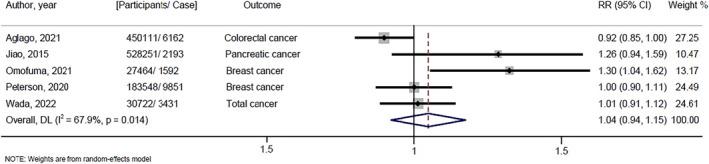
A growing body of evidence indicates the association of dietary advanced glycation end-products (dAGEs) with the risk of cancer. This systematic review and meta-analysis aimed to assess the overall association between dAGEs and cancer incidence. An extensive search was carried out through online databases including PubMed, Scopus, and Web of Science up to June 2024. All reported HRs and their 95% CIs for risk of cancer were used to estimate log HRs and their standard errors (SEs). The overall risk estimate was obtained using a random effects model. Inter-study heterogeneity was determined using Cochrane's test and -squared. Five prospective cohort studies with a total of 1,220,096 participants and 23,229 incident cancer cases (2193 pancreatic cancers, 11,443 breast cancers, 6162 colorectal cancers, and 3431 total cancers) were included in this meta-analysis. Compared with the lowest category of dAGEs, the pooled hazard ratio (HR) for overall cancers was 1.04 (95% CI: 0.94, 1.15; = 67.9%) for the highest category of dAGEs. Pooled estimates for different types of cancer showed no significant relationship between dAGEs and risk of breast cancer (HR: 1.119; 95% CI: 0.868, 1.444; = 77.6%; = 2 studies), pancreatic cancer (HR: 1.242; 95% CI: 0.971, 1.588; = 0.0%; = 2 studies), colon cancer (HR: 10.985; 95% CI: 0.887, 1.094; = 0.0%; = 2 studies) and rectal cancer (HR: 0.940; 95% CI: 0.616, 1.433; = 57.7%; = 2 studies). Dietary AGEs had no significant link with cancer risk. More well-designed prospective studies are required.
越来越多的证据表明,膳食晚期糖基化终产物(dAGEs)与癌症风险之间存在关联。本系统评价和荟萃分析旨在评估dAGEs与癌症发病率之间的总体关联。截至2024年6月,通过包括PubMed、Scopus和Web of Science在内的在线数据库进行了广泛检索。所有报告的癌症风险的HR及其95%CI用于估计对数HR及其标准误(SE)。使用随机效应模型获得总体风险估计值。使用Cochrane检验和I²来确定研究间的异质性。本荟萃分析纳入了五项前瞻性队列研究,共有1220096名参与者和23229例新发癌症病例(2193例胰腺癌、11443例乳腺癌、6162例结直肠癌和3431例所有癌症)。与dAGEs最低类别相比,dAGEs最高类别总体癌症的合并风险比(HR)为1.04(95%CI:0.94,1.15;I² = 67.9%)。不同类型癌症的合并估计显示,dAGEs与乳腺癌风险(HR:1.119;95%CI:0.868,1.444;I² = 77.6%;n = 2项研究)、胰腺癌风险(HR:1.242;95%CI:0.971,1.588;I² = 0.0%;n = 2项研究)、结肠癌风险(HR:1.0985;95%CI:0.887,1.094;I² = 0.0%;n = 2项研究)和直肠癌风险(HR:0.940;95%CI:0.616,1.433;I² = 57.7%;n = 2项研究)之间均无显著关系。膳食AGEs与癌症风险无显著关联。需要更多设计良好的前瞻性研究。

 Zotero 插件