
膳食中晚期糖基化终产物(AGEs)的摄入量与结直肠癌患者的死亡率。
Dietary Intake of Advanced Glycation End Products (AGEs) and Mortality among Individuals with Colorectal Cancer.
机构信息
Department of Epidemiology, Rollins School of Public Health, Emory University, Atlanta, GA 30322, USA.
Department of Epidemiology, Graduate School of Public Health, University of Pittsburgh, Pittsburgh, PA 15261, USA.
出版信息
Nutrients. 2021 Dec 10;13(12):4435. doi: 10.3390/nu13124435.
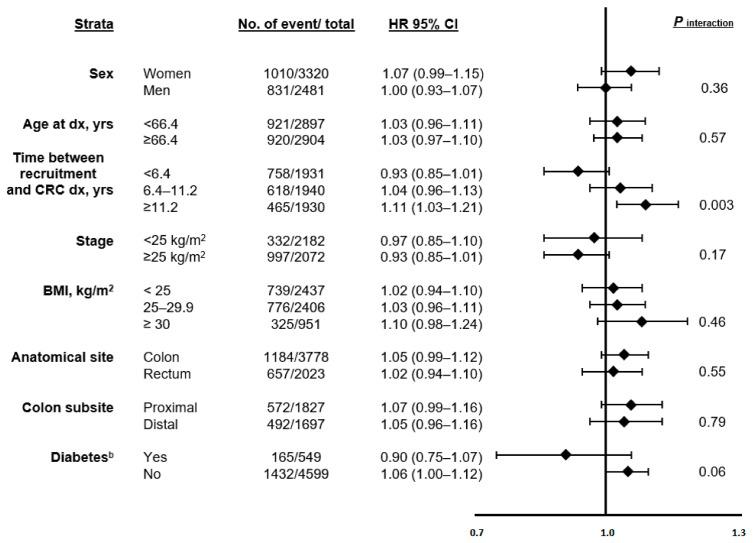
Advanced glycation end-products (AGEs) may promote oxidative stress and inflammation and have been linked to multiple chronic diseases, including cancer. However, the association of AGEs with mortality after colorectal cancer (CRC) diagnosis has not been previously investigated. Multivariable Cox proportional hazards models were used to calculate hazard ratios and corresponding 95% confidence intervals for associations between dietary intake of AGEs with CRC-specific and all-cause mortality among 5801 participant cases diagnosed with CRC in the European Prospective Investigation into Cancer and Nutrition study between 1993 and 2013. Dietary intakes of AGEs were estimated using country-specific dietary questionnaires, linked to an AGE database, that accounted for food preparation and processing. During a median of 58 months of follow-up, 2421 cases died (1841 from CRC). Individually or combined, dietary intakes of AGEs were not associated with all-cause and CRC-specific mortality among cases. However, there was a suggestion for a positive association between AGEs and all-cause or CRC-specific mortality among CRC cases without type II diabetes (all-cause, = 0.05) and CRC cases with the longest follow-up between recruitment and cancer diagnosis (CRC-specific, = 0.003; all-cause, = 0.01). Our study suggests that pre-diagnostic dietary intakes of AGEs were not associated with CRC-specific or all-cause mortality among CRC patients. Further investigations using biomarkers of AGEs and stratifying by sex, diabetes status, and timing of exposure to AGEs are warranted.
晚期糖基化终产物(AGEs)可能促进氧化应激和炎症,并与多种慢性疾病有关,包括癌症。然而,AGEs 与结直肠癌(CRC)诊断后死亡率之间的关系尚未被研究过。多变量 Cox 比例风险模型用于计算 AGEs 饮食摄入量与欧洲癌症前瞻性调查和营养研究中 5801 例 CRC 患者的 CRC 特异性和全因死亡率之间的关联的风险比和相应的 95%置信区间,这些患者在 1993 年至 2013 年期间被诊断出患有 CRC。使用特定国家的饮食问卷估计 AGEs 的饮食摄入量,这些问卷与 AGE 数据库相关联,该数据库考虑了食物准备和加工。在中位数为 58 个月的随访期间,有 2421 例病例死亡(1841 例死于 CRC)。单独或联合使用时,AGEs 的饮食摄入量与病例的全因和 CRC 特异性死亡率无关。然而,在没有 2 型糖尿病的 CRC 病例中(全因, = 0.05)和在招募和癌症诊断之间随访时间最长的 CRC 病例中(CRC 特异性, = 0.003;全因, = 0.01),AGEs 与全因或 CRC 特异性死亡率之间存在正相关的迹象。我们的研究表明,CRC 患者的预诊断饮食 AGEs 摄入量与 CRC 特异性或全因死亡率无关。使用 AGEs 的生物标志物并按性别、糖尿病状态和接触 AGEs 的时间进行分层进行进一步研究是必要的。
 Zotero 插件