
重症新型冠状病毒肺炎(COVID-19)感染患者中碳青霉烯酶产生肠杆菌科细菌(CPE)的出现及重症监护室中的成功控制
Emergence of carbapenemase-producing Enterobacterales (CPE) in patients with severe COVID-19 infection and successful control in intensive care.
作者信息
Longhitano Anthony, Campbell Duncan, Mothobi Nomvuyo, McKenzie Alison, Bartolo Caroline, Saha Sajal, Sherry Norelle, Athan Eugene
机构信息
Department of Infectious Diseases, Barwon Health, Geelong, VI, Australia.
Department of Microbiology, Australian Clinical Labs, Geelong, VI, Australia.
出版信息
Antimicrob Steward Healthc Epidemiol. 2024 Oct 31;4(1):e191. doi: 10.1017/ash.2024.373. eCollection 2024.
OBJECTIVE
We aim to highlight the risks of acquiring carbapenemase-producing Enterobacterales (CPE) resistance genes in patients with severe coronavirus disease 2019 (COVID-19) in intensive care.
DESIGN
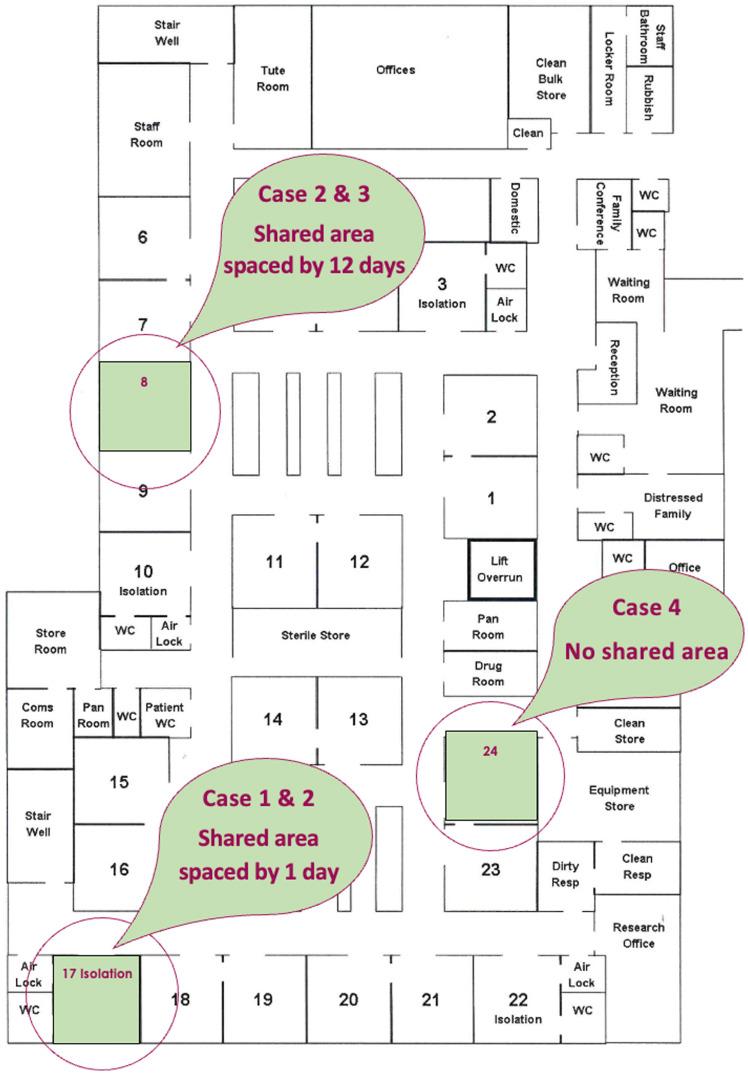
Outbreak analysis to assess for a transmission risk area (TRA) conducted after identification of potential CPE outbreak within shared room spaces in intensive care.
SETTING
Analysis conducted within a 24-bed single-room model intensive-care department within a level-3 tertiary center public hospital in regional Victoria, Australia.
PATIENTS
3 patients, with severe COVID-19 admitted to intensive care over a 3-month period with shared room spaces requiring prolonged mechanical ventilation and broad-spectrum antimicrobials, identified and were managed for CPE isolated from sputum. Overlap carbapenemase genes were identified among different organisms raising suspicion of transmitted resistance genes. A subsequent case managed for severe community-acquired pneumonia isolated CPE 3 months beyond these cases.
METHODS
Outbreak analysis via weekly cross-sectional point prevalence screening of fecal samples or rectal swabs for CPE from patients admitted to the intensive-care department over a 4-week period.
RESULTS
34 patients were included in the analysis with 51 tests for CPE screening conducted. No further cases of CPE were identified. Statewide Infection Surveillance team and the Department of Health and Human Services did not find the cases to derive from a TRA. No further action including environmental screening was indicated.
CONCLUSIONS
These cases highlight the independent acquisition of CPE genes in patients with severe COVID-19 and antimicrobial selective pressures resulting in significant morbidity and mortality. Increasing awareness, robust antimicrobial stewardship, and infection prevention measures could reduce pressures driving CPE resistance mutations and the risk of CPE transmission.
目的
我们旨在强调在重症监护病房中患有严重2019冠状病毒病(COVID-19)的患者获得产碳青霉烯酶肠杆菌科细菌(CPE)耐药基因的风险。
设计
在重症监护病房共享空间内确定潜在的CPE暴发后,进行暴发分析以评估传播风险区域(TRA)。
地点
在澳大利亚维多利亚州地区的一家三级中心公立医院的一个拥有24张单人床的重症监护病房内进行分析。
患者
3例患有严重COVID-19的患者在3个月内入住重症监护病房,他们共享病房空间,需要长时间机械通气和使用广谱抗菌药物,从痰液中分离出CPE并进行鉴定和管理。在不同生物体中鉴定出重叠的碳青霉烯酶基因,这引发了对传播耐药基因的怀疑。在这些病例之后3个月,一名因严重社区获得性肺炎接受治疗的后续病例也分离出了CPE。
方法
通过对重症监护病房入院患者的粪便样本或直肠拭子进行为期4周的每周横断面现患率筛查,以检测CPE,从而进行暴发分析。
结果
34例患者纳入分析,共进行了51次CPE筛查检测。未发现更多CPE病例。全州感染监测团队以及卫生与公众服务部未发现这些病例源自传播风险区域。未指示采取包括环境筛查在内的进一步行动。
结论
这些病例凸显了严重COVID-19患者独立获得CPE基因以及抗菌药物选择性压力导致的显著发病率和死亡率。提高认识、加强抗菌药物管理以及采取感染预防措施可降低推动CPE耐药突变的压力以及CPE传播风险。

 Zotero 插件