
新型SARS-CoV-2抗病毒药物伊布扎特雷韦对成人COVID-19患者的病毒学反应及安全性
Virologic Response and Safety of Ibuzatrelvir, A Novel SARS-CoV-2 Antiviral, in Adults With COVID-19.
作者信息
Mortezavi Mahta, Sloan Abigail, Singh Ravi Shankar P, Chen Luke F, Kim Jin Hyang, Shojaee Negin, Toussi Sima S, Prybylski John, Baniecki Mary Lynn, Bergman Arthur, Banerjee Anindita, Allerton Charlotte, Alami Negar Niki
机构信息
Pfizer Research and Development, Pfizer Inc, New York, New York, USA.
Pfizer Research and Development, Pfizer Inc, Cambridge, Massachusetts, USA.
出版信息
Clin Infect Dis. 2025 Mar 17;80(3):673-680. doi: 10.1093/cid/ciae529.
BACKGROUND
Despite effective vaccines and treatments for COVID-19, clinical burden persists. An unmet need exists for additional effective agents with safety profiles allowing use across a broad population. Ibuzatrelvir is an orally bioavailable SARS-CoV-2 Mpro inhibitor with demonstrated in vitro antiviral activity and low potential for safety concerns, including drug-drug interactions.
METHODS
This phase 2b, double-blind, randomized clinical trial enrolled US adults aged 18 to <65 years with symptomatic COVID-19 and no risk factors for severe disease. Participants were randomized 1:1:2:2 to receive 100, 300, or 600 mg ibuzatrelvir or placebo orally twice daily for 5 days. Nasopharyngeal specimens were collected on days 1 (baseline), 3, 5, 10, 14, and 21; adverse events (AEs) were recorded through day 33. The primary end point was change in SARS-CoV-2 RNA level (viral load [VL]) from baseline to day 5 among participants with baseline VL ≥4 log10 copies/mL.
RESULTS
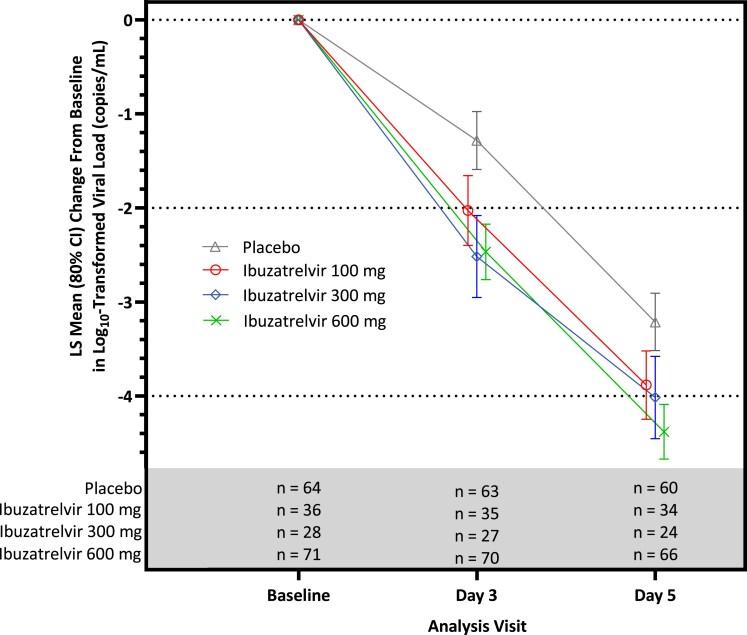
Of 240 enrollees, 237 received ≥1 dose; 199 were included in the primary analysis. Placebo-adjusted least squares mean (80% confidence interval) change from baseline in VL (log10 copies/mL) at day 5 was significant across all doses: 100 mg, ‒0.7 (‒1.1 to ‒0.3) log10 copies/mL, P = .02; 300 mg, ‒0.8 (‒1.3 to ‒0.3), P = .01; and 600 mg, ‒1.2 (‒1.5 to ‒0.8), P < .0001. AEs occurred in similar percentages of participants across groups. No deaths from any cause or treatment-related serious AEs occurred through day 33, and no participants reported dysgeusia.
CONCLUSIONS
All 3 ibuzatrelvir doses were associated with robust antiviral activity and an acceptable safety profile, supporting continued clinical development.
CLINICAL TRIALS REGISTRATION
NCT05799495.
背景
尽管有针对新冠病毒病(COVID-19)的有效疫苗和治疗方法,但临床负担依然存在。对于具有可在广泛人群中使用的安全性特征的其他有效药物仍存在未满足的需求。依布扎特雷韦是一种口服生物利用度良好的严重急性呼吸综合征冠状病毒2(SARS-CoV-2)主蛋白酶(Mpro)抑制剂,已证明具有体外抗病毒活性,且安全性问题(包括药物相互作用)的可能性较低。
方法
这项2b期双盲随机临床试验纳入了年龄在18至<65岁、患有症状性COVID-19且无重症风险因素的美国成年人。参与者按1:1:2:2随机分组,每天口服两次100、300或600毫克依布扎特雷韦或安慰剂,持续5天。在第1天(基线)、第3天、第5天、第10天、第14天和第21天采集鼻咽标本;记录至第33天的不良事件(AE)。主要终点是基线病毒载量(VL)≥4 log10拷贝/毫升的参与者从基线到第5天的SARS-CoV-2 RNA水平(病毒载量[VL])变化。
结果
在240名入组者中,237人接受了≥1剂治疗;199人纳入主要分析。在所有剂量组中,第5天VL相对于基线的安慰剂调整最小二乘均值(80%置信区间)变化(log10拷贝/毫升)均有统计学意义:100毫克组为-0.7(-1.1至-0.3)log10拷贝/毫升,P = 0.02;300毫克组为-0.8(-1.3至-0.3),P = 0.01;600毫克组为-1.2(-1.5至-0.8),P < 0.0001。各组中发生AE的参与者百分比相似。至第33天,未发生任何原因导致的死亡或与治疗相关的严重AE,也没有参与者报告味觉障碍。
结论
依布扎特雷韦的所有3个剂量均具有强大的抗病毒活性和可接受的安全性特征,支持继续进行临床开发。
临床试验注册
NCT05799495。

 Zotero 插件