
专注于外泌体以克服CAR-T细胞疗法现有的瓶颈。
Focusing on exosomes to overcome the existing bottlenecks of CAR-T cell therapy.
作者信息
Zhang Si-Heng, Peng Ling-Long, Chen Yi-Fei, Xu Yan, Moradi Vahid
机构信息
Faculty of Medicine, Macau University of Science and Technology, Taipa, Macao SAR, 999078, China.
Zhejiang Provincial Center for Disease Control and Prevention, Hangzhou, Zhejiang, 310000, China.
出版信息
Inflamm Regen. 2024 Nov 4;44(1):45. doi: 10.1186/s41232-024-00358-x.
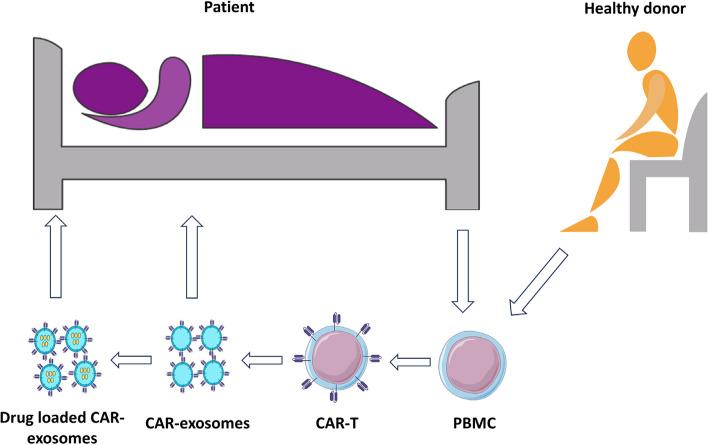
Since chimeric antigen receptor T (CAR-T) cells were introduced three decades ago, the treatment using these cells has led to outstanding outcomes, and at the moment, CAR-T cell therapy is a well-established mainstay for treating CD19 + malignancies and multiple myeloma. Despite the astonishing results of CAR-T cell therapy in B-cell-derived malignancies, several bottlenecks must be overcome to promote its safety and efficacy and broaden its applicability. These bottlenecks include cumbersome production process, safety concerns of viral vectors, poor efficacy in treating solid tumors, life-threatening side effects, and dysfunctionality of infused CAR-T cells over time. Exosomes are nano-sized vesicles that are secreted by all living cells and play an essential role in cellular crosstalk by bridging between cells. In this review, we discuss how the existing bottlenecks of CAR-T cell therapy can be overcome by focusing on exosomes. First, we delve into the effect of tumor-derived exosomes on the CAR-T cell function and discuss how inhibiting their secretion can enhance the efficacy of CAR-T cell therapy. Afterward, the application of exosomes to the manufacturing of CAR-T cells in a non-viral approach is discussed. We also review the latest advancements in ex vivo activation and cultivation of CAR-T cells using exosomes, as well as the potential of engineered exosomes to in vivo induction or boost the in vivo proliferation of CAR-T cells. Finally, we discuss how CAR-engineered exosomes can be used as a versatile tool for the direct killing of tumor cells or delivering intended therapeutic payloads in a targeted manner.
自从嵌合抗原受体T(CAR-T)细胞在三十年前被引入以来,使用这些细胞进行的治疗已取得了显著成果,目前,CAR-T细胞疗法是治疗CD19 +恶性肿瘤和多发性骨髓瘤的成熟支柱疗法。尽管CAR-T细胞疗法在B细胞来源的恶性肿瘤中取得了惊人的效果,但要提高其安全性和疗效并扩大其适用性,仍有几个瓶颈需要克服。这些瓶颈包括繁琐的生产过程、病毒载体的安全性问题、治疗实体瘤的疗效不佳、危及生命的副作用以及随着时间推移注入的CAR-T细胞功能失调。外泌体是由所有活细胞分泌的纳米级囊泡,通过在细胞间架起桥梁,在细胞间通讯中发挥着重要作用。在这篇综述中,我们讨论了如何通过关注外泌体来克服CAR-T细胞疗法现有的瓶颈。首先,我们深入探讨肿瘤来源的外泌体对CAR-T细胞功能的影响,并讨论抑制其分泌如何提高CAR-T细胞疗法的疗效。随后,我们讨论了外泌体在以非病毒方法制造CAR-T细胞中的应用。我们还回顾了使用外泌体进行CAR-T细胞体外激活和培养的最新进展,以及工程化外泌体在体内诱导或促进CAR-T细胞体内增殖的潜力。最后,我们讨论了CAR工程化外泌体如何作为一种通用工具直接杀伤肿瘤细胞或以靶向方式递送预期的治疗有效载荷。


 Zotero 插件