
采用经验采样法问卷揭示晚期癌症患者的日常生活体验:开发、内容验证和优化研究。
Uncovering the Daily Experiences of People Living With Advanced Cancer Using an Experience Sampling Method Questionnaire: Development, Content Validation, and Optimization Study.
机构信息
End-of-Life Care Research Group, Vrije Universiteit Brussel, Brussels, Belgium.
Department of Medical Oncology, Universitair Ziekenhuis Gent, Ghent, Belgium.
出版信息
JMIR Cancer. 2024 Nov 5;10:e57510. doi: 10.2196/57510.
BACKGROUND
The experience sampling method (ESM), a self-report method that typically uses multiple assessments per day, can provide detailed knowledge of the daily experiences of people with cancer, potentially informing oncological care. The use of the ESM among people with advanced cancer is limited, and no validated ESM questionnaires have been developed specifically for oncology.
OBJECTIVE
This study aims to develop, content validate, and optimize the digital Experience Sampling Method for People Living With Advanced Cancer (ESM-AC) questionnaire, covering multidimensional domains and contextual factors.
METHODS
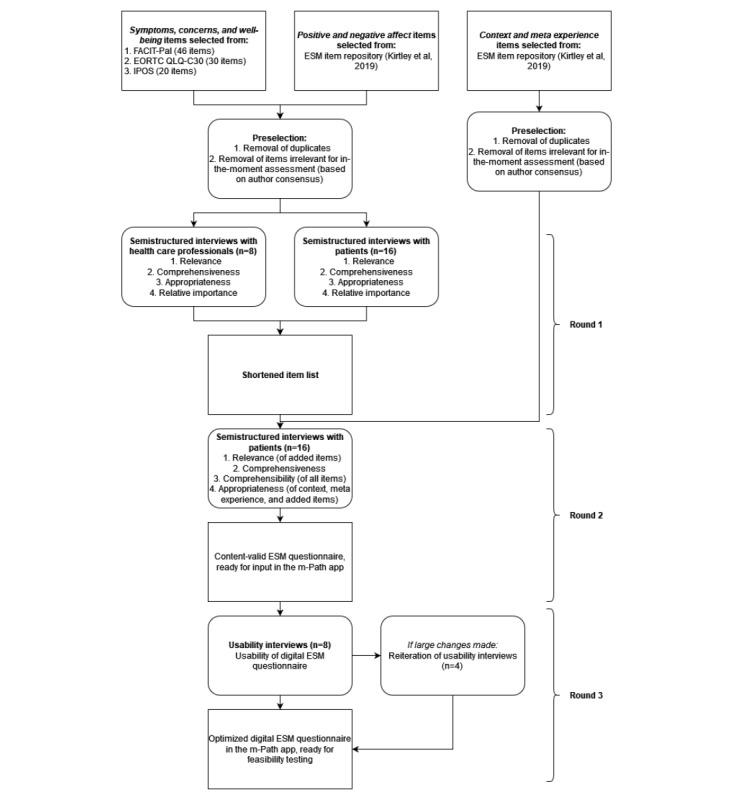
A 3-round mixed methods study was designed in accordance with the Consensus-Based Standards for the Selection of Health Measurement Instruments (COSMIN) and the European Organization for Research and Treatment of Cancer guidelines. The study included semistructured interviews with 43 people with stage IV breast cancer or stage III to IV lung cancer and 8 health care professionals. Round 1 assessed the appropriateness, relative importance, relevance, and comprehensiveness of an initial set of ESM items that were developed based on the existing questionnaires. Round 2 tested the comprehensibility of ESM items. Round 3 tested the usability of the digital ESM-AC questionnaire using the m-Path app. Analyses included descriptive statistics and qualitative content analysis.
RESULTS
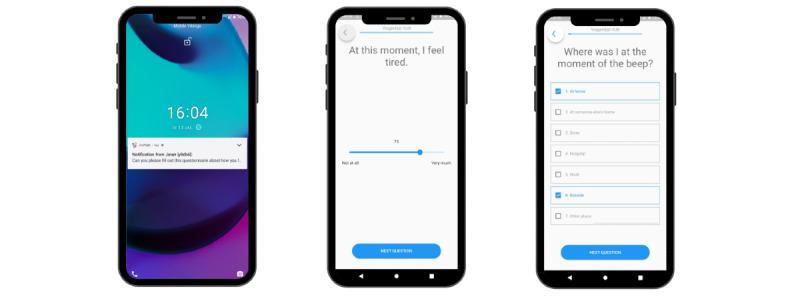
Following the first round, we developed an initial core set of 68 items (to be used with all patients) and a supplementary set (optional; patients select items), both covering physical, psychological, social, spiritual-existential, and global well-being domains and concurrent contexts in which experiences occur. We categorized items to be assessed multiple times per day as momentary items (eg, "At this moment, I feel tired"), once a day in the morning as morning items (eg, "Last night, I slept well"), or once a day in the evening as evening items (eg, "Today, I felt hopeful"). We used participants' evaluations to optimize the questionnaire items, the digital app, and its onboarding manual. This resulted in the ESM-AC questionnaire, which comprised a digital core questionnaire containing 31 momentary items, 2 morning items, and 7 evening items and a supplementary set containing 39 items. Participants largely rated the digital questionnaire as "easy to use," with an average score of 4.5 (SD 0.5) on a scale from 1 ("completely disagree") to 5 ("completely agree").
CONCLUSIONS
We developed the ESM-AC questionnaire, a content-validated digital questionnaire for people with advanced breast or lung cancer. It showed good usability when administered on smartphone devices. Future research should evaluate the potential of this ESM tool to uncover daily experiences of people with advanced breast or lung cancer, explore its clinical utility, and extend its validation to other populations with advanced diseases.
背景
经验采样法(ESM)是一种自我报告方法,通常每天进行多次评估,可以提供癌症患者日常体验的详细信息,从而为肿瘤学护理提供信息。在晚期癌症患者中使用 ESM 的情况有限,并且尚未专门为肿瘤学开发经过验证的 ESM 问卷。
目的
本研究旨在开发、内容验证和优化用于晚期癌症患者的数字式经验采样法(ESM-AC)问卷,涵盖多维领域和情境因素。
方法
本研究按照共识基础的健康测量仪器选择标准(COSMIN)和欧洲癌症研究与治疗组织(EORTC)指南设计了一个 3 轮混合方法研究。研究包括对 43 名患有 IV 期乳腺癌或 III 期至 IV 期肺癌的患者和 8 名卫生保健专业人员进行半结构式访谈。第 1 轮评估了基于现有问卷开发的初始 ESM 项目的适当性、相对重要性、相关性和全面性。第 2 轮测试了 ESM 项目的可理解性。第 3 轮使用 m-Path 应用程序测试了数字 ESM-AC 问卷的可用性。分析包括描述性统计和定性内容分析。
结果
第一轮之后,我们开发了一个包含 68 个项目的初始核心集(用于所有患者)和一个补充集(可选;患者选择项目),这两个集都涵盖了身体、心理、社会、精神-存在和整体幸福感领域以及发生体验的并发环境。我们将需要每天评估多次的项目归类为瞬间项目(例如,“此刻,我感到疲倦”),每天早上评估的项目归类为早晨项目(例如,“昨晚,我睡得很好”),或者每天晚上评估的项目归类为晚上项目(例如,“今天,我感到有希望”)。我们使用参与者的评估来优化问卷项目、数字应用程序及其入门手册。这就产生了 ESM-AC 问卷,其中包含一个包含 31 个瞬间项目、2 个早晨项目和 7 个晚上项目的数字核心问卷,以及一个包含 39 个项目的补充集。参与者普遍对数字问卷的评价为“易于使用”,平均得分为 4.5(标准差 0.5),分值范围为 1(完全不同意)至 5(完全同意)。
结论
我们开发了 ESM-AC 问卷,这是一种针对晚期乳腺癌或肺癌患者的内容验证的数字问卷。当在智能手机设备上使用时,它显示出良好的可用性。未来的研究应评估这种 ESM 工具发现晚期乳腺癌或肺癌患者日常体验的潜力,探讨其临床实用性,并将其验证扩展到其他晚期疾病患者。

 Zotero 插件