
Klotho 蛋白与代谢综合征的相关性受系统性免疫炎症调节:一项大规模基于人群的研究结果。
Systemic immune-inflammation mediates the association between Klotho protein and metabolic syndrome: findings from a large-scale population-based study.
机构信息
Key Laboratory of Birth Defects and Related Diseases of Women and Children, Department of Pediatric Cardiology, West China Second University Hospital, Sichuan University, Chengdu, China.
Department of Pediatric Cardiology, West China Second University Hospital, Sichuan University, Chengdu, 610041, Sichuan, China.
出版信息
Lipids Health Dis. 2024 Nov 5;23(1):360. doi: 10.1186/s12944-024-02339-y.
BACKGROUND
This study utilized large-scale population data from the National Health and Nutrition Examination Survey (NHANES) to elucidate the relationship between the Klotho protein and metabolic syndrome along with its components. We further investigated the possible mediating effect of inflammation on these relationships. Our objective was to identify biomarkers for risk stratification and potential therapeutic targets for metabolic syndrome.
METHODS
This study enrolled 13,119 participants aged 40-79 years, spanning five NHANES cycles from 2007 to 2016, with complete information on metabolic syndrome and the Klotho protein. The definition of metabolic syndrome followed the criteria of the National Cholesterol Education Program-Adult Treatment Panel III. Survey-weighted logistic regression and subgroup analysis were used to explore the associations between serum Klotho protein levels and metabolic syndrome, along with its components. Mediation analysis was performed to investigate the mediating effects of inflammation-related markers, including white blood cells, neutrophils, lymphocytes, monocytes, the neutrophil-to-lymphocyte ratio (NLR), the platelet-to-lymphocyte ratio (PLR), the systemic immune-inflammation index (SII) and the monocyte-to-HDL ratio (MHR), with the aim of elucidating how the Klotho protein influences the onset and progression of metabolic syndrome.
RESULTS
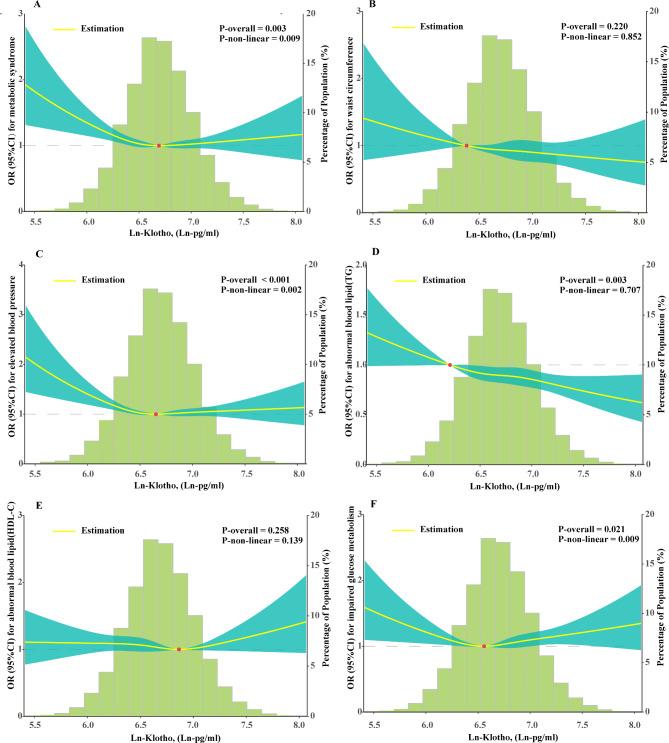
The study participants had an average age of 56.06 years (95% CI: 55.76-56.37), with a Klotho protein concentration of 798.10 pg/ml (95% CI: 656.50-980.50) and a 43.77% prevalence of metabolic syndrome (n = 5742). In the crude model, Klotho was negatively correlated with metabolic syndrome and its components, including central obesity, hypertension, and hypertriglyceridemia. After adjusting for all confounding factors, Klotho was demonstrated to be negatively associated only with metabolic syndrome (OR: 0.82, 95% CI: 0.70-0.97), hypertension (OR: 0.83, 95% CI: 0.70-0.98), and hypertriglyceridemia (OR: 0.78, 95% CI: 0.67-0.91). Subgroup and interaction analyses revealed significant interactions between age, sex, race/ethnicity, body mass index, and Klotho. Additionally, mediation analysis demonstrated that leukocytes, neutrophils and monocytes accounted for 34.78%, 31.91% and 7.13%, respectively, of the associations between Klotho and metabolic syndrome.
CONCLUSION
The serum concentration of Klotho protein was negatively associated with metabolic syndrome, with the relationship being partly mediated by systemic immune inflammation. The findings of this research revealed that the Klotho protein may be a valuable biomarker for risk stratification and a potential therapeutic target for metabolic syndrome.
背景
本研究利用来自国家健康和营养检查调查(NHANES)的大规模人口数据,阐明 Klotho 蛋白与代谢综合征及其成分之间的关系。我们进一步研究了炎症对这些关系的可能中介作用。我们的目标是确定代谢综合征的风险分层生物标志物和潜在治疗靶点。
方法
本研究纳入了 13119 名年龄在 40-79 岁的参与者,涵盖了 2007 年至 2016 年的五个 NHANES 周期,这些参与者的代谢综合征和 Klotho 蛋白信息完整。代谢综合征的定义遵循国家胆固醇教育计划-成人治疗小组 III 的标准。使用调查加权逻辑回归和亚组分析来探讨血清 Klotho 蛋白水平与代谢综合征及其成分之间的关联。进行中介分析以研究炎症相关标志物(包括白细胞、中性粒细胞、淋巴细胞、单核细胞、中性粒细胞与淋巴细胞比值(NLR)、血小板与淋巴细胞比值(PLR)、全身免疫炎症指数(SII)和单核细胞与高密度脂蛋白比值(MHR))在 Klotho 蛋白影响代谢综合征发生和发展中的中介作用,以阐明 Klotho 蛋白如何影响代谢综合征的发生和发展。
结果
研究参与者的平均年龄为 56.06 岁(95%CI:55.76-56.37),Klotho 蛋白浓度为 798.10pg/ml(95%CI:656.50-980.50),代谢综合征的患病率为 43.77%(n=5742)。在未校正模型中,Klotho 与代谢综合征及其成分呈负相关,包括中心性肥胖、高血压和高三酰甘油血症。在调整所有混杂因素后,仅发现 Klotho 与代谢综合征(OR:0.82,95%CI:0.70-0.97)、高血压(OR:0.83,95%CI:0.70-0.98)和高三酰甘油血症(OR:0.78,95%CI:0.67-0.91)呈负相关。亚组和交互分析显示,年龄、性别、种族/民族、体重指数和 Klotho 之间存在显著交互作用。此外,中介分析表明白细胞、中性粒细胞和单核细胞分别占 Klotho 与代谢综合征之间关联的 34.78%、31.91%和 7.13%。
结论
血清 Klotho 蛋白浓度与代谢综合征呈负相关,这种关系部分由全身免疫炎症介导。本研究的结果表明,Klotho 蛋白可能是代谢综合征风险分层的有价值的生物标志物和潜在的治疗靶点。


 Zotero 插件