
应激诱导的皮质醇反应可预测对疼痛的共情:急性应激期间脑岛与感觉运动皮层之间基于任务的连接作用。
Stress-induced cortisol response predicts empathy for pain: The role of task-based connectivity between the insula and sensorimotor cortex during acute stress.
作者信息
Tang Zihan, Liu Yadong, Zhao Xiaolin, Hu Weiyu, Zhang Mengning, Ren Yipeng, Wei Zhenni, Yang Juan
机构信息
Faculty of Psychology, Southwest University, Chongqing, 400715, China.
Key Laboratory of Cognition and Personality, Ministry of Education, Southwest University, Chongqing, 400715, China.
出版信息
Neurobiol Stress. 2024 Oct 18;33:100682. doi: 10.1016/j.ynstr.2024.100682. eCollection 2024 Nov.
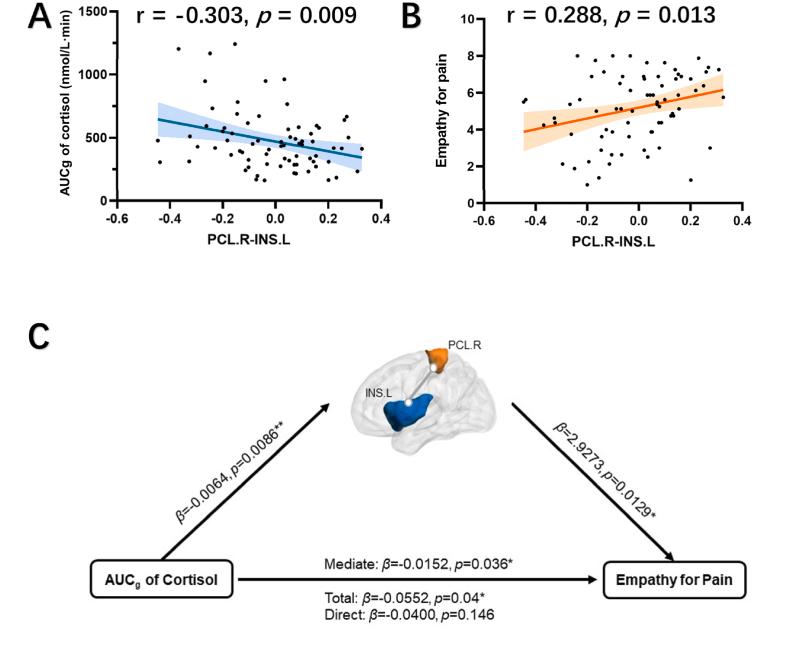
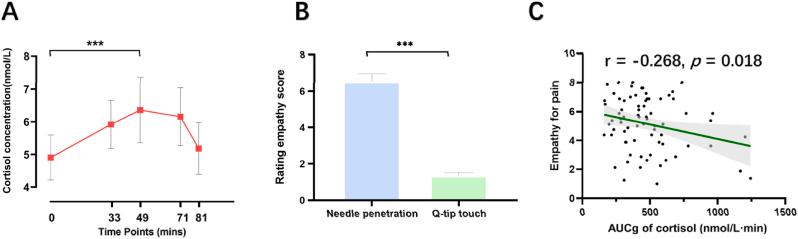
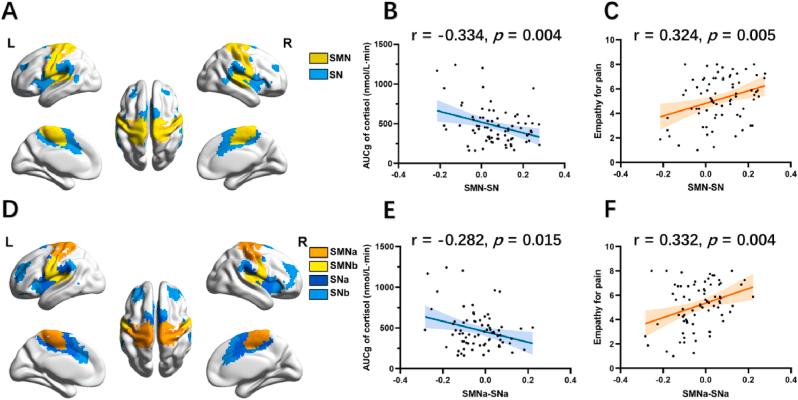
Empathy for pain is a key driver of prosocial behavior and is influenced by acute psychosocial stress. However, the role of task-based brain connectivity during acute stress have been neglected. Hence, we aimed to explore the relationship between the magnitude of cortisol response to acute stress and empathy for pain, as well as the neural connectivity mechanisms involved. In this study, 80 healthy participants (37 women and 43 men) were exposed to the acute psychosocial stress paradigm (ScanSTRESS) and were scanned by functional magnetic resonance imaging. Saliva samples were collected to measure the magnitude of cortisol stress response. Subsequently, the participants took part in a pain-video task to assess their empathy for pain. Six participants were excluded because of physical discomfort or excessive head movement in all runs during the task-dependent fMRI scan. Therefore, 33 women and 41 men were included in data analysis. We found that empathy for pain was negatively correlated with the magnitude of cortisol stress response ( = -0.268, = 0.018) and that the task-based connectivity between the salience network and sensorimotor network, including its sub-network and sub-region, was negatively correlated with the magnitude of cortisol stress response, and positively correlated with empathy for pain. Furthermore, task-based connectivity between the insula and the paracentral lobule mediates the effect of the stress-induced cortisol response on empathy for pain (indirect effect = -0.0152, 95% CI = [-0.036, -0.001], = 0.036). Our research suggests that empathy is not only correlated with stress-induced glucocorticoids but also tied to the stress-induced reduced communication between basic and higher brain regions.
对疼痛的同理心是亲社会行为的关键驱动因素,且受急性心理社会压力的影响。然而,急性应激期间基于任务的大脑连通性的作用一直被忽视。因此,我们旨在探讨急性应激时皮质醇反应的强度与对疼痛的同理心之间的关系,以及其中涉及的神经连通机制。在本研究中,80名健康参与者(37名女性和43名男性)暴露于急性心理社会应激范式(ScanSTRESS)下,并通过功能磁共振成像进行扫描。收集唾液样本以测量皮质醇应激反应的强度。随后,参与者参与一项疼痛视频任务,以评估他们对疼痛的同理心。6名参与者因在任务相关功能磁共振成像扫描的所有时段中身体不适或头部运动过度而被排除。因此,33名女性和41名男性被纳入数据分析。我们发现,对疼痛的同理心与皮质醇应激反应的强度呈负相关(r = -0.268,p = 0.018),且显著网络与感觉运动网络之间基于任务的连通性,包括其子网络和子区域,与皮质醇应激反应的强度呈负相关,与对疼痛的同理心呈正相关。此外,脑岛与中央旁小叶之间基于任务的连通性介导了应激诱导的皮质醇反应对疼痛同理心的影响(间接效应 = -0.0152,95%置信区间 = [-0.036, -0.001],p = 0.036)。我们的研究表明,同理心不仅与应激诱导的糖皮质激素相关,还与应激导致的大脑基本区域和高级区域之间交流减少有关。

 Zotero 插件