
后生动物构建的生物能量成本。
The bioenergetic cost of building a metazoan.
机构信息
Center for Mechanisms of Evolution, Biodesign Institute, Arizona State University, Tempe, AZ 85287.
出版信息
Proc Natl Acad Sci U S A. 2024 Nov 12;121(46):e2414742121. doi: 10.1073/pnas.2414742121. Epub 2024 Nov 7.
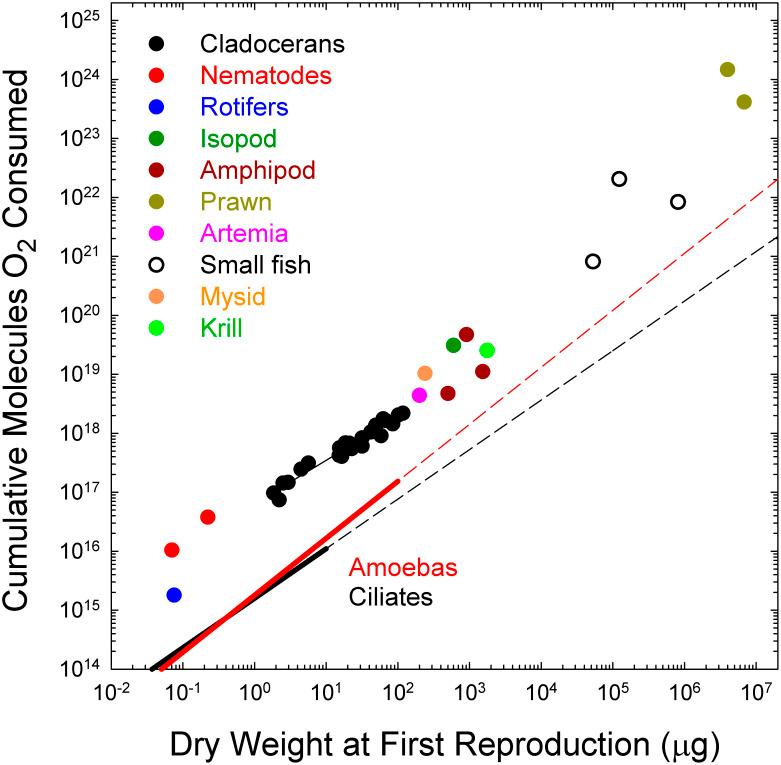
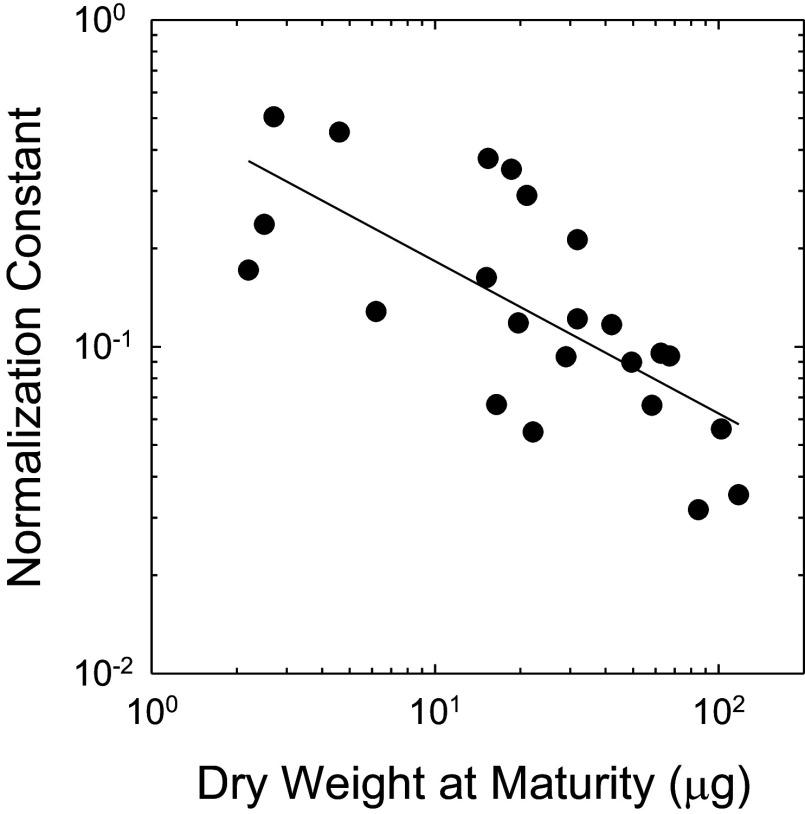
All life forms depend on the conversion of energy into biomass used in growth and reproduction. For unicellular heterotrophs, the energetic cost associated with building a cell scales slightly sublinearly with cell weight. However, observations on multiple species and numerous other metazoans suggest that although a similar size-specific scaling is retained in multicellular heterotrophs, there is a quantum leap in the energy required to build a replacement soma, presumably owing to the added investment in nonproductive features such as cell adhesion, support tissue, and intercellular communication and transport. Thus, any context-dependent ecological advantages that accompany the evolution of multicellularity come at a high baseline bioenergetic cost. At the phylogenetic level, for both unicellular and multicellular eukaryotes, the energetic expense per unit biomass produced declines with increasing adult size of a species, but there is a countergradient scaling within the developmental trajectories of individual metazoan species, with the cost of biomass production increasing with size. Translation of the results into the universal currency of adenosine triphosphate (ATP) hydrolyses provides insight into the demands on the electron-transport/ATP-synthase machinery per organism and on the minimum doubling times for biomass production imposed by the costs of duplicating the energy-producing infrastructure.
所有生命形式都依赖于将能量转化为用于生长和繁殖的生物质。对于单细胞异养生物,与细胞重量相关的构建细胞的能量成本呈轻微次线性增长。然而,对多种物种和许多其他后生动物的观察表明,尽管在多细胞异养生物中保留了类似的特定于大小的比例关系,但构建替代体细胞所需的能量却发生了质的飞跃,这可能是由于细胞黏附、支持组织以及细胞间通信和运输等非生产性特征的额外投入。因此,伴随多细胞生物进化而来的任何与环境相关的生态优势都伴随着高基线生物能量成本。在系统发生水平上,对于单细胞和多细胞真核生物,每单位生物质产生的能量消耗随着物种成年个体大小的增加而降低,但在单个后生动物物种的发育轨迹中存在反梯度比例关系,即生物质生产的成本随着体型的增加而增加。将这些结果转化为三磷酸腺苷(ATP)水解的通用货币,为了解每个生物体的电子传递/ATP 合酶机制的需求以及由复制产生能量的基础设施的成本所强加的生物质生产的最小倍增时间提供了深入的见解。

 Zotero 插件