
了解两种聚酯降解酶的催化效率:一项实验与理论研究
Understanding the Catalytic Efficiency of Two Polyester Degrading Enzymes: An Experimental and Theoretical Investigation.
作者信息
Clark Matilda, Tornesakis Konstantinos, König Gerhard, Zahn Michael, Lichtenstein Bruce R, Pickford Andrew R, Cox Paul A
机构信息
Centre for Enzyme Innovation, University of Portsmouth, St Michael's Building, Portsmouth PO1 2DT, U.K.
School of Medicine, Pharmacy and Biomedical Sciences, University of Portsmouth, St Michael's Building, Portsmouth PO1 2DT, U.K.
出版信息
ACS Omega. 2024 Oct 23;9(44):44724-44733. doi: 10.1021/acsomega.4c06528. eCollection 2024 Nov 5.
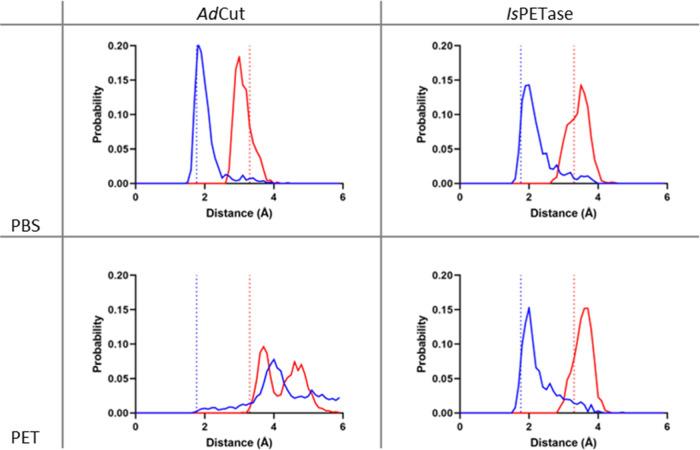
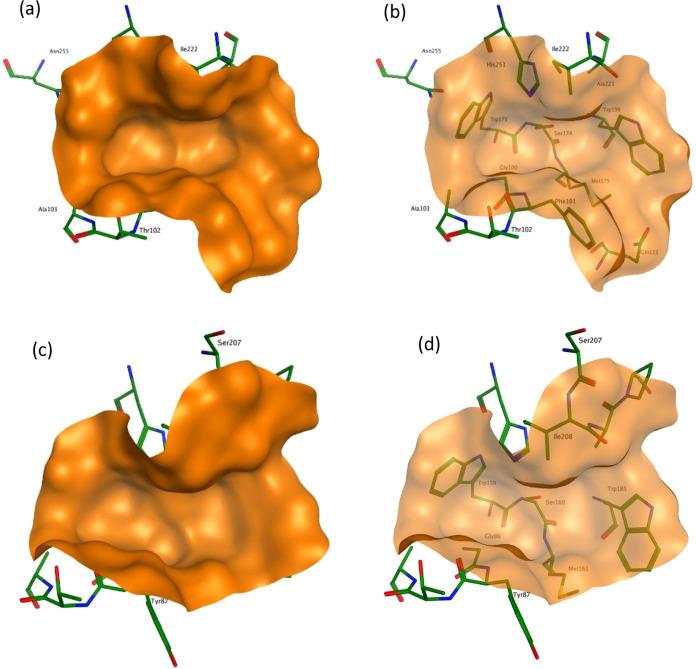
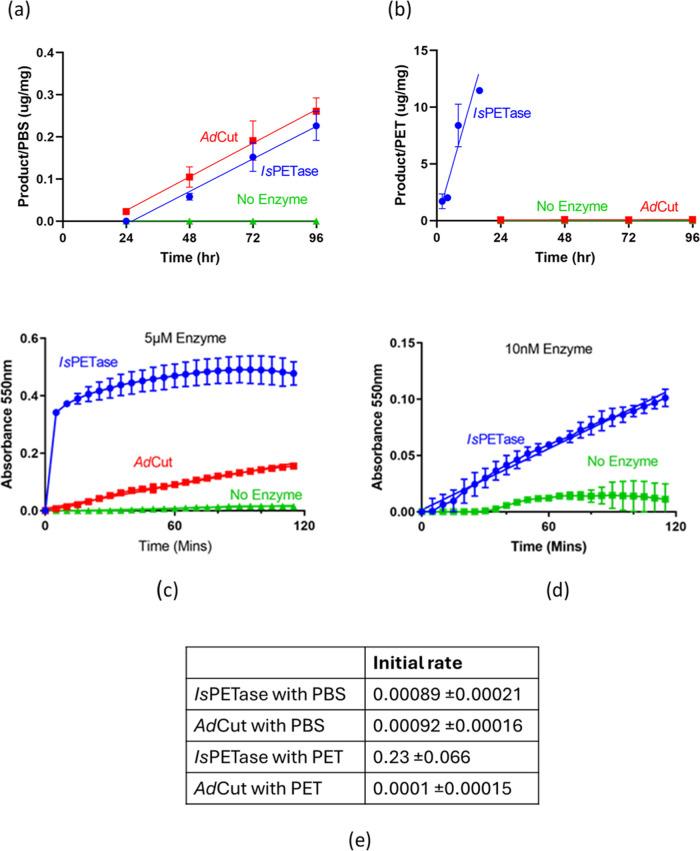
The discovery of novel plastic degrading enzymes commonly relies on comparing features of the primary sequence to those of known plastic degrading enzymes. However, this approach cannot always guarantee success. This is exemplified by the different degradation rates of the two polymers poly(ethylene terephthalate) (PET) and polybutylene succinate (PBS) by two hydrolases: PETase from and Cut from . Despite the enzymes showing a very high sequence identity of 82%, PETase shows significant hydrolysis activity for both polymers, whereas Cut only shows significant hydrolysis activity for PBS. By solving the structure of Cut using X-ray crystallography, and using this as the basis for computer simulations, comparisons are made between the differences in the calculated binding geometries and the catalytic results obtained from biochemical experiments. The results reveal that the low activity of Cut toward PET can be explained by the low sampling of the productive conformation observed in the simulations. While the active site serine in PETase can closely encounter the PET carbonyl carbon, in Cut it cannot: a feature that can be attributed to the shape of the catalytic binding pocket. These results yield an important insight into the design requirements for novel plastic degrading enzymes, as well as showing that computational methods can be used as a valuable tool in understanding the molecular basis for different hydrolysis activities in homologous polyesterase enzymes.
新型塑料降解酶的发现通常依赖于将一级序列的特征与已知塑料降解酶的特征进行比较。然而,这种方法并非总能保证成功。这一点体现在两种水解酶对两种聚合物聚对苯二甲酸乙二酯(PET)和聚丁二酸丁二醇酯(PBS)的不同降解速率上:来自……的PET酶和来自……的Cut酶。尽管这两种酶的序列同一性高达82%,但PET酶对这两种聚合物都表现出显著的水解活性,而Cut酶仅对PBS表现出显著的水解活性。通过使用X射线晶体学解析Cut酶的结构,并以此为基础进行计算机模拟,对计算出的结合几何结构差异与生化实验获得的催化结果进行了比较。结果表明,Cut酶对PET的低活性可以通过模拟中观察到的生产性构象的低采样率来解释。在PET酶中,活性位点丝氨酸能够紧密接触PET羰基碳,而在Cut酶中则不能:这一特征可归因于催化结合口袋的形状。这些结果为新型塑料降解酶的设计要求提供了重要见解,同时也表明计算方法可作为理解同源聚酯酶不同水解活性分子基础方面的宝贵工具。




 Zotero 插件