
鉴定与失巢凋亡相关的长链非编码RNA特征作为肺腺癌的一种新型预后模型。
Identification of anoikis-related long non-coding RNA signature as a novel prognostic model in lung adenocarcinoma.
作者信息
Fang Xisheng, Wei Mei, Liu Xia, Lu Lin, Liu Guolong
机构信息
Department of Medical Oncology, The First Affiliated Hospital, Jinan University, Guangzhou, China.
Department of Medical Oncology, Guangzhou First People's Hospital, South China University of Technology, Guangzhou, China.
出版信息
Transl Cancer Res. 2024 Oct 31;13(10):5458-5472. doi: 10.21037/tcr-24-264. Epub 2024 Oct 18.
BACKGROUND
Anoikis, as a specific form of programmed cell death, involves in tumor metastasis. However, there is still lacking of anoikis-related long non-coding RNA (lncRNA) risk signature in the diagnosis and prognosis of lung adenocarcinoma (LUAD). This study constructed a prognostic risk model by comprehensively analyzing anoikis-related lncRNAs which could effectively diagnose and predict the outcomes of LUAD patients.
METHODS
A list of anoikis-related genes (ARGs) was retrieved from literatures. Anoikis-related lncRNAs were selected using co-expression analysis from The Cancer Genome Atlas (TCGA) database. Univariate and multivariate regression analyses were used to construct a prognostic model. The performance of the risk signature in predicting the prognosis and clinical significance were determined by Kaplan-Meier survival analysis, receiver operating characteristic (ROC) curves, univariate and multivariate regression analyses. Moreover, the differences of tumor immune microenvironment between the high- and low-risk groups were explored. Finally, a novel nomogram was developed by combining the signature and clinicopathological factors, and the association between lncRNAs and differential N6-methyladenosine (m6A) genes was analyzed by Spearman's analysis.
RESULTS
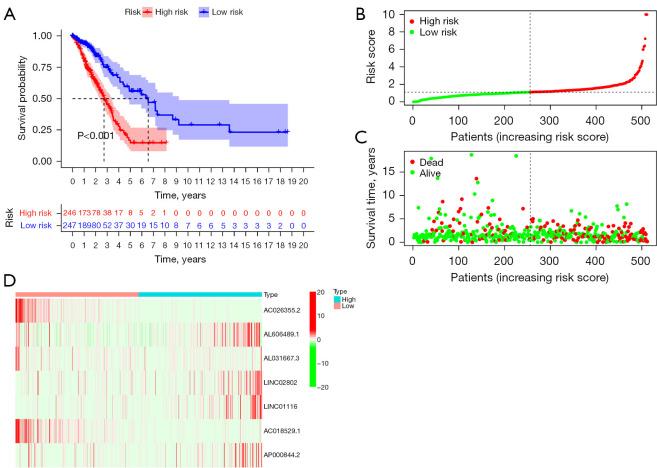
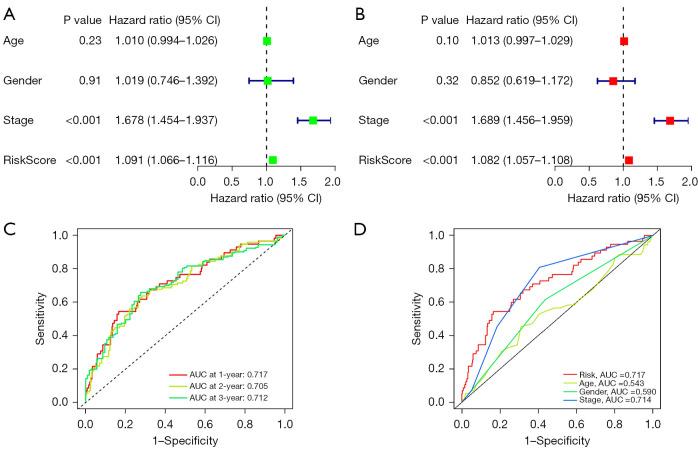
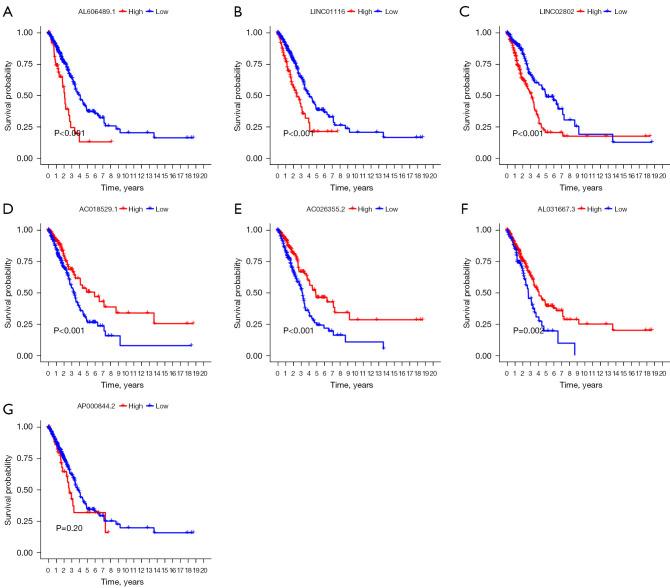
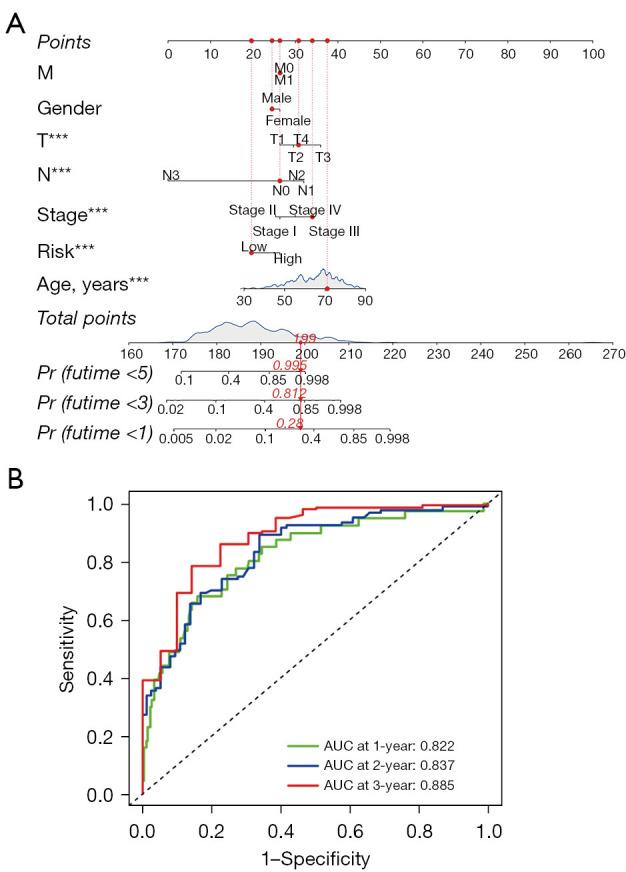
A total of 1,694 anoikis-related lncRNAs were identified from 479 cases of LUAD. According to the univariate and multivariate Cox analyses, we established a prognostic risk model consisting of seven lncRNAs (AC026355.2, AL606489.1, AL031667.3, LINC02802, LINC01116, AC018529.1, and AP000844.2). This prognostic risk model could efficiently classify low- and high-risk patients. The area under the curve (AUC) value was 0.717, which indicated more powerful predictive capability than commonly used clinicopathological factors. The high- and low-risk groups demonstrated different immune microenvironment. Moreover, the nomogram also demonstrated good performance in predicting the prognosis. Twelve differential m6A regulators were identified, and RBM15 was found to be correlated positively with the hub lncRNA AL606489.1.
CONCLUSIONS
Our study constructed a prognostic risk model based on anoikis-related lncRNAs, which could provide novel perspective on the prognosis of LUAD patients.
背景
失巢凋亡作为程序性细胞死亡的一种特殊形式,参与肿瘤转移。然而,在肺腺癌(LUAD)的诊断和预后中,仍缺乏与失巢凋亡相关的长链非编码RNA(lncRNA)风险特征。本研究通过综合分析与失巢凋亡相关的lncRNAs构建了一个预后风险模型,该模型可有效诊断和预测LUAD患者的预后。
方法
从文献中检索出与失巢凋亡相关的基因(ARG)列表。利用来自癌症基因组图谱(TCGA)数据库的共表达分析筛选出与失巢凋亡相关的lncRNAs。采用单因素和多因素回归分析构建预后模型。通过Kaplan-Meier生存分析、受试者工作特征(ROC)曲线、单因素和多因素回归分析确定风险特征在预测预后方面的性能及临床意义。此外,还探讨了高风险组和低风险组之间肿瘤免疫微环境的差异。最后,结合风险特征和临床病理因素开发了一种新型列线图,并通过Spearman分析分析lncRNAs与差异N6-甲基腺苷(m6A)基因之间的关联。
结果
从479例LUAD病例中鉴定出总共1694个与失巢凋亡相关的lncRNAs。根据单因素和多因素Cox分析,我们建立了一个由七个lncRNAs(AC026355.2、AL606489.1、AL031667.3、LINC⁃02802、LINC01116、AC018529.1和AP000844.2)组成的预后风险模型。该预后风险模型能够有效地将低风险和高风险患者进行分类。曲线下面积(AUC)值为0.717,这表明其预测能力比常用的临床病理因素更强。高风险组和低风险组表现出不同的免疫微环境。此外,列线图在预测预后方面也表现良好。鉴定出12个差异m6A调节因子,发现RBM15与核心lncRNA AL606489.1呈正相关。
结论
我们的研究构建了基于失巢凋亡相关lncRNAs的预后风险模型,可为LUAD患者的预后提供新的视角。



 Zotero 插件