
阐明绿海藻角叉菜中化合物的抗人类黑色素瘤和抗衰老机制。
Elucidation of anti-human melanoma and anti-aging mechanisms of compounds from green seaweed Caulerpa racemosa.
机构信息
Alumnus Department of Dermatology and Venereology, Faculty of Medicine, Public Health, and Nursing, Universitas Gadjah Mada, Yogyakarta, Indonesia.
Division of Clinical Nutrition, Department of Nutrition, Faculty of Medicine, Hasanuddin University, Makassar, 90245, Indonesia.
出版信息
Sci Rep. 2024 Nov 11;14(1):27534. doi: 10.1038/s41598-024-78464-6.
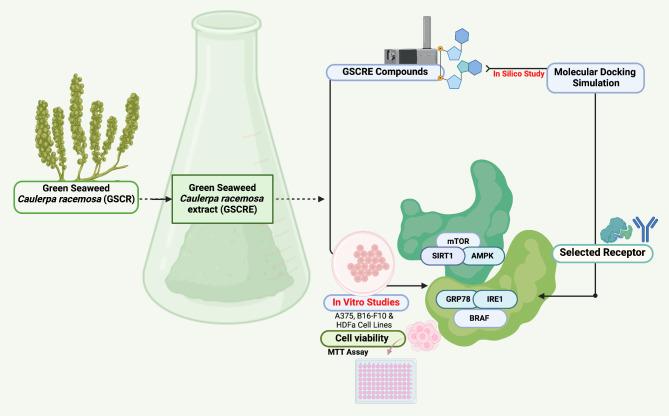
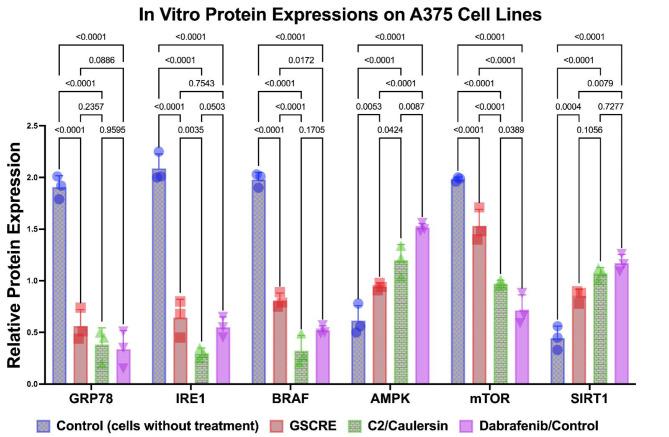
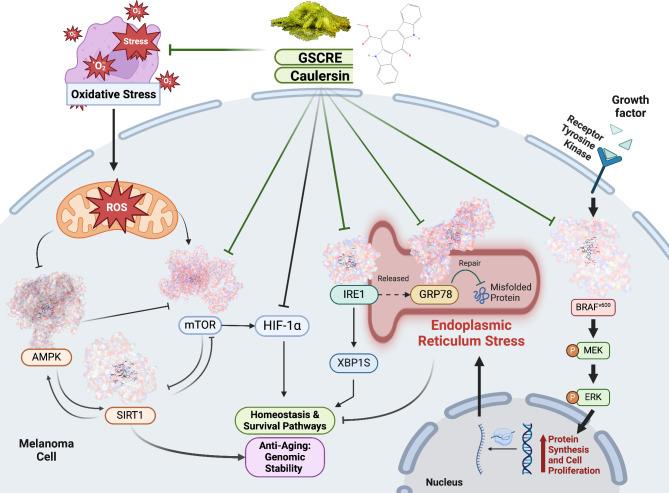
Human melanoma is linked with aging-related disorders, prompting interest in the development of functional foods derived from natural ingredients to mitigate its incidence. Molecules in green seaweeds such as Caulerpa racemosa can serve this purpose due to their anti-tumor and anti-inflammatory properties. A previous work study compounds profiling has been carried out, and in this research the molecular docking studies targeting receptors associated with melanoma (GRP78, IRE1, BRAF) and aging (mTOR, AMPK, SIRT1) identified four promising compound in an extract of C. racemosa. The current study aims to the mechanism of those compounds at a cellular level using the human A375 (BRAF-V600E mutation) and A375 and B16-F10 cell lines. The MTT assay was used to evaluate the potential of GSCRE compounds against A375 and B16-F10 cell lines, with comparisons made to normal HDFa cell lines. Results indicated that compound C2, also known as Caulersin, demonstrated a significantly different ∆G affinity binding score compared to the control drug Dabrafenib. GSCRE crude extract, particularly C2, showed potential in modulating mTOR, AMPK, and SIRT1 pathways and downregulating GRP78, IRE1, and BRAF signaling (p < 0.05). Interestingly, C2 was less effective in suppressing A375 and B16-F10 cell lines (LD C2 < LD Dabrafenib/control), with its LD value nearly matching that of the Trametinib control in B16-F10 cell lines. Consequently, GSCRE, especially C2 or Caulersin, shows promise as a new molecule for developing functional foods to combat aging and human melanoma. However, further in vivo studies and clinical trials are necessary to confirm these findings.
人类黑色素瘤与衰老相关疾病有关,这促使人们对开发源自天然成分的功能性食品产生了兴趣,以降低其发病率。由于具有抗肿瘤和抗炎特性,绿海藻如石莼属中的分子可以达到这个目的。之前的一项化合物分析研究已经进行,在这项研究中,针对与黑色素瘤(GRP78、IRE1、BRAF)和衰老(mTOR、AMPK、SIRT1)相关的受体进行了分子对接研究,从石莼属提取物中鉴定出了四种有前途的化合物。本研究旨在使用人 A375(BRAF-V600E 突变)和 A375 和 B16-F10 细胞系在细胞水平上研究这些化合物的作用机制。MTT 法用于评估 GSCRE 化合物对 A375 和 B16-F10 细胞系的潜在作用,并与正常 HDFa 细胞系进行比较。结果表明,化合物 C2(也称为 Caulersin)与对照药物 Dabrafenib 相比,表现出明显不同的 ∆G 亲和力结合评分。GSCRE 粗提取物,特别是 C2,在调节 mTOR、AMPK 和 SIRT1 途径以及下调 GRP78、IRE1 和 BRAF 信号方面显示出潜力(p < 0.05)。有趣的是,C2 在抑制 A375 和 B16-F10 细胞系方面的效果较差(LD C2 < LD Dabrafenib/对照),其 LD 值与 B16-F10 细胞系中 Trametinib 对照的 LD 值几乎相同。因此,GSCRE,特别是 C2 或 Caulersin,作为开发功能性食品以对抗衰老和人类黑色素瘤的新分子具有潜力。然而,需要进一步的体内研究和临床试验来证实这些发现。



 Zotero 插件