
解码肿瘤-纤维化相互作用:机制、对进展的影响及创新治疗策略。
Decoding tumor-fibrosis interplay: mechanisms, impact on progression, and innovative therapeutic strategies.
作者信息
Chen Huiguang, Xu Xuexin, Li Jingxian, Xue Yu, Li Xin, Zhang Kaiyu, Jiang Haihui, Liu Xiaoliu, Li Mingzhe
机构信息
Institute of Infection, Immunology, and Tumor Microenvironment, School of Medicine, Wuhan University of Science and Technology, Wuhan, China.
Department of Anatomy, School of Medicine, Wuhan University of Science and Technology, Wuhan, China.
出版信息
Front Pharmacol. 2024 Oct 23;15:1491400. doi: 10.3389/fphar.2024.1491400. eCollection 2024.
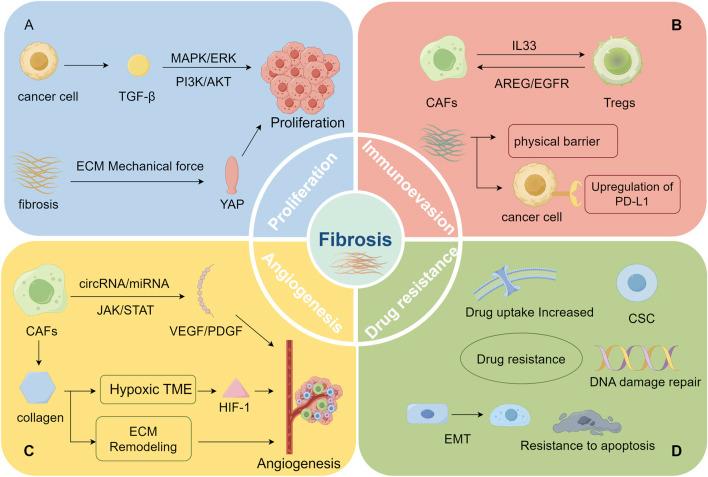
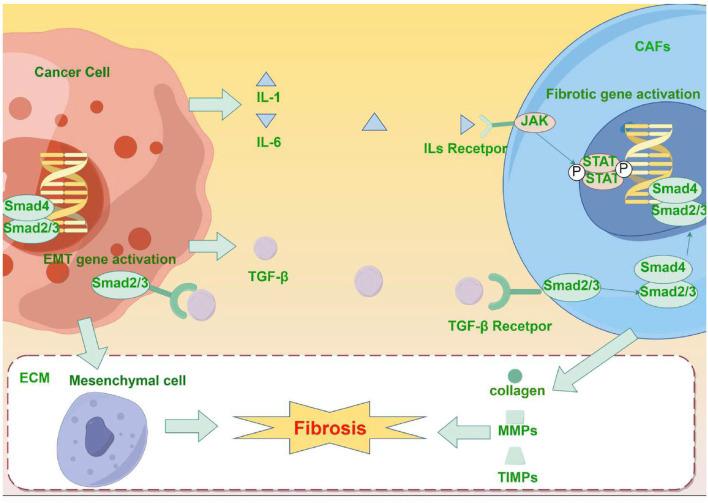
Malignant tumors are a category of diseases that possess invasive and metastatic capabilities, with global incidence and mortality rates remaining high. In recent years, the pivotal role of fibrosis in tumor progression, drug resistance, and immune evasion has increasingly been acknowledged. Fibrosis enhances the proliferation, migration, and invasion of tumor cells by modifying the composition and structure of the extracellular matrix, thereby offering protection for immune evasion by tumor cells. The activation of cancer-associated fibroblasts (CAFs) plays a significant role in this process, as they further exacerbate the malignant traits of tumors by secreting a variety of cytokines and growth factors. Anti-fibrotic tumor treatment strategies, including the use of anti-fibrotic drugs and inhibition of fibrosis-related signaling pathways such as Transforming Growth Factor-β (TGF-β), have demonstrated potential in delaying tumor progression and improving the effectiveness of chemotherapy, targeted therapy, and immunotherapy. In the future, by developing novel drugs that target the fibrotic microenvironment, new therapeutic options may be available for patients with various refractory tumors.
恶性肿瘤是一类具有侵袭和转移能力的疾病,全球发病率和死亡率居高不下。近年来,纤维化在肿瘤进展、耐药性和免疫逃逸中的关键作用日益得到认可。纤维化通过改变细胞外基质的组成和结构来增强肿瘤细胞的增殖、迁移和侵袭能力,从而为肿瘤细胞的免疫逃逸提供保护。癌症相关成纤维细胞(CAFs)的激活在这一过程中起着重要作用,因为它们通过分泌多种细胞因子和生长因子进一步加剧肿瘤的恶性特征。抗纤维化肿瘤治疗策略,包括使用抗纤维化药物和抑制纤维化相关信号通路(如转化生长因子-β(TGF-β)),已显示出在延缓肿瘤进展以及提高化疗、靶向治疗和免疫治疗效果方面的潜力。未来,通过开发针对纤维化微环境的新型药物,可能为患有各种难治性肿瘤的患者提供新的治疗选择。
 Zotero 插件