
心血管疾病(CVD)及其危险因素20年发病率的性别差异:阿提卡研究(2002 - 2022年)
Sex-related differences in the 20-year incidence of CVD and its risk factors: The ATTICA study (2002-2022).
作者信息
Sigala Evangelia G, Vaina Sophia, Chrysohoou Christina, Dri Eirini, Damigou Evangelia, Tatakis Fotis Panagiotis, Sakalidis Athanasios, Barkas Fotios, Liberopoulos Evangelos, Sfikakis Petros P, Tsioufis Costas, Pitsavos Christos, Panagiotakos Demosthenes
机构信息
Department of Nutrition and Dietetics, School of Health Sciences and Education, Harokopio University, 17671, Athens, Greece.
First Cardiology Clinic, Medical School, National and Kapodistrian University of Athens, Hippokration Hospital, 15772, Athens, Greece.
出版信息
Am J Prev Cardiol. 2024 Jul 10;19:100709. doi: 10.1016/j.ajpc.2024.100709. eCollection 2024 Sep.
OBJECTIVE
The purpose of this study was to examine sex-related differences in the long-term (20-year) incidence of cardiovascular disease (CVD) and its determinants.
METHODS
In 2002, 3,042 apparently healthy Greek adults were recruited, and in 2022, the 20-year follow-up was conducted with 2,169 participants, 1,988 of whom had completed CVD assessments. Sex-specific analyses using nested Cox proportional hazards were performed, as well as classification and regression tree (CRT) analysis modeling.
RESULTS
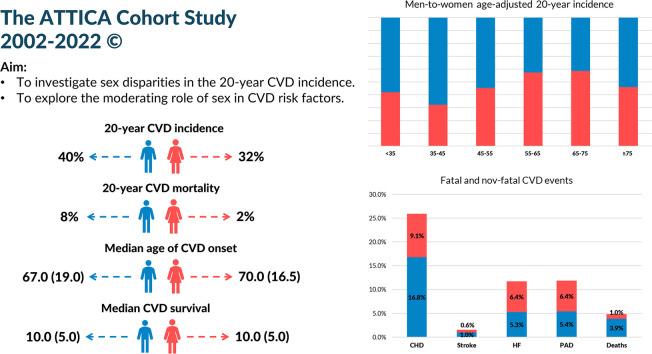
Overall, men exhibited higher CVD incidence rates during the 20-year period compared to women; age-adjusted analyses revealed, however, that women displayed higher CVD rates between 55 and 75 years old. CVD mortality and premature mortality were more pronounced in men. Although, CVD presentation in women lagged men, over survival was comparable. Moreover, the CVD risk factors burden was greater in women beyond the age of 35. Clinical risk factors and adherence to the Mediterranean dietary pattern emerged as the most significant predictors of sex-specific 20-year CVD incidence.
CONCLUSION
This study highlights various sex disparities in CVD, challenging prevailing perceptions that CVD is a men's phenomenon. Tailoring prevention strategies to address sex-specific differences, particularly through lifestyle interventions, could effectively reduce CVD burden.
目的
本研究旨在探讨心血管疾病(CVD)长期(20年)发病率及其决定因素中的性别差异。
方法
2002年招募了3042名表面健康的希腊成年人,2022年对2169名参与者进行了20年随访,其中1988人完成了CVD评估。使用嵌套Cox比例风险模型进行了性别特异性分析,以及分类与回归树(CRT)分析建模。
结果
总体而言,在20年期间男性的CVD发病率高于女性;然而,年龄调整分析显示,55至75岁之间女性的CVD发病率更高。男性的CVD死亡率和过早死亡率更为明显。虽然女性的CVD发病比男性晚,但总体生存率相当。此外,35岁以上女性的CVD风险因素负担更大。临床风险因素和对地中海饮食模式的依从性是性别特异性20年CVD发病率的最显著预测因素。
结论
本研究突出了CVD方面的各种性别差异,挑战了CVD是男性疾病的普遍观念。针对性别差异制定预防策略,特别是通过生活方式干预,可以有效减轻CVD负担。


 Zotero 插件