
利用动态动脉僵硬度和踝臂指数预测急性心肌梗死患者的全因死亡率和心血管结局:一项前瞻性队列研究。
Prediction of All-Cause Mortality and Cardiovascular Outcomes Using Ambulatory Arterial Stiffness and Ankle-Brachial Indices in Patients with Acute Myocardial Infarction: A Prospective Cohort Study.
作者信息
Koumelli Areti, Konstantinou Konstantinos, Sakalidis Athanasios, Pappelis Konstantinos, Mantzouranis Emmanouil, Chrysohoou Christina, Nihoyannopoulos Petros I, Tousoulis Dimitrios, Tsioufis Konstantinos
机构信息
First Department of Cardiology, School of Medicine, National and Kapodistrian University of Athens, Hippokration General Hospital, 11527 Athens, Greece.
Department of Cardiology, Royal Brompton and Harefield Hospitals, Guy's & St Thomas' NHS Foundation Trust, London UB9 6JH, UK.
出版信息
J Clin Med. 2025 Jun 30;14(13):4627. doi: 10.3390/jcm14134627.
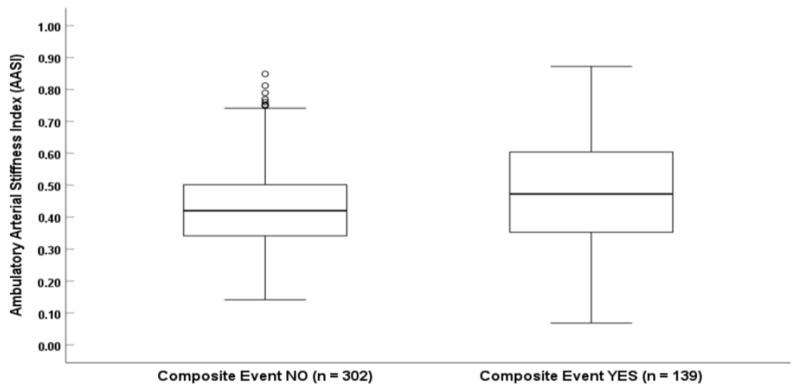
: The ankle-brachial index (ABI) is a non-invasive diagnostic tool for peripheral artery disease (PAD) and a marker of systemic atherosclerosis, predictive of cardiovascular (CV) events. The ambulatory arterial stiffness index (AASI), derived from 24-h blood pressure monitoring, also predicts CV morbidity and mortality, particularly stroke. However, their combined prognostic utility in acute myocardial infarction (AMI) remains underexplored. This study aimed to assess the predictive value of ABI and AASI in patients with AMI. : We conducted a single-center observational cohort study including 441 consecutive patients with AMI (79% male; mean age 62 years). ABI was measured using an automated device, with ≤0.9 defined as abnormal. AASI was calculated from 24-h blood pressure recordings. The primary endpoint was a composite of all-cause and CV death and major CV events, assessed in-hospital and over a 3-year follow-up. : Median ABI was 1.10 (IQR 1.00-1.18); 10.4% had abnormal ABI. Abnormal ABI was associated with a threefold higher risk of in-hospital adverse events (OR 2.93, 95% CI: 1.48-5.81, = 0.002). In Cox regression, abnormal ABI predicted long-term all-cause mortality (HR 2.88, 95% CI: 1.53-5.42, = 0.001), independent of traditional risk factors. Each 0.1 increase in AASI was linked to a 21% higher risk of the composite outcome ( = 0.001) and 25% increased risk of recurrent AMI or urgent revascularization ( = 0.001). : In this prospective cohort of patients with AMI, ABI and AASI were associated with adverse outcomes, suggesting their potential role in risk stratification. These exploratory findings require validation in larger, multicenter cohorts to assess their incremental prognostic value and generalizability.
踝臂指数(ABI)是一种用于诊断外周动脉疾病(PAD)的非侵入性工具,也是全身动脉粥样硬化的一个标志物,可预测心血管(CV)事件。动态动脉僵硬度指数(AASI)源自24小时血压监测,也可预测心血管疾病的发病率和死亡率,尤其是中风。然而,它们在急性心肌梗死(AMI)中的联合预后效用仍未得到充分研究。本研究旨在评估ABI和AASI对AMI患者的预测价值。我们进行了一项单中心观察性队列研究,纳入了441例连续的AMI患者(79%为男性;平均年龄62岁)。使用自动设备测量ABI,≤0.9定义为异常。根据24小时血压记录计算AASI。主要终点是全因死亡、心血管死亡和主要心血管事件的复合终点,在住院期间和3年随访中进行评估。ABI中位数为1.10(四分位间距1.00 - 1.18);10.4%的患者ABI异常。ABI异常与住院期间不良事件风险高出三倍相关(比值比2.93,95%置信区间:1.48 - 5.81;P = 0.002)。在Cox回归分析中,如果不考虑传统风险因素,ABI异常可预测长期全因死亡率(风险比2.88,95%置信区间:1.53 - 5.42;P = 0.001)。AASI每增加0.1,复合结局风险升高21%(P = 0.001),复发性AMI或紧急血运重建风险升高25%(P = 0.



 Zotero 插件