
采用改良 Dixon 序贯法确定剖宫产术后硬膜外注射氢吗啡酮镇痛的有效剂量
Effective Dose of Epidural Hydromorphone for Analgesia Following Caesarean Section in Using Modified Dixon Sequential Method.
作者信息
Liu Qiao-Qiao, Mao Mao, Lin Ning-Hua, Xu Chen-Yang, Li Qian, Jiang Chang-Shuo, Feng Shan-Wu, Yuan Hong-Mei
机构信息
Department of Anesthesiology, Women's Hospital of Nanjing Medical University, Nanjing Women and Children's Healthcare Hospital, Nanjing, 210004, People's Republic of China.
Department of Anesthesiology, Nanjing Drum Tower Hospital, The Affiliated Hospital of Nanjing University Medical School, Nanjing, 210008, People's Republic of China.
出版信息
J Pain Res. 2024 Nov 9;17:3671-3679. doi: 10.2147/JPR.S480917. eCollection 2024.
BACKGROUND
A single dose of epidural hydromorphone has been suggested as an alternative method for providing analgesia after caesarean section (CS). Nevertheless, the optimal dosage of epidural hydromorphone for postoperative pain relief following CS has yet to be determined.
METHODS
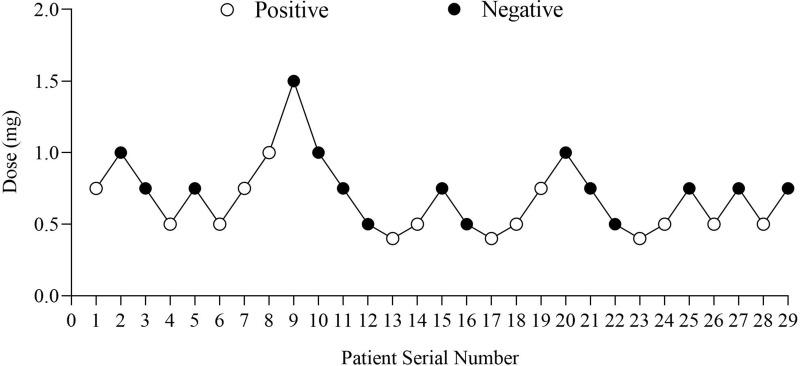
This trial included 30 singleton primiparous women undergoing scheduled caesarean delivery, who were recruited to determine doses of epidural hydromorphone using the modified Dixon sequential method. The initial hydromorphone dose was 0.75 mg, with adjustments based on the efficacy of the preceding participant's dose over 12 hours. Various parameters such as blood pressure, heart rate, respiratory rate, visual analog scale (VAS) pain score, postoperative adverse reactions, and patient satisfaction with analgesic effect were recorded at each time point. The VAS scores were categorized as positive (score >3) or negative (score ≤3). Participants received a single epidural injection of 0.2% ropivacaine 20 mg along with a study dose of hydromorphone. The median effective dose (ED50), 90% effective dose (ED90), and corresponding 95% confidence intervals (CIs) of hydromorphone with ropivacaine for analgesia after caesarean section were calculated using the probit method.
RESULTS
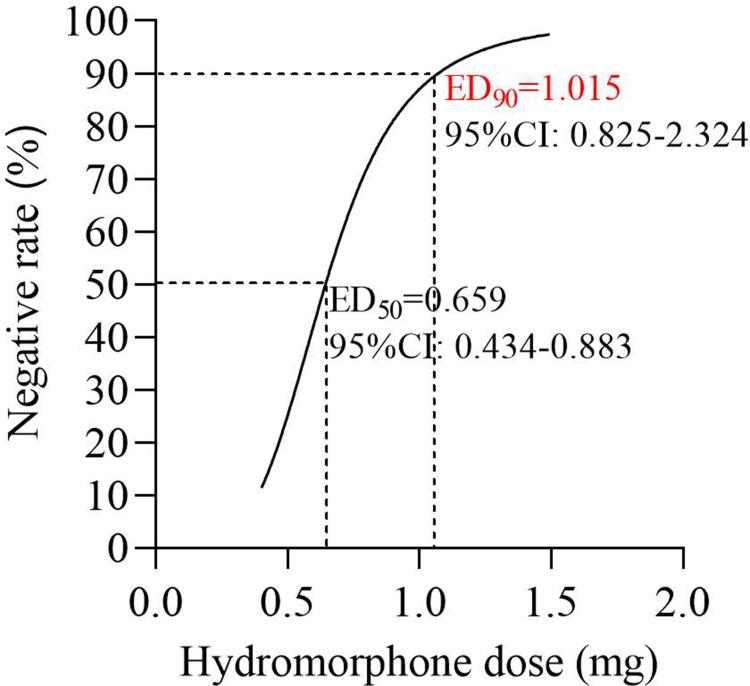
The ED90 and ED50 in our population were 1.105 mg (95% CI: 0.825-2.324 mg) and 0.659 mg (95% CI: 0.434-0.883 mg), respectively.
CONCLUSION
Epidural hydromorphone can be safely used for postoperative analgesia in patients undergoing caesarean section, and the analgesic effect is satisfactory when the dosage is appropriate.
背景
单次硬膜外注射氢吗啡酮已被提议作为剖宫产术后提供镇痛的一种替代方法。然而,剖宫产术后用于缓解疼痛的硬膜外氢吗啡酮的最佳剂量尚未确定。
方法
本试验纳入了30名单胎初产妇,她们接受择期剖宫产,采用改良的 Dixon 序贯法确定硬膜外氢吗啡酮的剂量。初始氢吗啡酮剂量为0.75mg,根据前一名参与者12小时剂量的疗效进行调整。在每个时间点记录各种参数,如血压、心率、呼吸频率、视觉模拟评分(VAS)疼痛评分、术后不良反应以及患者对镇痛效果的满意度。VAS评分分为阳性(评分>3)或阴性(评分≤3)。参与者接受单次硬膜外注射20mg 0.2%罗哌卡因以及研究剂量的氢吗啡酮。采用概率单位法计算剖宫产术后氢吗啡酮与罗哌卡因联合镇痛的半数有效剂量(ED50)、90%有效剂量(ED90)以及相应的95%置信区间(CI)。
结果
我们人群中的ED90和ED50分别为1.105mg(95%CI:0.825 - 2.324mg)和0.659mg(95%CI:0.434 - 0.883mg)。
结论
硬膜外氢吗啡酮可安全用于剖宫产患者的术后镇痛,剂量适当时镇痛效果满意。

 Zotero 插件