
基于宏基因组分析的结直肠高级腺瘤患者肠道微生物组的改变。
Alterations of Gut Microbiome in Patients with Colorectal Advanced Adenoma by Metagenomic Analyses.
机构信息
Department of Gastroenterology, the First Medical Center of Chinese PLA General Hospital, Beijing, China.
Medical School of Chinese People's Liberation Army, Beijing, China.
出版信息
Turk J Gastroenterol. 2024 Nov 1;35(11):859-868. doi: 10.5152/tjg.2024.24294.
BACKGROUND/AIMS: Colorectal cancer (CRC) is one of the deadliest cancers worldwide, mostly arising from adenomatous polyps. Mounting evidence has demonstrated that changes in the gut microbiome play key roles in CRC progression, while quite few studies focused on the altered microbiota architecture of advanced adenoma (AA), a crucial precancerous stage of CRC. Thus, we aimed to investigate the microbial profiles of AA patients.
MATERIALS AND METHODS
Fecal samples were collected from 26 AA patients and 26 age- and sex-matched normal controls (NC), and analyzed by shotgun metagenomic sequencing.
RESULTS
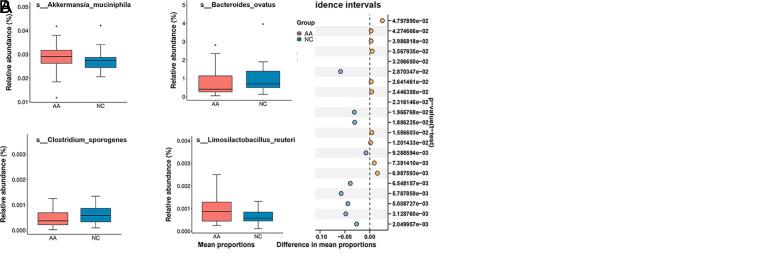
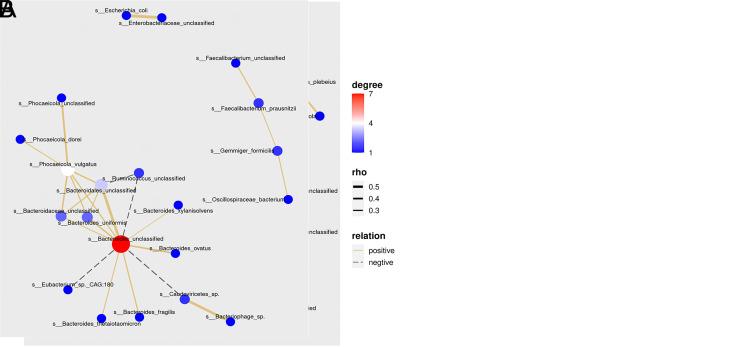
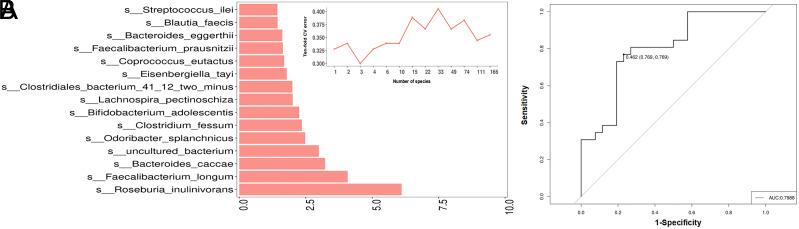
Gut microbial dysbiosis was observed in AA patients with lower alpha diversity. Advanced adenoma was characterized by an increased Bacillota/Bacteroidota ratio and higher Pseudomonadota levels compared to normal individuals. Linear discriminant analysis effect size (LEfSe) analysis was performed and identified 14 microbiota with significantly different abundance levels between AA and NC groups. Functional analysis revealed that tryptophan metabolism was upregulated in AA. Correspondingly, the expressions of gut microbes implicated in tryptophan metabolism also changed, including Akkermansia muciniphila, Bacteroides ovatus, Clostridium sporogenes, and Limosilactobacillus reuteri. The microbial network suggested that AA exhibited decreased correlation complexity, with Escherichia coli and Enterobacteriaceae unclassified harboring the strongest connectivity. A diagnostic model consisting of 3 microbial species was established based on random forest, yielding an area under the curve (AUC) of 0.799.
CONCLUSION
Our study profiled the alterations of the gut microbiome in AA patients, which may enrich the knowledge of microbial signatures along with colorectal tumorigenesis and provide promising biomarkers for AA diagnosis.
背景/目的:结直肠癌(CRC)是全球最致命的癌症之一,主要由腺瘤性息肉发展而来。越来越多的证据表明,肠道微生物组的变化在 CRC 的进展中起着关键作用,而很少有研究关注 CRC 的重要癌前阶段——高级别腺瘤(AA)的微生物群结构改变。因此,我们旨在研究 AA 患者的微生物特征。
材料和方法
收集了 26 名 AA 患者和 26 名年龄和性别匹配的正常对照(NC)的粪便样本,并进行了 shotgun 宏基因组测序分析。
结果
AA 患者的肠道微生物失调,α多样性降低。与正常个体相比,高级别腺瘤的特点是厚壁菌门/拟杆菌门比值增加,假单胞菌门水平升高。进行了线性判别分析效应量(LEfSe)分析,鉴定出 AA 与 NC 组之间丰度水平有显著差异的 14 种微生物。功能分析显示,色氨酸代谢在 AA 中上调。相应地,参与色氨酸代谢的肠道微生物的表达也发生了变化,包括阿克曼氏菌、卵形拟杆菌、梭状芽胞杆菌和雷氏乳杆菌。微生物网络表明,AA 表现出降低的相关性复杂性,大肠杆菌和肠杆菌科未分类菌具有最强的连接性。基于随机森林建立了一个由 3 种微生物组成的诊断模型,曲线下面积(AUC)为 0.799。
结论
本研究描绘了 AA 患者肠道微生物组的改变,这可能丰富了微生物特征与结直肠肿瘤发生的知识,并为 AA 的诊断提供了有前途的生物标志物。



 Zotero 插件