
2023 年 12 月,瑞典与沙拉吧相关的新型 IIγA11 爆发。
Outbreak of the novel IIγA11 linked to salad bars in Sweden, December 2023.
机构信息
Department of Microbiology, Public Health Agency of Sweden, Solna, Sweden.
ECDC Fellowship Programme, Public Health Microbiology path (EUPHEM), European Centre for Disease Prevention and Control (ECDC), Stockholm, Sweden.
出版信息
Epidemiol Infect. 2024 Nov 18;152:e140. doi: 10.1017/S0950268824001432.
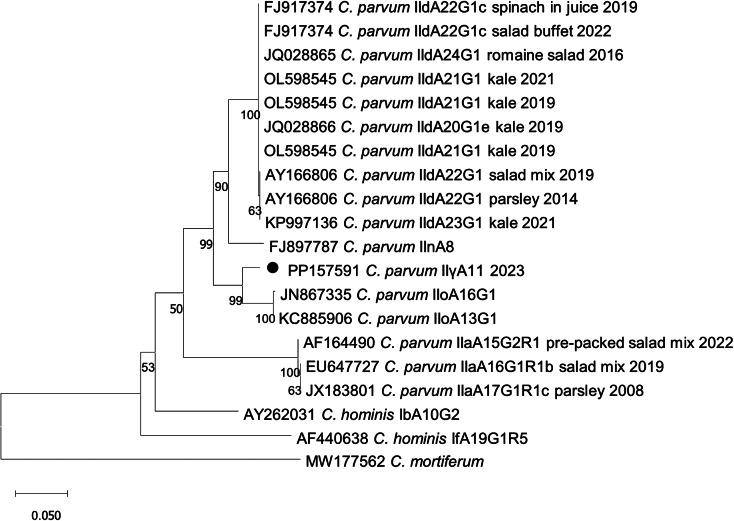
We report a foodborne outbreak of the previously undetected subtype IIγA11. In December 2023, notifications of cryptosporidiosis cases increased in Sweden, prompting the initiation of a national outbreak investigation, and a case-control study was performed to identify the source. We identified 60 cases between 15 December 2023 and 1 January 2024. The median age was 44 years (range: 16-81), and 73% were women. Controls were recruited from a national random pool; frequency was matched by age group and sex. Compared to controls, cases were more likely to have consumed items from salad bars in grocery stores (8% vs. 85%; adjusted odds ratios [aOR]: 58; 95% confidence interval [CI]: 22-186). In regards to food items from the salad bars, cases were more likely to have consumed kale mix salad compared to controls (62% vs. 32%; aOR: 3.6; 95%CI: 1.2-12). Trace-back investigations identified kale producers from Sweden, Belgium, and Spain, but no particular grower was identified, and no food samples were available for microbiological analysis. Our investigation indicates that leafy greens such as kale may contain spp. and cause outbreaks and it is important to understand how the contamination occurs to prevent future outbreaks and apply adequate preventive measures.
我们报告了一起先前未检测到的 IIγA11 亚型食源性暴发。2023 年 12 月,瑞典通报的隐孢子虫病病例增加,促使启动了全国暴发调查,并开展了病例对照研究以确定来源。我们在 2023 年 12 月 15 日至 2024 年 1 月 1 日期间确定了 60 例病例。中位年龄为 44 岁(范围:16-81 岁),73%为女性。对照来自全国随机抽样库;按照年龄组和性别进行频率匹配。与对照组相比,病例更有可能食用杂货店沙拉吧中的食品(8%比 85%;调整后的优势比[aOR]:58;95%置信区间[CI]:22-186)。在沙拉吧的食物方面,与对照组相比,病例更有可能食用羽衣甘蓝混合沙拉(62%比 32%;aOR:3.6;95%CI:1.2-12)。追溯调查确定了来自瑞典、比利时和西班牙的羽衣甘蓝生产商,但未确定特定的种植者,也没有可用的食品样本进行微生物分析。我们的调查表明,羽衣甘蓝等绿叶蔬菜可能含有 spp.,并导致暴发,了解污染是如何发生的对于预防未来的暴发和采取适当的预防措施非常重要。


 Zotero 插件