
探索患者和公众参与 NICE 快速卫生技术评估的障碍和促进因素:一项定性研究。
Exploring Barriers and Facilitators to Patients and Members of the Public Contributing to Rapid Health Technology Assessments for NICE: A Qualitative Study.
机构信息
Population Health Sciences Institute, Newcastle University, Newcastle upon Tyne, UK.
NIHR Innovation Observatory, Newcastle University, Newcastle upon Tyne, UK.
出版信息
Health Expect. 2024 Dec;27(6):e70109. doi: 10.1111/hex.70109.
BACKGROUND
Evidence and External Assessment Groups (EAGs) assist in the National Institute of Health and Care Excellence's Technology Appraisal programme by either critiquing evidence provided by companies on different health technologies, or by carrying out an independent search and evaluation of the published evidence. Historically, there has been little patient and public involvement within the work of EAGs.
OBJECTIVE
To identify key barriers and facilitators to patient and public involvement in EAG Reports feeding into the National Institute for Health and Care Excellence's Health Technology Appraisal process.
METHODS
A primary qualitative study consisting of one-to-one interviews with EAG researchers and focus groups with members of the public. From anonymised transcripts, data were deductively coded using a framework analysis against the Theoretical Domains Framework and translated to the COM-B model. Coding was triangulated through inductive thematic analysis, guided by the principles of Braun and Clarke.
RESULTS
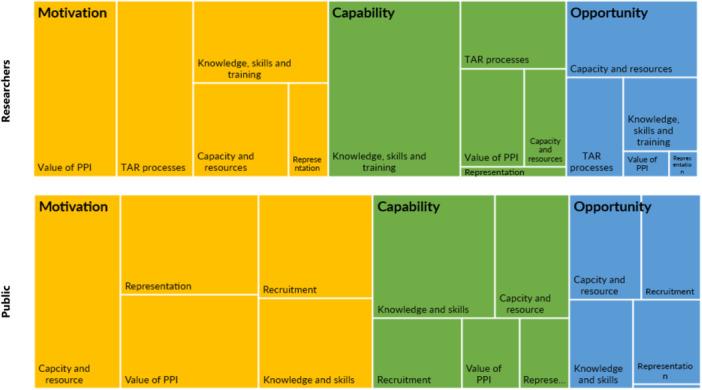
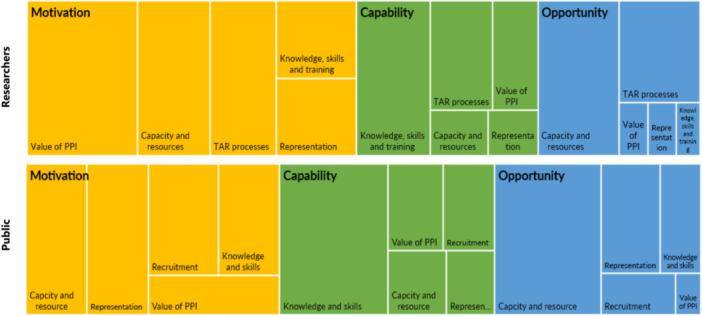
Ten researchers were interviewed and four focus groups with a total of 26 members of the public were undertaken. Both EAG researchers and the public felt they did not have enough knowledge, time and money to be able to embed patient and public involvement; researchers suggested that patient and public involvement might not be relevant to the scope of their Reports. Members of the public highlighted a lack of awareness of the Technology Appraisal process and that jargon may stop them being involved. Both researchers and members of the public said having specific guidance on how to embed patient and public involvement in EAG Reports would be helpful, including guidance on how to write plain language summaries.
CONCLUSION
The perspectives of both EAG researchers and members of the public suggest work needs to be conducted to produce frameworks for patient and public involvement and plain language summaries within EAG Reports specifically. Additionally, that further awareness-raising of Technology Appraisals and the role of EAGs would help members of the public to contribute effectively to EAG Reports.
PATIENT OR PUBLIC CONTRIBUTION
Two members of the public were part of the research team and governed all stages of the research in accordance with the UK Standards for Public Involvement.
背景
证据和外部评估小组(EAG)通过批评公司提供的不同健康技术的证据,或者通过对已发表证据进行独立搜索和评估,协助国家卫生与保健卓越研究所的技术评估计划。历史上,EAG 的工作中几乎没有患者和公众的参与。
目的
确定患者和公众参与 EAG 报告的关键障碍和促进因素,这些报告是为了向国家卫生与保健卓越研究所的健康技术评估过程提供信息。
方法
这是一项主要的定性研究,包括对 EAG 研究人员的一对一访谈和对公众成员的焦点小组。从匿名的转录本中,使用框架分析对理论领域框架进行演绎编码,并将其转换为 COM-B 模型。通过 Braun 和 Clarke 原则指导的归纳主题分析对编码进行三角验证。
结果
对 10 名研究人员进行了访谈,并对 26 名公众成员进行了 4 个焦点小组的访谈。EAG 研究人员和公众都认为他们没有足够的知识、时间和资金来嵌入患者和公众的参与;研究人员认为患者和公众的参与可能与他们报告的范围无关。公众成员强调对技术评估过程缺乏认识,而且行话可能会阻止他们参与。研究人员和公众成员都表示,有具体的指导如何将患者和公众的参与嵌入 EAG 报告中会很有帮助,包括如何编写通俗易懂的摘要的指导。
结论
EAG 研究人员和公众的观点表明,需要开展工作,为 EAG 报告中的患者和公众参与以及通俗易懂的摘要制定框架。此外,进一步提高对技术评估和 EAG 作用的认识将有助于公众成员有效地为 EAG 报告做出贡献。
患者或公众的贡献
两名公众成员是研究团队的成员,按照英国公众参与标准,负责研究的所有阶段。
 Zotero 插件