
一种用于医学和外科数据组织的新技术:WSES-WJES 去中心化知识图谱。
A new technology for medical and surgical data organisation: the WSES-WJES Decentralised Knowledge Graph.
机构信息
Department of Surgical Diseases 3, Gomel State Medical University, University Clinic, Gomel, Belarus.
Kaliningrad Branch, Federal Research Center "Informatics and Management" of the Russian Academy of Sciences (FRC IU RAS), Kaliningrad, Russia.
出版信息
World J Emerg Surg. 2024 Nov 20;19(1):37. doi: 10.1186/s13017-024-00563-6.
BACKGROUND
The quality of Big Data analysis in medicine and surgery heavily depends on the methods used for clinical data collection, organization, and storage. The Knowledge Graph (KG) represents knowledge through a semantic model, enhancing connections between diverse and complex information. While it can improve the quality of health data collection, it has limitations that can be addressed by the Decentralized (blockchain-powered) Knowledge Graph (DKG). We report our experience in developing a DKG to organize data and knowledge in the field of emergency surgery.
METHODS AND RESULTS
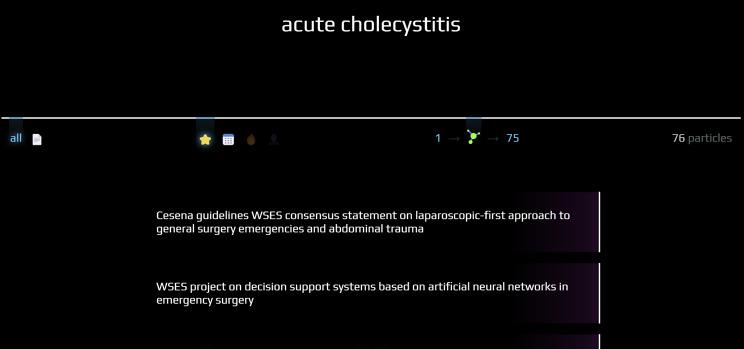
The authors leveraged the cyb.ai protocol, a decentralized protocol within the Cosmos network, to develop the Emergency Surgery DKG. They populated the DKG with relevant information using publications from the World Society of Emergency Surgery (WSES) featured in the World Journal of Emergency Surgery (WJES). The result was the Decentralized Knowledge Graph (DKG) for the WSES-WJES bibliography.
CONCLUSIONS
Utilizing a DKG enables more effective structuring and organization of medical knowledge. This facilitates a deeper understanding of the interrelationships between various aspects of medicine and surgery, ultimately enhancing the diagnosis and treatment of different diseases. The system's design aims to be inclusive and user-friendly, providing access to high-quality surgical knowledge for healthcare providers worldwide, regardless of their technological capabilities or geographical location. As the DKG evolves, ongoing attention to user feedback, regulatory frameworks, and ethical considerations will be critical to its long-term success and global impact in the surgical field.
背景
医学和外科领域的大数据分析质量在很大程度上取决于用于临床数据收集、组织和存储的方法。知识图谱 (KG) 通过语义模型表示知识,增强了不同和复杂信息之间的联系。虽然它可以提高健康数据收集的质量,但它具有局限性,可以通过去中心化(基于区块链)的知识图谱 (DKG) 来解决。我们报告了在开发用于组织急诊外科领域数据和知识的 DKG 方面的经验。
方法和结果
作者利用了 cyb.ai 协议,这是 Cosmos 网络中的一个去中心化协议,来开发紧急手术 DKG。他们使用世界急诊外科学会 (WSES) 在世界急诊外科学杂志 (WJES) 上发表的出版物来填充 DKG。结果是 WSES-WJES 书目去中心化知识图谱 (DKG)。
结论
利用 DKG 可以更有效地对医学知识进行结构化和组织。这有助于更深入地理解医学和外科领域各个方面之间的相互关系,最终提高对不同疾病的诊断和治疗。该系统的设计旨在具有包容性和用户友好性,为全球医疗保健提供者提供高质量的手术知识,无论其技术能力或地理位置如何。随着 DKG 的发展,对用户反馈、监管框架和伦理考虑的持续关注对于其在外科领域的长期成功和全球影响至关重要。

 Zotero 插件