
从脑肿瘤患者的脑脊液游离 DNA 中检测诊断性体细胞拷贝数改变。
Detection of diagnostic somatic copy number alterations from cerebrospinal fluid cell-free DNA in brain tumor patients.
机构信息
Dr. Senckenberg Institute of Neurooncology, University Hospital, Goethe University Frankfurt, Frankfurt, Germany.
Department of Neurology, University Hospital, Goethe University Frankfurt, Frankfurt, Germany.
出版信息
Acta Neuropathol Commun. 2024 Nov 20;12(1):177. doi: 10.1186/s40478-024-01887-9.
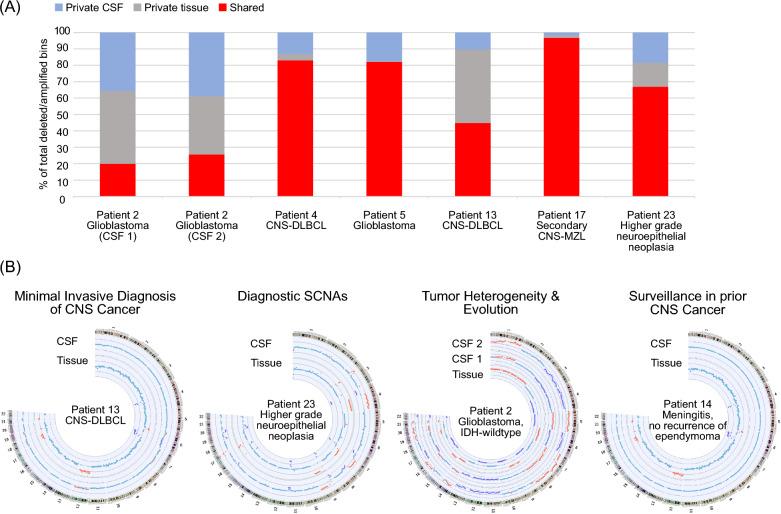
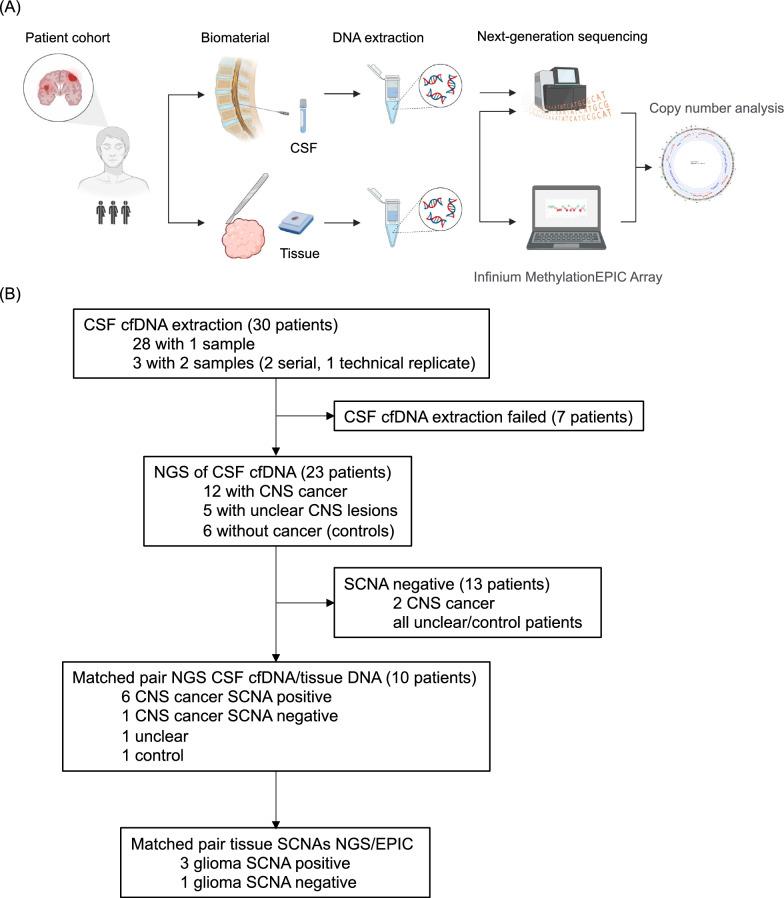
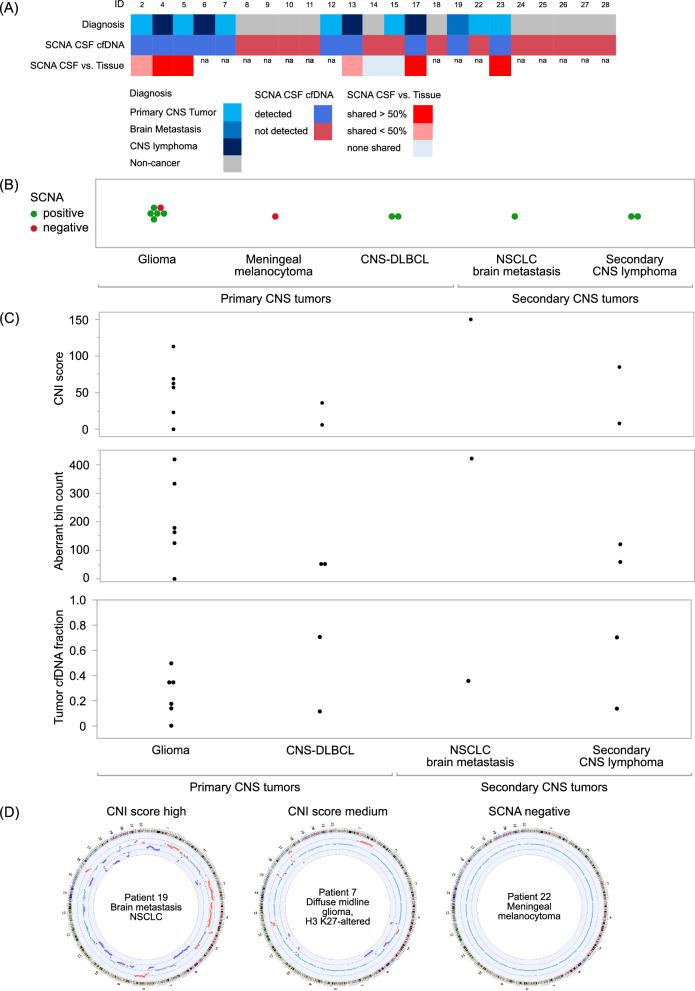
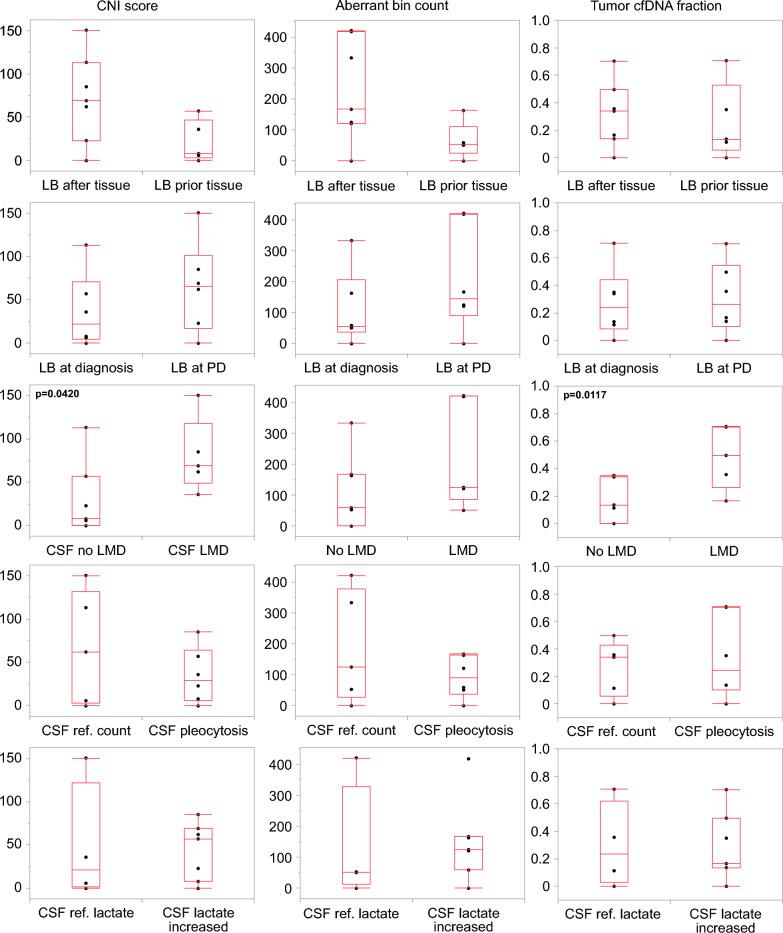
The gold standard for precise diagnostic classification of brain tumors requires tissue sampling, which carries relevant procedural risks. Brain biopsies often have limited sensitivity and fail to address tumor heterogeneity, because small tissue parts are being examined. This study aims to explore the detection and quantification of diagnostically relevant somatic copy number aberrations (SCNAs) in cell-free DNA (cfDNA) extracted from cerebrospinal fluid (CSF) in a real-world cohort of patients with defined brain tumor subtypes. A total of 33 CSF samples were collected from 30 patients for cfDNA extraction. Shallow whole-genome sequencing was conducted on CSF samples containing > 3ng of cfDNA and corresponding tissue DNA from nine patients. The sequencing cohort encompassed 26 samples of 23 patients, comprising 12 with confirmed CNS cancer as compared to 11 patients with either ambiguous CNS lesions (n = 5) or non-cancer CNS lesions (n = 6). After mapping and quality filtering SCNAs were called by depth-of-coverage analyses with a binning of 5.5 Mbp. SCNAs were exclusively identified in CSF cfDNA from brain tumor patients (10/12, 83%). In tumor patients, SCNAs were detectable in cfDNA from all patients with, but also in five of seven patients without tumor cells detected by CSF cytopathology. A substantial number of shared SCNAs were traceable between tissue and CSF in matched pair analyses. Additionally, some SCNAs unique to either CSF or tissue indicating spatial heterogeneity or tumor evolution. Also, diagnostically relevant genomic alterations as well as essential and desirable SCNAs as implemented in the current WHO classification of CNS tumors for certain primary brain tumor subtypes were traceable. In summary, this minimally invasive cfDNA-based LB approach employing shallow whole genome sequencing demonstrates potential for providing a molecularly informed diagnosis of CNS cancers, mapping tumor heterogeneity, tracking tumor evolution, and surveilling tumor patients. Further prospective trials are warranted.
脑肿瘤精确诊断分类的金标准需要组织取样,这会带来相关的程序风险。脑活检通常灵敏度有限,并且无法解决肿瘤异质性问题,因为只检查了小的组织部分。本研究旨在探索在具有明确脑肿瘤亚型的患者的真实队列中,从脑脊液(CSF)中提取的无细胞 DNA(cfDNA)中检测和定量诊断相关的体细胞拷贝数异常(SCNAs)。共从 30 名患者中采集了 33 份 CSF 样本用于 cfDNA 提取。对 9 名患者的 CSF 样本和相应组织 DNA 中含有>3ngcfDNA 的样本进行了浅层全基因组测序。测序队列包括 23 名患者的 26 个样本,其中 12 个样本为经证实的中枢神经系统癌症,11 个样本为中枢神经系统病变不明确(n=5)或非癌症性中枢神经系统病变(n=6)。在进行映射和质量过滤后,通过深度覆盖分析以 5.5 Mbp 的间隔调用 SCNAs。仅在脑肿瘤患者的 CSF cfDNA 中(10/12,83%)检测到 SCNAs。在肿瘤患者中,cfDNA 可在所有患者中检测到 SCNAs,但在 CSF 细胞学未检测到肿瘤细胞的 7 名患者中的 5 名患者中也可检测到 SCNAs。在配对分析中,在组织和 CSF 之间可追踪到大量共享的 SCNAs。此外,一些 SCNAs 仅在 CSF 或组织中存在,表明存在空间异质性或肿瘤演变。此外,还可追踪到与当前 CNS 肿瘤的 WHO 分类相关的诊断相关的基因组改变以及必要和理想的 SCNAs,用于某些原发性脑肿瘤亚型。总之,这种基于最小侵入性 cfDNA 的 LB 方法采用浅层全基因组测序,具有为 CNS 癌症提供分子信息诊断、绘制肿瘤异质性、跟踪肿瘤演变以及监测肿瘤患者的潜力。需要进一步进行前瞻性试验。
 Zotero 插件