
用于监测成人胶质瘤和脑转移瘤的液体活检
Liquid biopsies for the monitoring of gliomas and brain metastases in adults.
作者信息
Dwarshuis Govert, Kroon Lente L, Brandsma Dieta, Noske David P, Best Myron G, Sol Nik
机构信息
Department of Neurosurgery, Brain Tumor Center Amsterdam, Cancer Center Amsterdam, Amsterdam UMC, Amsterdam, The Netherlands.
Department of Neurology, Netherlands Cancer Institute-Antoni Van Leeuwenhoek, Amsterdam, The Netherlands.
出版信息
Acta Neuropathol. 2025 Apr 26;149(1):37. doi: 10.1007/s00401-025-02880-9.
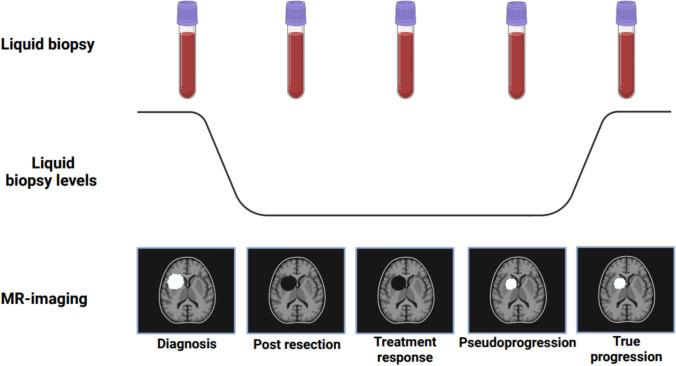
Clinical evaluation and MR imaging are currently the cornerstone of brain tumor progression monitoring. However, this is complicated by the occurrence of treatment effects such as pseudoprogression and radionecrosis. While essential for patient management, the distinction from true progression remains a significant challenge. Moreover, MR imaging provides limited real-time insights into tumor heterogeneity, genetic divergence, and treatment resistance. Although surgical histopathological biopsies can yield additional valuable information, they are not always conclusive, invasive, and therefore, not suitable for longitudinal measurements. In the era of precision medicine, there is a critical need for minimally invasive, accurate, and cost-effective monitoring methods for both primary brain tumors and brain metastases. Liquid biopsies have emerged as a potential candidate. Various analytes, including circulating nucleic acids, extracellular vesicles, platelet RNAs, and circulating tumor cells, can be obtained from whole blood and its derivatives, as well as other body fluids such as cerebrospinal fluid. In this narrative review, we outline the potential of liquid biopsies for the management of gliomas and brain metastases in adults and emphasize their utility in monitoring disease progression and treatment response. We discuss the most studied biofluids and analytes, along with their respective advantages and downsides. Furthermore, we address key considerations for future research and biobanking to pave the way for clinical implementation.
临床评估和磁共振成像(MR)目前是脑肿瘤进展监测的基石。然而,诸如假性进展和放射性坏死等治疗效应的出现使这一过程变得复杂。虽然对于患者管理至关重要,但将其与真正的进展区分开来仍然是一项重大挑战。此外,MR成像对肿瘤异质性、基因差异和治疗抵抗的实时洞察有限。尽管手术组织病理活检可以提供额外的有价值信息,但它们并不总是具有决定性意义,具有侵入性,因此不适合进行纵向测量。在精准医学时代,对于原发性脑肿瘤和脑转移瘤,迫切需要微创、准确且经济高效的监测方法。液体活检已成为一个潜在的候选方法。可以从全血及其衍生物以及其他体液(如脑脊液)中获取各种分析物,包括循环核酸、细胞外囊泡、血小板RNA和循环肿瘤细胞。在这篇叙述性综述中,我们概述了液体活检在成人间胶质瘤和脑转移瘤管理中的潜力,并强调其在监测疾病进展和治疗反应方面的效用。我们讨论了研究最多的生物流体和分析物,以及它们各自的优缺点。此外,我们阐述了未来研究和生物样本库的关键考虑因素,以为临床应用铺平道路。

 Zotero 插件