
疥疮的患病率及其决定因素:一项全球系统评价与荟萃分析。
Prevalence and determinants of scabies: A global systematic review and meta-analysis.
作者信息
Gupta Saptorshi, Thornley Simon, Morris Arthur, Sundborn Gerhard, Grant Cameron
机构信息
Faculty of Medical and Health Sciences, Section of Biostatistics and Epidemiology, The University of Auckland, Auckland, New Zealand.
LabPlus, Auckland City Hospital, Auckland, New Zealand.
出版信息
Trop Med Int Health. 2024 Dec;29(12):1006-1017. doi: 10.1111/tmi.14058. Epub 2024 Nov 22.
OBJECTIVES
Scabies is a neglected skin disease that disproportionately affects people from resource poor and overcrowded countries. Global data on prevalence and risk factors are limited. This article aims to estimate the global burden of scabies and identifies the risks associated with it.
METHODS
Databases (PubMed, Scopus and Cochrane Reviews) were accessed to identify studies of scabies prevalence published between 2000 and 2024. Results were pooled to estimate prevalence and identify factors, which explained between-study heterogeneity. Odds ratios (ORs), risk of bias, subgroup analyses and meta-regression were used to describe variation in effect size and heterogeneity based on country-level demographic and economic variables.
RESULTS
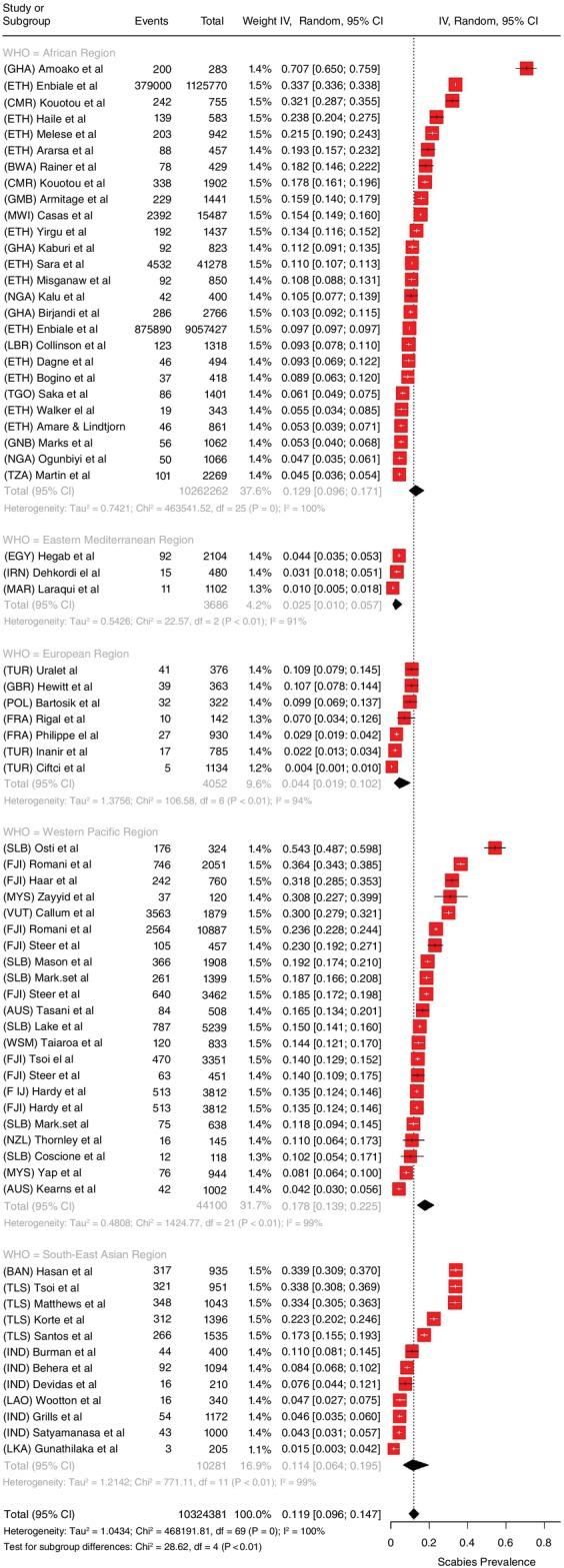
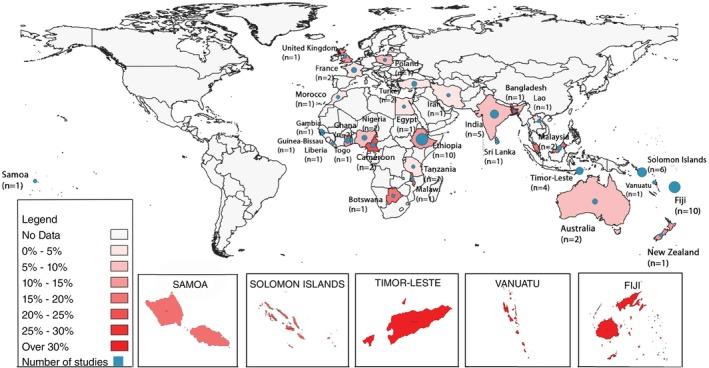
Seventy studies yielded a pooled prevalence of 11.9% (95% confidence interval [CI]: 9.60-14.7) with substantial heterogeneity . Prevalence was highest in Oceania (17.9%; 95% CI: 13.9-22.8) compared to other regions. Pooled risk factors for scabies showed significant associations for demographic and behavioural factors including contact history with household members with itch (OR 11.3; 95% CI 4.82-26.51; ; n = 7), lack of soap use (OR 3.41; 95% CI: 2.56-4.54; ; n = 7), bed-sharing (OR 2.64; 95% CI: 1.50-4.63; ; n = 7), sharing of clothes (OR 2.52; 95% CI: 1.58-4.03; ; n = 7), infrequent bathing (OR 2.13; 95% CI: 1.41-3.22; ; n = 6), presence of pets (OR 1.76; 95% CI: 1.08-2.87; ; n = 4) and being a male (OR = 1.19; 95% CI: 1.04-1.37; ; n = 22). Socioeconomic factors were not convincingly associated with scabies prevalence.
CONCLUSION
Prevalence of scabies is associated with geographic location and behavioural factors, but not between-country socioeconomic status. In addition to mass drug administration, risk factors are identified which may be included in health promotion programmes to reduce scabies prevalence and its sequelae in the long term.
目的
疥疮是一种被忽视的皮肤病,对资源匮乏和人口密集国家的人群影响尤为严重。关于其患病率和风险因素的全球数据有限。本文旨在估计全球疥疮负担,并确定与之相关的风险因素。
方法
检索数据库(PubMed、Scopus和Cochrane综述),以识别2000年至2024年间发表的疥疮患病率研究。汇总结果以估计患病率并确定解释研究间异质性的因素。使用比值比(OR)、偏倚风险、亚组分析和meta回归,根据国家层面的人口和经济变量描述效应大小和异质性的变化。
结果
70项研究得出的合并患病率为11.9%(95%置信区间[CI]:9.60 - 14.7),存在显著异质性。与其他地区相比,大洋洲的患病率最高(17.9%;95% CI:13.9 - 22.8)。疥疮的合并风险因素显示,人口和行为因素之间存在显著关联,包括与有瘙痒症状的家庭成员的接触史(OR 11.3;95% CI 4.82 - 26.51; ;n = 7)、不使用肥皂(OR 3.41;95% CI:2.56 - 4.54; ;n = 7)、共睡一张床(OR 2.64;95% CI:1.50 - 4.63; ;n = 7)、共用衣物(OR 2.52;95% CI:1.58 - 4.03; ;n = 7)、不常洗澡(OR 2.13;95% CI:1.41 - 3.22; ;n = 6)、有宠物(OR 1.76;95% CI:1.08 - 2.87; ;n = 4)以及男性(OR = 1.19;95% CI:1.04 - 1.37; ;n = 22)。社会经济因素与疥疮患病率之间的关联并不令人信服。
结论
疥疮患病率与地理位置和行为因素有关,但与国家间的社会经济地位无关。除了大规模药物治疗外,还确定了一些风险因素,可将其纳入健康促进计划,以长期降低疥疮患病率及其后遗症。


 Zotero 插件