
建立双分型系统并对肠道病毒进行全球多样性分析。
A dual typing system establishment and global diversity analysis for sapoviruses.
机构信息
College of Life Sciences and Bioengineering, Beijing Jiaotong University, Beijing, 100044, China.
Institute for Infectious Disease and Endemic Disease Control, Beijing Center for Disease Prevention and Control, Beijing, China.
出版信息
BMC Genomics. 2024 Nov 22;25(1):1131. doi: 10.1186/s12864-024-11048-w.
BACKGROUND
The genus Sapovirus in the family Caliciviridae comprises of a genetically diverse group of viruses that are responsible for causing acute gastroenteritis in both human and animals globally. As the number of sequences continues to grow and more recombinant sequences are identified, the classification criteria of genogroups and genotypes of sapovirus need to be further refined. In this study, we aimed to optimize the classification of sapoviruses.
RESULTS
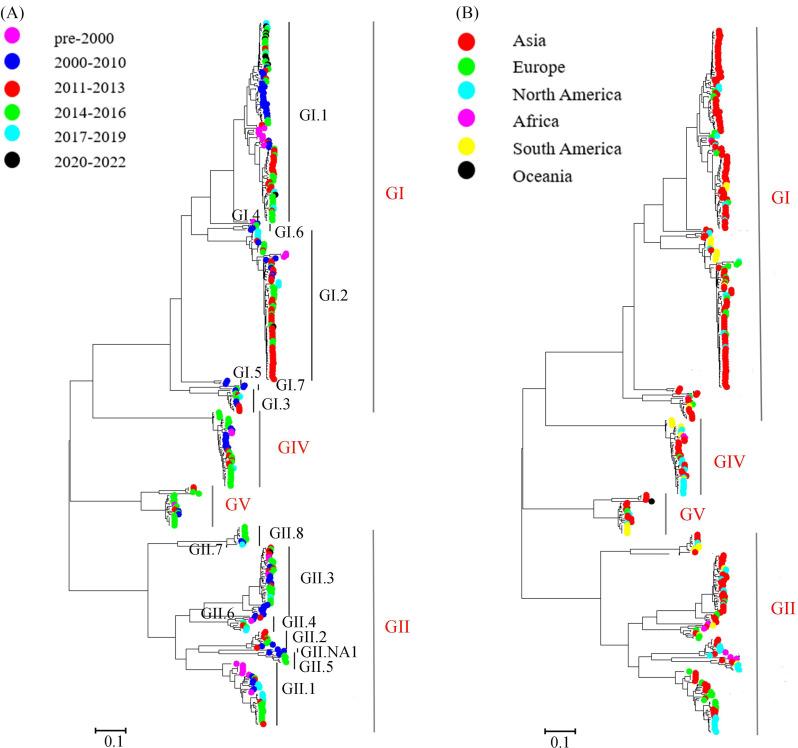
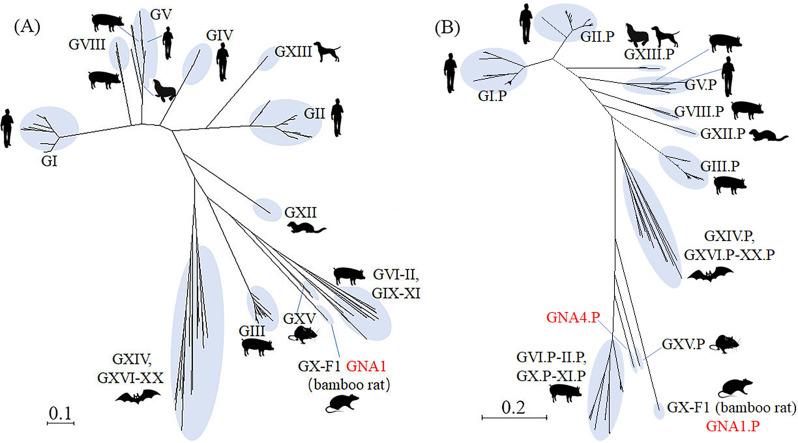
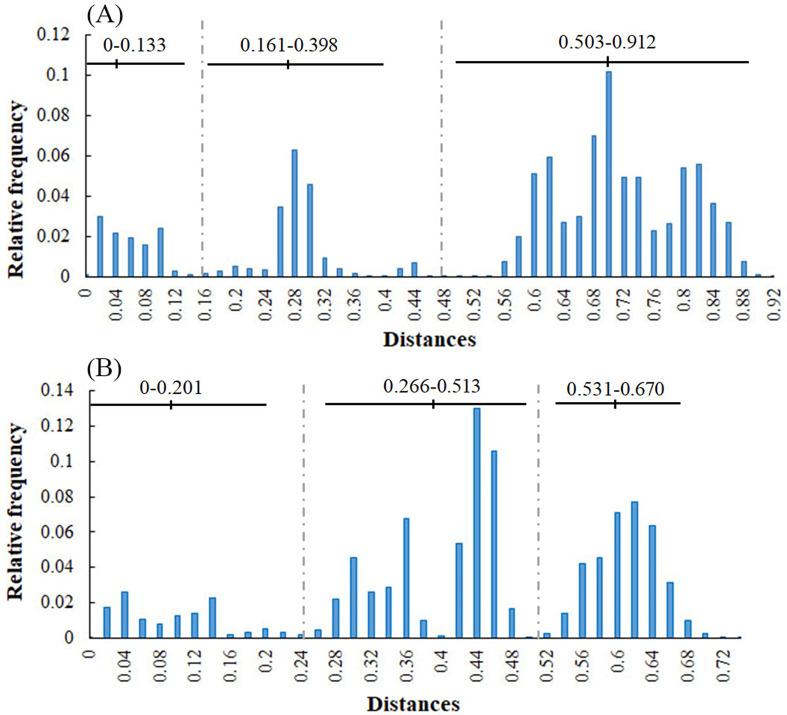
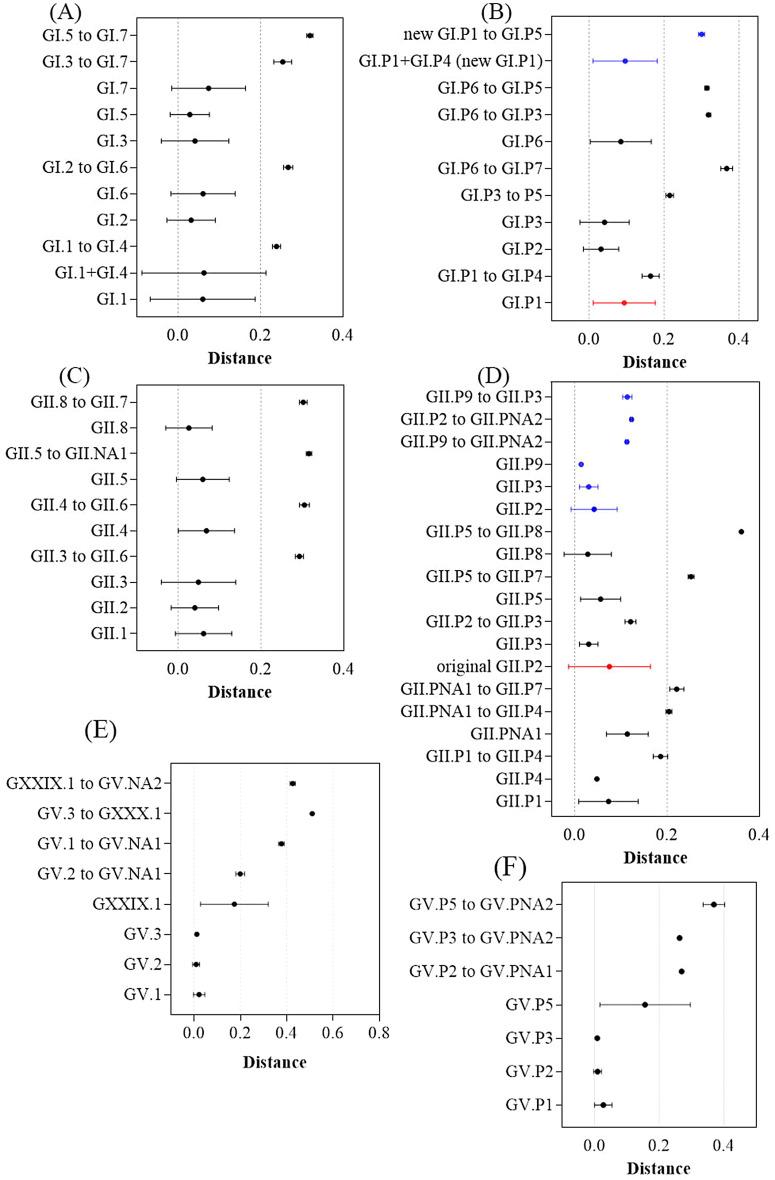
Through evolutionary clustering and genetic distance analysis, we have updated the classification criteria for VP1 genogroup and genotypes. We adjusted the original mean values ± 3 standard deviations (SD) of genetic distances to mean values ± 2.5SD, resulting the corresponding cutoff values for the same genotype and genogroup set at <0.161 and <0.503, respectively. Additionally, we established classification criteria for RdRp types and groups, referred to as P-types and P-groups,, with mean values ± 2SD and cutoff values of <0.266 and <0.531 for the same type and group, respectively. This refinement has expanded the VP1 genogroups to thirty-four and identified twenty-four P-groups. For human sapoviruses, the new criteria have resulted in the addition of one genotype, GV.PNA1. Moreover, the new criteria defined three P-groups and 21 P-types for human sapoviruses. Spatial-temporal analysis revealed no specific distribution pattern for human sapoviruses.
CONCLUSIONS
We established a dual typing system on classification based on VP1 and RdRp nucleotide sequences for sapoviruses.
背景
杯状病毒科的诺如病毒属是一组遗传多样性的病毒,它们在全球范围内导致人和动物急性胃肠炎。随着序列数量的不断增加和更多重组序列的出现,需要进一步细化诺如病毒的基因群和基因型分类标准。在这项研究中,我们旨在优化诺如病毒的分类。
结果
通过进化聚类和遗传距离分析,我们更新了 VP1 基因群和基因型的分类标准。我们将原始平均值±3 个标准差(SD)的遗传距离调整为平均值±2.5SD,相应的同一基因型和基因群的截断值分别为<0.161 和<0.503。此外,我们建立了 RdRp 类型和组的分类标准,称为 P 型和 P 组,其相同类型和组的平均值±2SD 和截断值分别为<0.266 和<0.531。这种细化将 VP1 基因群扩展到 34 个,并确定了 24 个 P 组。对于人类诺如病毒,新的标准增加了一个基因型,GV.PNA1。此外,新的标准定义了人类诺如病毒的三个 P 组和 21 个 P 型。时空分析显示人类诺如病毒没有特定的分布模式。
结论
我们建立了一种基于 VP1 和 RdRp 核苷酸序列的诺如病毒分类双重分型系统。


 Zotero 插件