
探索阿尔茨海默病生物标志物领域:基于体液的诊断方法全面分析。
Navigating the Alzheimer's Biomarker Landscape: A Comprehensive Analysis of Fluid-Based Diagnostics.
机构信息
Weill Cornell Medicine-Qatar, Qatar Foundation, Education City, Doha P.O. Box 24144, Qatar.
出版信息
Cells. 2024 Nov 18;13(22):1901. doi: 10.3390/cells13221901.
BACKGROUND
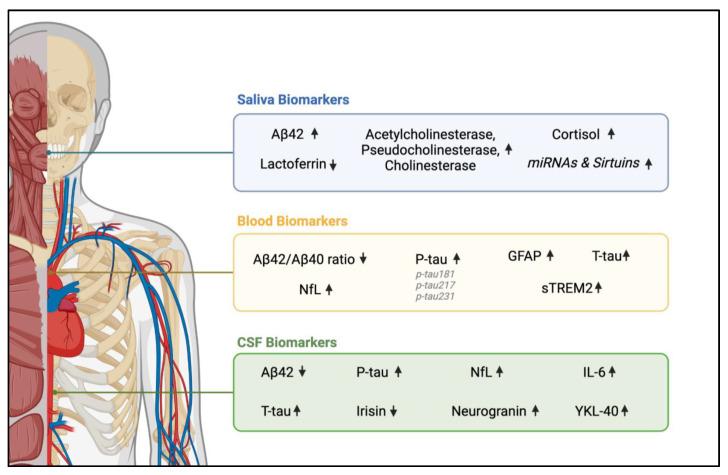
Alzheimer's disease (AD) affects a significant portion of the aging population, presenting a serious challenge due to the limited availability of effective therapies during its progression. The disease advances rapidly, underscoring the need for early diagnosis and the application of preventative measures. Current diagnostic methods for AD are often expensive and invasive, restricting access for the general public. One potential solution is the use of biomarkers, which can facilitate early detection and treatment through objective, non-invasive, and cost-effective evaluations of AD. This review critically investigates the function and role of biofluid biomarkers in detecting AD, with a specific focus on cerebrospinal fluid (CSF), blood-based, and saliva biomarkers.
RESULTS
CSF biomarkers have demonstrated potential for accurate diagnosis and valuable prognostic insights, while blood biomarkers offer a minimally invasive and cost-effective approach for diagnosing cognitive issues. However, while current biomarkers for AD show significant potential, none have yet achieved the precision needed to replace expensive PET scans and CSF assays. The lack of a single accurate biomarker underscores the need for further research to identify novel or combined biomarkers to enhance the clinical efficacy of existing diagnostic tests. In this context, artificial intelligence (AI) and deep-learning (DL) tools present promising avenues for improving biomarker analysis and interpretation, enabling more precise and timely diagnoses.
CONCLUSIONS
Further research is essential to confirm the utility of all AD biomarkers in clinical settings. Combining biomarker data with AI tools offers a promising path toward revolutionizing the personalized characterization and early diagnosis of AD symptoms.
背景
阿尔茨海默病(AD)影响了相当一部分老年人群体,由于在疾病进展过程中有效治疗方法的有限可用性,这是一个严重的挑战。该疾病进展迅速,强调了早期诊断和应用预防措施的必要性。目前 AD 的诊断方法通常昂贵且具有侵入性,限制了公众的获得。一种潜在的解决方案是使用生物标志物,通过对 AD 的客观、非侵入性和具有成本效益的评估,来促进早期检测和治疗。本综述批判性地研究了生物流体标志物在 AD 检测中的功能和作用,特别关注脑脊液(CSF)、基于血液和唾液的生物标志物。
结果
CSF 标志物已被证明具有准确诊断和有价值的预后见解的潜力,而血液标志物则提供了一种微创且具有成本效益的方法来诊断认知问题。然而,虽然目前 AD 的生物标志物显示出了很大的潜力,但没有一种生物标志物具有取代昂贵的 PET 扫描和 CSF 检测的精度。缺乏单一准确的生物标志物突显了进一步研究的必要性,以确定新的或组合的生物标志物,从而提高现有诊断测试的临床效果。在这种情况下,人工智能(AI)和深度学习(DL)工具为改善生物标志物分析和解释提供了有前途的途径,使诊断更加精确和及时。
结论
需要进一步研究来确认所有 AD 生物标志物在临床环境中的效用。将生物标志物数据与 AI 工具相结合,为 AD 症状的个性化特征描述和早期诊断带来了革命性的前景。
 Zotero 插件