
哺乳动物的生殖健康能否承受大量的聚苯乙烯微塑料和纳米塑料衍生物的暴露?系统评价。
Can Mammalian Reproductive Health Withstand Massive Exposure to Polystyrene Micro- and Nanoplastic Derivatives? A Systematic Review.
机构信息
Department of Bioscience and Technology for Food, Agriculture and Environment, University of Teramo, 64100 Teramo, Italy.
出版信息
Int J Mol Sci. 2024 Nov 13;25(22):12166. doi: 10.3390/ijms252212166.
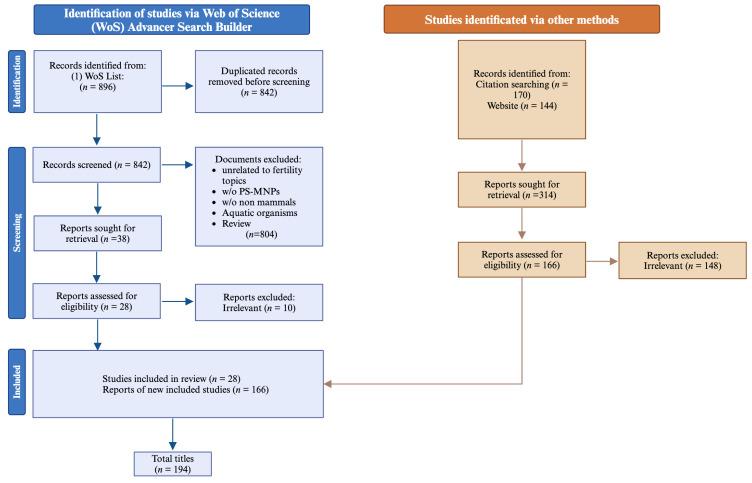
The widespread use of plastics has increased environmental pollution by micro- and nanoplastics (MNPs), especially polystyrene micro- and nanoplastics (PS-MNPs). These particles are persistent, bioaccumulative, and linked to endocrine-disrupting toxicity, posing risks to reproductive health. This review examines the effects of PS-MNPs on mammalian reproductive systems, focusing on oxidative stress, inflammation, and hormonal imbalances. A comprehensive search in the Web of Science Core Collection, following PRISMA 2020 guidelines, identified studies on the impact of PS-MNPs on mammalian fertility, including oogenesis, spermatogenesis, and folliculogenesis. An analysis of 194 publications revealed significant reproductive harm, such as reduced ovarian size, depleted follicular reserves, increased apoptosis in somatic cells, and disrupted estrous cycles in females, along with impaired sperm quality and hormonal imbalances in males. These effects were linked to endocrine disruption, oxidative stress, and inflammation, leading to cellular and molecular damage. Further research is urgently needed to understand PS-MNPs toxicity mechanisms, develop interventions, and assess long-term reproductive health impacts across generations, highlighting the need to address these challenges given the growing environmental exposure.
塑料的广泛使用增加了微塑料和纳米塑料(MNPs),特别是聚苯乙烯微塑料和纳米塑料(PS-MNPs)对环境的污染。这些颗粒具有持久性、生物蓄积性,并与内分泌干扰毒性有关,对生殖健康构成风险。本综述考察了 PS-MNPs 对哺乳动物生殖系统的影响,重点关注氧化应激、炎症和激素失衡。根据 PRISMA 2020 指南,在 Web of Science Core Collection 中进行全面检索,确定了关于 PS-MNPs 对哺乳动物生育力影响的研究,包括卵母细胞发生、精子发生和卵泡发生。对 194 篇出版物的分析显示,PS-MNPs 对雌性动物具有显著的生殖危害,如卵巢体积减小、卵泡储备枯竭、体细胞凋亡增加以及动情周期紊乱,同时雄性动物的精子质量受损和激素失衡。这些影响与内分泌干扰、氧化应激和炎症有关,导致细胞和分子损伤。迫切需要进一步研究以了解 PS-MNPs 的毒性机制,开发干预措施,并评估跨代的长期生殖健康影响,这凸显了在环境暴露不断增加的情况下解决这些挑战的必要性。




 Zotero 插件