
黑色素瘤中的程序性死亡受体-1阻断治疗:反应机制与肿瘤内在抗性
PD-1 blockade treatment in melanoma: Mechanism of response and tumor-intrinsic resistance.
作者信息
Wang Tong, Ma Wenjie, Zou Zijian, Zhong Jingqin, Lin Xinyi, Liu Wanlin, Sun Wei, Hu Tu, Xu Yu, Chen Yong
机构信息
Department of Musculoskeletal Surgery, Fudan University Shanghai Cancer Center, Shanghai, China.
Department of Oncology, Shanghai Medical College, Shanghai, China.
出版信息
Cancer Sci. 2025 Feb;116(2):329-337. doi: 10.1111/cas.16398. Epub 2024 Nov 27.
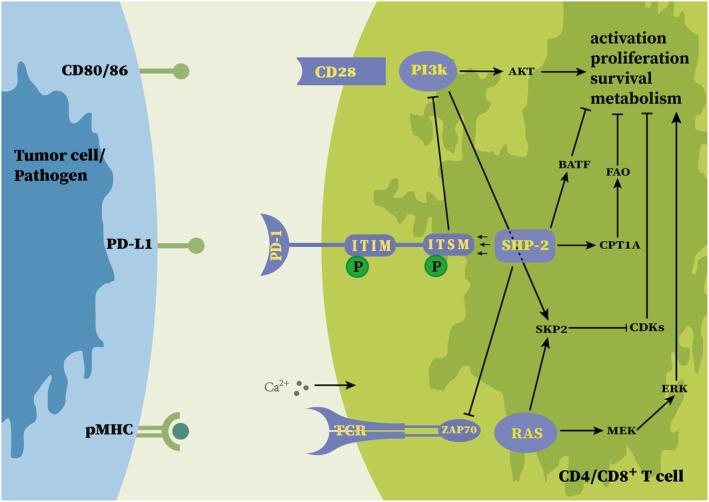
Malignant melanoma is characterized by high immunogenicity, genetic heterogeneity, and diverse pathological manifestations, affecting both skin and mucosa over the body. Pembrolizumab and nivolumab, both anti-PD-1 monoclonal antibodies, were approved by the US FDA for unresectable or metastatic melanoma in 2011 and 2014, respectively, with enduring and transformative outcomes. Despite marked clinical achievements, only a subset of patients manifested a complete response. Approximately 55% of melanoma patients exhibited primary resistance to PD-1 antibodies, with nearly 25% developing secondary resistance within 2 years of treatment. Thus, there is a critical need to comprehensively elucidate the mechanisms underlying the efficacy and resistance to PD-1 blockade. This review discusses the fundamental mechanisms of PD-1 blockade, encompassing insights from T cells and B cells, and presents resistance to anti-PD-1 with a particular focus on tumoral-intrinsic mechanisms in melanoma.
恶性黑色素瘤具有高免疫原性、基因异质性和多样的病理表现,可累及全身皮肤和黏膜。帕博利珠单抗和纳武利尤单抗均为抗程序性死亡蛋白1(PD-1)单克隆抗体,分别于2011年和2014年被美国食品药品监督管理局(FDA)批准用于不可切除或转移性黑色素瘤,取得了持久且变革性的治疗效果。尽管取得了显著的临床成就,但只有一部分患者表现出完全缓解。约55%的黑色素瘤患者对PD-1抗体表现出原发性耐药,近25%的患者在治疗2年内出现继发性耐药。因此,迫切需要全面阐明PD-1阻断治疗疗效和耐药的潜在机制。本综述讨论了PD-1阻断的基本机制,包括来自T细胞和B细胞的见解,并特别关注黑色素瘤中肿瘤内在机制导致的抗PD-1耐药。
 Zotero 插件