
电子烟暴露与年轻成年人通气均匀性之间的关联:一项横断面研究。
Association between e-cigarette exposure and ventilation homogeneity in young adults: a cross-sectional study.
作者信息
Stanojevic Sanja, Yung Mei Ha, Sahin Berke, Johnson Noah, Stewart Hanna, Laflamme Olivier D, Maksym Geoffrey, Mateos-Corral Dimas, Asbridge Mark
机构信息
Department of Community Health and Epidemiology, Faculty of Medicine, Dalhousie University, Halifax, NS, Canada
Department of Community Health and Epidemiology, Faculty of Medicine, Dalhousie University, Halifax, NS, Canada.
出版信息
Eur Respir J. 2025 Mar 27;65(3). doi: 10.1183/13993003.01675-2024. Print 2025 Mar.
BACKGROUND
The number of young people who use e-cigarettes is rising. It remains unclear whether e-cigarette use impairs lung function. We aimed to compare ventilation distribution between young adults exposed to e-cigarettes and an unexposed group.
METHODS
Study participants included otherwise healthy young adults (18-24 years) who self-reported e-cigarette use and unexposed participants who had no history of e-cigarette, tobacco or cannabis exposure. Exposure to e-cigarettes was defined using three measures: 1) ever-exposed, 2) daily use and 3) puff frequency, which includes none (unexposed), minimal (<2 puffs·h), moderate (3-4 puffs·h) and heavy (≥5 puffs·h). Ventilation distribution was measured using the multiple-breath washout test and reported as lung clearance index (LCI).
RESULTS
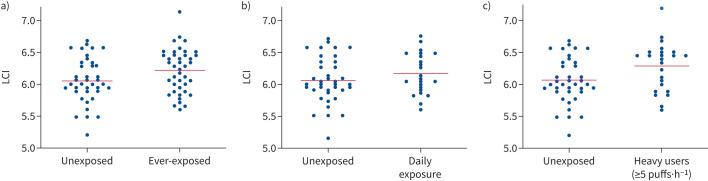
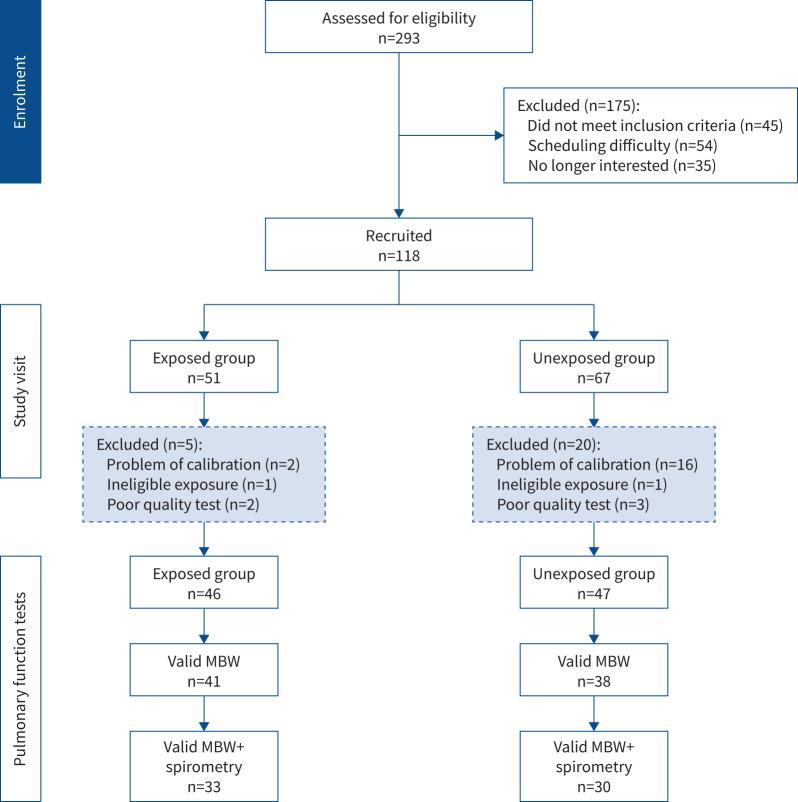
A total of 93 participants were recruited; 38 unexposed and 41 exposed participants had LCI measures. The exposed group consisted predominately of participants who used flavoured e-liquids (94.5%) that contained nicotine (93.5%). The magnitude and direction of the difference in LCI across the exposure definitions was similar. Compared with the unexposed group, in the unadjusted models LCI was higher in those with any e-cigarette use (mean difference 0.15, 95% CI -0.004-0.31), daily users (mean difference 0.10, 95% CI -0.08-0.28) and heavy users (mean difference 0.22, 95% CI 0.03-0.41).
CONCLUSION
This preliminary work suggests that LCI may be a useful biomarker to measure the effects of e-cigarette use on ventilation distribution and to track early functional impairment of the small airways.
背景
使用电子烟的年轻人数量正在上升。目前尚不清楚使用电子烟是否会损害肺功能。我们旨在比较接触电子烟的年轻成年人与未接触组之间的通气分布情况。
方法
研究参与者包括其他方面健康的年轻成年人(18 - 24岁),他们自我报告使用电子烟,以及没有电子烟、烟草或大麻接触史的未接触参与者。使用三种指标定义电子烟接触情况:1)曾经接触过,2)每日使用,3)抽吸频率,包括无(未接触)、极少(<2次/小时)、中度(3 - 4次/小时)和重度(≥5次/小时)。使用多次呼吸洗脱试验测量通气分布,并报告为肺清除指数(LCI)。
结果
共招募了93名参与者;38名未接触者和41名接触者进行了LCI测量。接触组主要由使用含尼古丁(93.5%)的调味电子烟液(94.5%)的参与者组成。在不同接触定义下,LCI差异的大小和方向相似。与未接触组相比,在未调整模型中,任何使用电子烟的人(平均差异0.15,95%CI -0.004 - 0.31)、每日使用者(平均差异0.10,95%CI -0.08 - 0.28)和重度使用者(平均差异0.22,95%CI 0.03 - 0.41)的LCI更高。
结论
这项初步研究表明,LCI可能是一种有用的生物标志物,可用于测量电子烟使用对通气分布的影响,并追踪小气道的早期功能损害。
 Zotero 插件