
欧洲50岁及以上成年人2型糖尿病的发病情况:个体异质性和判别准确性的交叉多层次分析
Onset of Type 2 diabetes in adults aged 50 and older in Europe: an intersectional multilevel analysis of individual heterogeneity and discriminatory accuracy.
作者信息
O'Sullivan Julie Lorraine, Alonso-Perez Enrique, Färber Francesca, Fuellen Georg, Rudolf Henrik, Heisig Jan Paul, Kreyenfeld Michaela, Gellert Paul
机构信息
Institute for Medical Sociology and Rehabilitation Science, Charité - Universitätsmedizin Berlin, Corporate Member of Freie Universität Berlin, Humboldt-Universität zu Berlin, and Berlin Institute of Health, Charitéplatz 1, Berlin, 10117, Germany.
German Center for Mental Health (DZPG), Berlin-Potsdam, Germany.
出版信息
Diabetol Metab Syndr. 2024 Nov 29;16(1):291. doi: 10.1186/s13098-024-01533-3.
BACKGROUND
Disparities in the development of Type 2 Diabetes (T2D) are associated with various social determinants, including sex/gender, migration background, living arrangement, education, and household income. This study applied an intersectional perspective to map social disparities and investigate intersectional effects regarding the onset of T2D among older adults across Europe.
METHODS
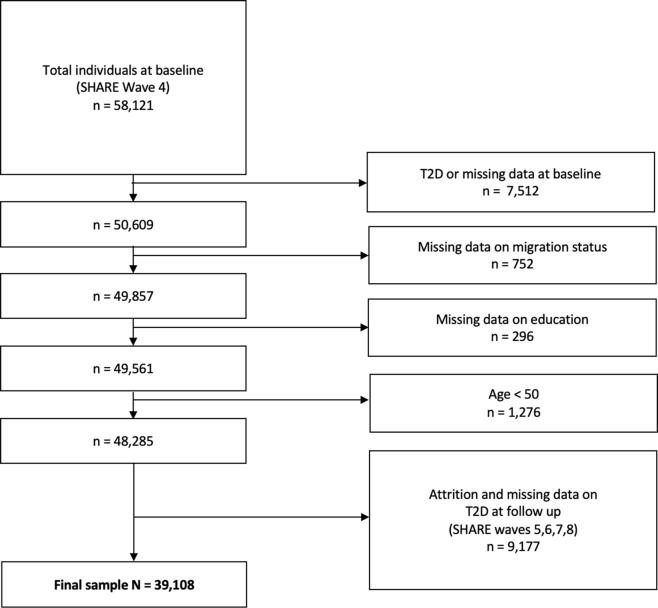
We used data from the Survey of Health and Retirement in Europe (SHARE) to conduct an Intersectional Multilevel Analysis of Individual Heterogeneity and Discriminatory Accuracy (I-MAIHDA) of T2D onset. Individuals aged 50 years or older without known T2D at Wave 4 (2011, baseline) were included and followed through Waves 5 (2013), 6 (2015), 7 (2016), and 8 (2019-2020). Intersectional models were used to estimate additive main effects of sex/gender, migration background, living arrangement, education level, and household income and intersectional interactions.
RESULTS
A total of 39,108 individuals were included (age at baseline M = 65.18 years (SD = 9.62), 57.4% women). T2D onset was reported for 9.2% of the sample over the 9-year observation period. In the fully adjusted model, all social determinants showed significant additive associations with T2D onset, while the discriminatory accuracy of the social strata was found to be low (Variance Partition Coefficient = 0.3%).
CONCLUSIONS
This study provides a comprehensive mapping of intersectional disparities in onset of T2D among older adults in Europe. The results highlight the risk heterogeneity within the population and show social disadvantages faced by certain groups. However, while the T2D risks were higher in some strata than in others, the intersectional effects were small overall and mostly attributable to the additive main effects. The results suggest that public health strategies to prevent T2D should be universal but tailored to meet the specific situation of the different intersectional strata.
背景
2型糖尿病(T2D)发展的差异与多种社会决定因素相关,包括性别、移民背景、生活安排、教育程度和家庭收入。本研究采用交叉视角来描绘社会差异,并调查欧洲老年人中T2D发病的交叉效应。
方法
我们使用来自欧洲健康与退休调查(SHARE)的数据,对T2D发病进行个体异质性和歧视准确性的交叉多层次分析(I-MAIHDA)。纳入了在第4波(2011年,基线)时年龄在50岁及以上且无已知T2D的个体,并跟踪至第5波(2013年)、第6波(2015年)、第7波(2016年)和第8波(2019 - 2020年)。使用交叉模型来估计性别、移民背景、生活安排、教育水平和家庭收入的相加主效应以及交叉交互作用。
结果
总共纳入了39108名个体(基线时年龄M = 65.18岁(标准差 = 9.62),57.4%为女性)。在9年的观察期内,9.2%的样本报告发生了T2D。在完全调整模型中,所有社会决定因素均显示与T2D发病存在显著的相加关联,而发现社会阶层的歧视准确性较低(方差分解系数 = 0.3%)。
结论
本研究全面描绘了欧洲老年人中T2D发病的交叉差异。结果突出了人群中的风险异质性,并显示了某些群体面临的社会劣势。然而,虽然某些阶层的T2D风险高于其他阶层,但总体交叉效应较小,且大多归因于相加主效应。结果表明,预防T2D的公共卫生策略应具有普遍性,但需根据不同交叉阶层的具体情况进行调整。


 Zotero 插件